Coronavirus and Teacher Pay

Education Week has a story about how states that were planning investments in teacher compensation are now abandoning them in light of the COVID-19 pandemic. The article mentions Tennessee, and Gov. Bill Lee’s preference for funding a voucher scheme instead of investing in teachers.


Just as the movement to pay teachers more money was gaining political steam, the economic fallout from the coronavirus is jeopardizing most of this year’s statewide initiatives to increase salaries, according to an Education Week analysis.


In recent weeks, lawmakers in Florida, Georgia, and Tennessee, many citing a potential recession, have significantly reduced the pay bumps that teachers were expecting to get. In Kentucky, a much-anticipated $2,000 raise might get scrapped altogether. And in at least five states, proposals for teacher salary increases are in limbo as legislatures have either suspended their sessions or are retooling state budgets to account for the economic crisis.


“In the midst of a pandemic, you try not to put too much focus on that, but educators are very concerned about this decision,” said Tikeila Rucker, the president of the United Education Association, which represents teachers in Memphis, Tenn., of the governor cutting the proposed bump in the state’s contribution to teacher salaries from 4 percent to 2 percent. “It feels like a disservice to the people. … We’re already underappreciated, overworked, underpaid, and undervalued, and when there’s a need to make a cut, it feels like we’re dispensable.”

READ MORE>

For more on education politics and policy in Tennessee, follow @TNEdReport

Your support$5 or more today — makes publishing education news possible.
Vouchers vs. Teachers

There’s a budget showdown looming this afternoon pitting Tennessee teachers versus Gov. Bill Lee’s voucher scheme. Erik Schelzig has more:


Tennessee lawmakers are gearing up for a long day Thursday in which they hope to come to an agreement over deep budget cuts before going into recess until the coronavirus crisis subsides.


One of the biggest sticking points is Gov. Bill Lee’s plan to keep funding in the budget to launch his school voucher program this fall while cutting a planned 4% teacher pay raise in half.

More on vouchers, teacher pay, and Lee’s amended budget>

For more on education politics and policy in Tennessee, follow @TNEdReport

Your support$5 or more today — makes publishing education news possible.
Make that 2%

In Governor Bill Lee’s initial budget address, he proposed a 4% adjustment to the BEP salary component (effectively a 2% raise for teachers). Now, in the face of the coronavirus threat, his revised budget adjusts that to a 2% increase. That effectively means most teachers will see a raise of less than 1% or, in many cases, no raise at all.

Here’s the budget amendment.

It reduces the BEP inflationary adjustment and cuts in half the initial proposed increase in the teacher salary component. It also completely deletes the charter school slush fund.

Also, according to Chalkbeat, the budget proposal retains $37 million to fund the first year of Lee’s voucher scheme:


Lee retained $37 million for education savings accounts, a controversial program set to start this fall to let eligible families in Memphis and Nashville use taxpayer money to pay for private school tuition.

Meanwhile, the proposal adds significantly to the Rainy Day fund.

Yes, instead of using the state’s billions in reserves to keep schools and other services moving forward, this budget proposal actually ADDS to the rainy day fund while cutting improvements to teacher pay.

It’s up to the General Assembly to approve this measure, of course, but there’s little indication Lee’s moves will be challenged.

For more on education politics and policy in Tennessee, follow @TNEdReport

Your support — $5 or more today — makes publishing education news possible.

Wilson County Voters Approve Funds for Teacher Pay Raise

Yesterday’s election provided good news for teachers in Wilson County, as voters there approved a sales tax increase with a portion of the proceeds from increased revenue dedicated to increasing teacher pay. The Lebanon Democrat has more:


The sales tax in Wilson County will be going to 9.75 percent from 9.25 percent after voters overwhelmingly gave their OK Tuesday.


The referendum passed 58% to 42%, according to complete yet unofficial results posted by Wilson County Elections Administrator Phillip Warren.

The vote came as the result of a decision by the Wilson County Commission to put the issue of where to find new revenue to fund teacher pay to voters.


The move comes as Wilson County is feeling the impact of the national teacher shortage, driven in part by low pay for educators. Additionally, new reports indicate teacher pay in Tennessee has actually fallen over the last decade when adjusted for inflation. Wilson County also suffers from a pay scale tied to teacher value-added scores.

For more on education politics and policy in Tennessee, follow @TNEdReport

Your support$5 or more today — makes publishing education news possible.
Why Should Teachers Work for Free?

Former teacher Kat Tipton writes in Education Week that free work is expected of teachers, and suggests it’s likely because a vast majority of educators are women.

When I was hired to be a 1st grade teacher, I was given absolutely no curriculum for reading or science. While my school did have a math curriculum, it was out of date from the brand new, controversial Common Core State Standards and did not match our assessments. Instead, I was told to plan with my colleagues.

This often led to me scouring the internet for good resources. While some coworkers were willing to share, they rarely sat down and explained what they were giving me, and I certainly never had the opportunity to observe them using it. I was in over my head and had no idea what I was doing.

However, there is a growing number of disdainful educators who are downright angry that teachers are daring to sell their materials on Teachers Pay Teachers. At a technology conference last summer, I heard a presenter loudly talking in the vendor expo center. I listened as he laughed and called TPT sellers the “whores of education.” In a session later that day, I learned about a website where teachers can upload their work for free for others to use.

Why are teachers expected to give away their hard work for free? The presenters in charge of the website explained that they were there to “help kids” and not themselves. I have seen this same sentiment on Twitter often. If you really cared about kids, you would just let people have the things you make rather than sell them!

But, is that fair? Do doctors who work with children give their medical advice away for free? Does Google look around, as it makes new technology for teachers, and say, “You know what? Let’s share all this with Microsoft. After all, it’s for kids!”? Can you think of a single other profession in which those in it are not given what they need to complete their job, are expected to make their own materials, and are then expected to just give those materials away to others?

No, the real problem here is that so many teachers aren’t given what they need in order to do their job—for kids—that they have to pay other teachers to get what they need. The lack of funding in our schools is shocking, and it’s no surprise that schools can’t afford up-to-date curriculum when many can’t even afford basic furniture or actual teachers.

More than three-quarters of public school teachers are women. Would we value the work done by teachers and sold online—and would we be less likely to call those who participate “whores”—if more teachers were men? The average public school teacher makes about $55,000 a year, and the majority have at least two degrees. If a teacher had a side job at American Eagle, would she still be a “whore”? Why is selling something related to teaching as a side job considered to be the worst thing a teacher can do?

MORE>

For more on education politics and policy in Tennessee, follow @TNEdReport

Your support$5 or more today — makes publishing education news possible.
The Impact of a Broken School Funding System

Tennessee’s school funding formula, the BEP, is broken. It fails to adequately fund teaching positions. It fails to account for actual salaries paid to teachers. It fails to provide the money necessary to adequately equip schools. There’s simply not enough funding for nurses or counselors or other key support staff. Here’s one teacher talking about what a broken school funding system looks like.

For more on education politics and policy in Tennessee, follow @TNEdReport

Your support$5 or $10 today — makes publishing education news possible.
What Matters? Money!

While some Tennessee lawmakers are pushing for a significant new investment in our state’s schools, new evidence suggests that a cash infusion is just what schools need to retain teachers and improve student outcomes.

Here’s the breakdown from Matt Barnum:

This tracks with a post I shared recently from We Are Teachers noting that a boost to teacher pay has a long-term impact on student achievement:


When teachers get paid more, students do better. In one study, a 10% increase in teacher pay was estimated to produce a 5 to 10% increase in student performance. Teacher pay also has long-term benefits for students. A 10% increase in per-pupil spending for each of the 12 years of education results in students completing more education, having 7% higher wages, and having a reduced rate of adult poverty. These benefits are even greater for families who are in poverty.

Tennessee needs $500 million just to properly staff schools — and that’s just teachers. We need more to add the proper number of counselors, nurses, and other key support staff.

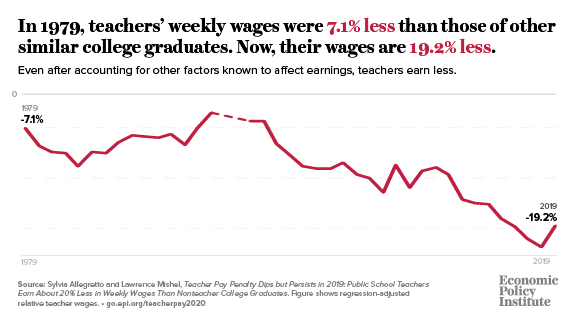
Our teachers need a raise — Tennessee teachers earn about $2400 less than they did back in 2009 when salaries are adjusted for inflation.

This new round of research backs up what those on the front lines of public education will tell you: Money matters. It matters a lot.

While Gov. Lee and his legislative allies push failed charter solutions and sketchy voucher plans, our public schools are starving for support.

For more on education politics and policy in Tennessee, follow @TNEdReport

Your support$5 or more today — makes publishing education news possible.


Hamilton County Teachers Win 2.5% Raise

Teachers in Hamilton County won approval of a 2.5% pay hike, according to the Chattanooga Times-Free Press.


The Board of Education voted unanimously in favor of the 2.5% raise proposed earlier this month by Superintendent Bryan Johnson at its meeting Thursday night — the same night the board approved a new contract and a raise for Johnson.


The mid-year raise, which is effective retroactively as of Feb. 8, is possible thanks to $3 million in savings during the first half of the fiscal year, according to district officials.

The move comes even as some lawmakers are focusing on ways to improve Gov. Bill Lee’s proposed 4% increase to the state’s share of BEP money dedicated to teachers.

Meanwhile, Nashville school board members are calling on the state to dramatically increase investment in schools.

For the second year in a row, Lee has proposed doubling a state slush fund for charter schools while offering only a small increase in teacher compensation. In fact, one study indicates teachers in Tennessee are paid at a lower rate (when accounting for inflation) than they were back in 2009.

After adjusting for inflation, however, teachers’ average pay during the 2018-2019 school year was still about 4.4% lower than a decade earlier.

For more on education politics and policy in Tennessee, follow @TNEdReport

Your support $5 or more today — makes publishing education news possible.

A Broken Promise to Teachers

Jill Richardson offers thoughts on the Trump Administration’s plan to cancel student loan forgiveness for teachers in OtherWords.

Before sharing my opinions about Trump’s recent proposal to cut student loan forgiveness, let me explain my own situation.

In my 20s, I was fresh out of college with a business degree and worked in software for a few years. In my 30s, I went to graduate school for sociology. I’m single and I had no family support. So I took out student loans.

I made the decision to take student loans carefully. It’s a risk, because you might not graduate and then you’ll be left with thousands of dollars to pay back.

There were two mitigating factors that led me to go for it. First, you can opt for income-based repayment. Under that option, your loan payments are tied to your income. If you’re broke, your payments are small. If you’re rich, you pay more. That seems fair.

Second, if you work in the public sector or at a non-profit organization, your loans are forgiven after 10 years of repayment. (If not, they are forgiven after 20 years.)

I’m a little more than a year away from graduation. After seven years of graduate school, if I’m lucky, I’ll get a job that pays less than I made in software in my 20s. And then I’ll pay back loans for a decade.

I’ll be 50 years old when my loans are forgiven. It will affect my ability to buy a home, start a family, or save for retirement. I chose that.

Yet Trump has proposed cutting loan forgiveness for people who work in non-profit or government jobs for ten years. For students like me who already took out loans, it’s reneging on a promise.

If you want to run the government like a profit-maximizing business, maybe cutting loan forgiveness makes sense. But there are good reasons why the government should not be run like a business.

Businesses are run to maximize the profits of their shareholders. Any benefits to their customers or the wider public are incidental. The government should benefit all of us.

A healthy society is one with social mobility, where a talented, hardworking person born into poverty can rise above their class. Unless you’re a star athlete, education is the key to getting ahead. Education is not equally accessible to all.

Students from low-income families with college aspirations are already at a disadvantage for a long list of reasons. Sociologist Sara Goldrick-Rab studies how the current financial aid system is skewed against the poor. For example, she finds that aid packages underestimate the actual cost of attending school, and assume that children don’t contribute financially to their parents (which many low income students do).

Loans aren’t ideal. Any measures that could allow students to graduate without crippling debt would be better. But they are something. They allow some students who could not otherwise afford it to get a college education. They promote social mobility.

I want to live in a country where talented people from poor families can still go to college. I think that makes our country better — not just in an idealistic way because of lofty morals, but in a real, tangible way that I believe we will all gain from.

I don’t think we are better when the rich stay rich because Aunt Becky can buy her kids’ way into college without them earning it, while a genius born to poor parents can’t. I think we all do better when talented people born into poor families can realize their full potential, enriching our society for all of us.

Loan forgiveness isn’t the magic bullet to achieving a perfect meritocracy, but it’s something. And it’s not a giveaway of free money — it’s an investment in a better society.

OtherWords columnist Jill Richardson is pursuing a PhD in sociology at the University of Wisconsin-Madison. Distributed by OtherWords.org.

For more on education politics and policy in Tennessee, follow @TNEdReport

Your support$5 or more today — makes publishing education news possible.