There are lots of ways this problem can be addressed – but one that matters a lot is paying teachers more.
A lot more.
Teacher pay matters. Investing in the people who have direct contact with students is a direct investment in student success.
When teachers get paid more, students do better. In one study, a 10% increase in teacher pay was estimated to produce a 5 to 10% increase in student performance. Teacher pay also has long-term benefits for students. A 10% increase in per-pupil spending for each of the 12 years of education results in students completing more education, having 7% higher wages, and having a reduced rate of adult poverty. These benefits are even greater for families who are in poverty.
A recently-released analysis of teacher compensation relative to other professions shows that teachers in Tennessee face a nearly 30% pay gap compared to similarly-trained professionals.
In Tennessee, the story is particularly bleak.
The teacher pay penalty is nearly 30% – worse than the national average.
Tennessee is also now the state that invests the least in public education.
Tennessee’s numbers are worse than the national average – and America’s numbers are pretty sad, too:
Inflation-adjusted weekly wages for public school teachers fell 6.2% over the last three decades, while wages for other college graduates rose 28.8% over the same period.
Teacher pay matters – TN policymakers don’t get it
Yes, it’s about money.
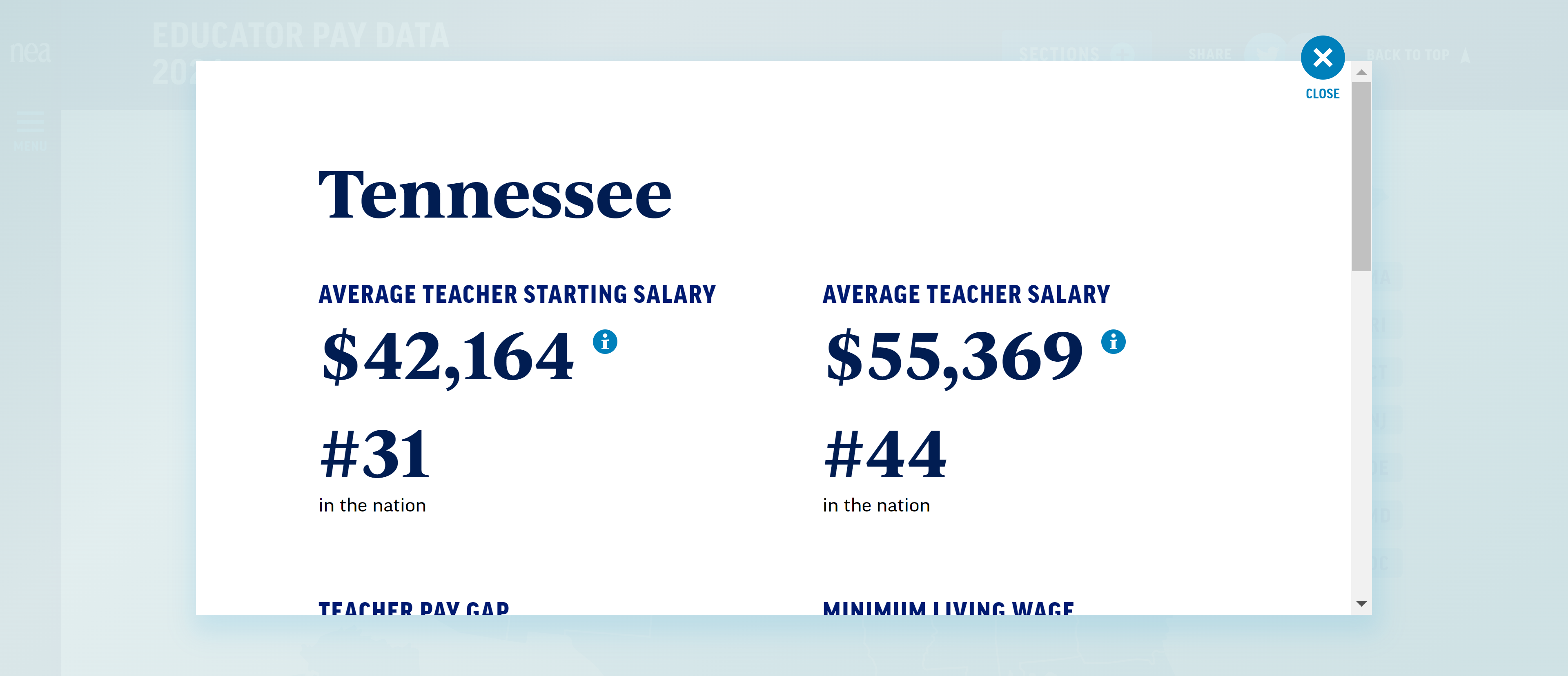
Despite Gov. Bill Lee and his GOP allies claiming to invest in teachers, average teacher pay in the state is still among the lowest in the nation.
From National Education Association analysis of teacher pay
And a new report suggests the teacher pay penalty – the gap between teacher pay and the pay of other comparably-educated professionals – is at an all-time high.
The latest data says the “teacher pay penalty” – the gap between teacher compensation and the pay of other professionals – is now at an all-time high – 27%.
Of further concern:
Young people’s interest in education continues to slide as they recognize “many downsides” to teaching, including its unattractive pay.
Since 2009, Tennessee has identified shortages in the overall numbers of K-12 teachers needed for public schools as well as teachers for specific subjects. There is a critical need in the state for STEM teachers, as well as shortages in high school English, social studies, world languages, Pre-K through high school special education, and English as a second language.
In short, policymakers have been aware of this problem for a long, long time.
Now, the crisis is acute – and nothing is being done.
This week, the district announced plans to move starting teacher pay to $50,000 and adjust the pay scale for all teachers accordingly.
Effectively, the plan moves every teacher up four spots on the pay scale.
This will mean raises of between $3000-$5000 for all teachers in the system.
Teacher pay matters. Investing in the people who have direct contact with students is a direct investment in student success.
When teachers get paid more, students do better. In one study, a 10% increase in teacher pay was estimated to produce a 5 to 10% increase in student performance. Teacher pay also has long-term benefits for students. A 10% increase in per-pupil spending for each of the 12 years of education results in students completing more education, having 7% higher wages, and having a reduced rate of adult poverty. These benefits are even greater for families who are in poverty.
Tennessee Education Association challenges Gov. Lee’s attempt at union busting
The Tennessee Education Association is challenging a new state law that prevents local school districts from allowing teachers to have their association dues automatically deducted from their paychecks.
The move by the Lee Administration was tied to a teacher pay raise and widely seen as an effort to weaken the oldest and largest organization advocating for teachers in the state.
In recent years, TEA has been the source of the strongest opposition to Lee’s agenda of using public money to fund private schools.
Tennessee’s largest professional teachers organization is challenging the constitutionality of a new state law that prohibits school districts from making payroll deductions for employees’ professional association dues.
The Tennessee Education Association filed its lawsuit Tuesday in Davidson County Chancery Court on behalf of its local education associations and 41,000 members statewide. The complaint names Gov. Bill Lee’s administration, which pushed for the change, and the state education department as defendants. Several local education associations have joined the suit.
State does little to help attract, retain educators
Nashville’s Fox 17 reports that Tennessee is facing a teacher shortage that is growing worse by the year:
The report shows this school year started with more than 1,000 teacher vacancies state-wide, and about 3,000 positions filled by people with an emergency teaching credential. The vacancies are up 16 percent since last school year.
Low pay and poor working conditions are cited as reasons for the exodus from the profession. Likewise, fewer college students are seeking teaching credentials.
I wrote recently about Gov. Bill Lee’s heavy spin around teacher compensation. While Lee claims Tennessee will soon be in the Top 10 in teacher pay, we currently rank in the bottom 7 – and even below Alabama.
“Tennessee teachers are the best in the Southeast, and we have the outcomes and data to back that up, but we are not paid as the best and are behind our peers in neighboring states,” said TEA President Tanya Coats. “Teachers, like other Tennesseans, have been affected by inflation and rising costs in the family budget. State revenues are strong, and we’ve seen record budget surpluses for many years. More can be done to improve the economics of being a professional teacher in our state, and TEA will continue to advocate for professional salaries for our dedicate educators.”
Coats noted that the proposed teacher pay increase will bring Tennessee’s minimum teacher salary to $42,000 a year. She then pointed out that Alabama’s minimum teacher pay is $43,358.
It’s also noteworthy that only 25% of Tennessee teachers earn more than $60,000 a year.
Bill Lee’s rhetoric on teacher pay doesn’t match the policy reality – and teachers are making that clear by leaving the profession.
For more on education politics and policy in Tennessee, follow @tnedreport
Sure, the UT football team claimed a big win over Alabama in football this year. However, teachers in Alabama still earn more than teachers here in Tennessee.
And yes, that’s even AFTER Gov. Bill Lee’s proposed teacher pay raise announced in last night’s State of the State address.
“Tennessee teachers are the best in the Southeast, and we have the outcomes and data to back that up, but we are not paid as the best and are behind our peers in neighboring states,” said TEA President Tanya Coats. “Teachers, like other Tennesseans, have been affected by inflation and rising costs in the family budget. State revenues are strong, and we’ve seen record budget surpluses for many years. More can be done to improve the economics of being a professional teacher in our state, and TEA will continue to advocate for professional salaries for our dedicate educators.”
Coats noted that the proposed teacher pay increase will bring Tennessee’s minimum teacher salary to $42,000 a year. She then pointed out that Alabama’s minimum teacher pay is $43,358.
Yes, that’s right – even with a 4% raise this year, Tennessee teachers will still lag behind neighboring Alabama in teacher pay.
This despite the state facing a significant teacher shortage AND having a surplus in excess of $2 billion.
The Tennessee State Board of Education is looking at ways to smooth the pathway into teaching, including by eliminating a key hurdle faced by some candidates – a test of teaching aptitude.
Currently, all teachers in Tennessee must pass the education teacher performance assessment, whether they have a degree in another field or they’re in the process of student teaching.
But some are looking to drop the requirement for this assessment.
If adopted, the exemption would only apply to about 800-900 teacher certification applicants a year – those who are already “job-embedded” candidates doing teaching under the supervision of a mentor teacher.
The idea, according to officials at the State Board of Education, is to eliminate a barrier to teacher certification for those with a high level of training.
However, as the story notes, schools of education and even recent teacher applicants say the certification process, including the testing, is a key element of preparation for the classroom.
It was about a decade ago when then-Education Commissioner Kevin Huffman pushed the State Board to increase the rigor of requirements to become a certified teacher.
This was supposed to dramatically improve education quality in Tennessee.
Now, facing both a teacher shortage AND a reluctance by policymakers to significantly improve teacher compensation, the State Board is seeking to lower requirements so more people will be eligible for these positions.
It’s noteworthy that in each case, the reform in question did NOT result in any increase in compensation or improvement in working conditions for teachers.
It’s as if investing in teachers is a bridge too far – instead, so-called education “reformers” will continue to try everything possible EXCEPT dramatically raising pay in order to address the issue at hand.
Amid a global pandemic that is seeing an already troubling teacher shortage exacerbated, voters in Nashville are expressing concern that schools are underfunded and teachers are underpaid. These findings come as the result of a poll of registered voters conducted on behalf of the Nashville Public Education Foundation.
The poll found that voters (72%) believe teachers are underpaid – this in spite of a recent pay plan raising pay in Nashville some $7000 or more for most teachers. The pollster noted that previous results showed 80% of voters thought teachers were underpaid.
The findings on funding are not surprising in a state that had a $2 billion surplus in the past fiscal year and is underfunding schools by at least $1.7 billion.
According to the poll, 66% of Nashville voters feel public schools in the city are underfunded.
Meanwhile, Gov. Bill Lee is attempting to divert attention from his party’s dismal track record on school funding by pushing a statewide “review” of the school funding formula, known as the BEP.
What Lee and legislative leaders are not (yet) talking about is a dramatic increase in state funding for schools. Of course, there’s a February court date that may result in the Tennessee Supreme Court ordering policymakers to properly invest in schools.