Tennessee’s school funding formula, the BEP, is broken. It fails to adequately fund teaching positions. It fails to account for actual salaries paid to teachers. It fails to provide the money necessary to adequately equip schools. There’s simply not enough funding for nurses or counselors or other key support staff. Here’s one teacher talking about what a broken school funding system looks like.
Wow! This is what a CARING teacher looks like! This is what a FRUSTRATED teacher looks like! This is what a potentially FORMER teacher looks like! #MNPSWeHaveAProblempic.twitter.com/aV1iS2H5Bb
While some Tennessee lawmakers are pushing for a significant new investment in our state’s schools, new evidence suggests that a cash infusion is just what schools need to retain teachers and improve student outcomes.
Here’s the breakdown from Matt Barnum:
A newly published study based on several states shows that in the long run school spending increases substantially boost test scores and graduation rates https://t.co/oM6ctL3iRfpic.twitter.com/6WaQ41Vnjm
This tracks with a post I shared recently from We Are Teachers noting that a boost to teacher pay has a long-term impact on student achievement:
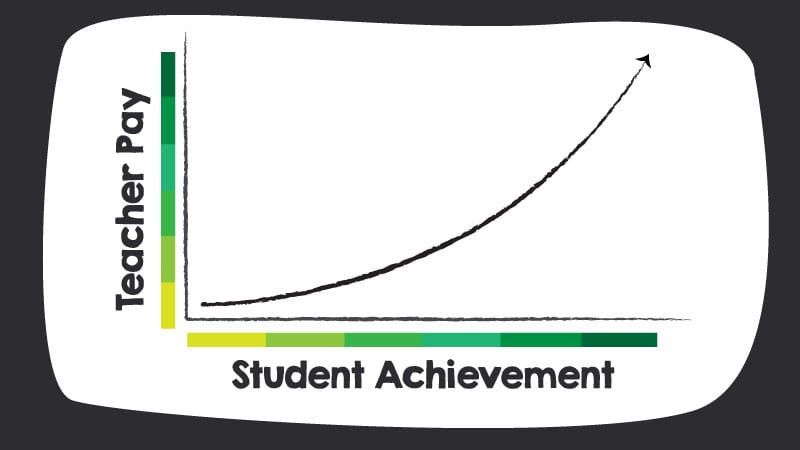
When teachers get paid more, students do better. In one study, a 10% increase in teacher pay was estimated to produce a 5 to 10% increase in student performance. Teacher pay also has long-term benefits for students. A 10% increase in per-pupil spending for each of the 12 years of education results in students completing more education, having 7% higher wages, and having a reduced rate of adult poverty. These benefits are even greater for families who are in poverty.
Tennessee needs $500 million just to properly staff schools — and that’s just teachers. We need more to add the proper number of counselors, nurses, and other key support staff.
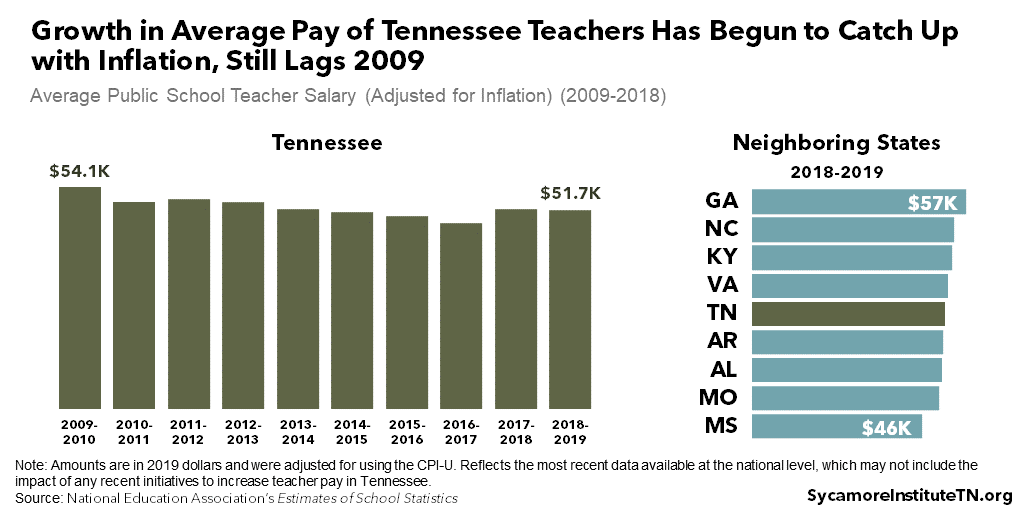
Our teachers need a raise — Tennessee teachers earn about $2400 less than they did back in 2009 when salaries are adjusted for inflation.
This new round of research backs up what those on the front lines of public education will tell you: Money matters. It matters a lot.
The mid-year raise, which is effective retroactively as of Feb. 8, is possible thanks to $3 million in savings during the first half of the fiscal year, according to district officials.
The move comes even as some lawmakers are focusing on ways to improve Gov. Bill Lee’s proposed 4% increase to the state’s share of BEP money dedicated to teachers.
Meanwhile, Nashville school board members are calling on the state to dramatically increase investment in schools.
For the second year in a row, Lee has proposed doubling a state slush fund for charter schools while offering only a small increase in teacher compensation. In fact, one study indicates teachers in Tennessee are paid at a lower rate (when accounting for inflation) than they were back in 2009.
After adjusting for inflation, however, teachers’ average pay during the 2018-2019 school year was still about 4.4% lower than a decade earlier.
For more on education politics and policy in Tennessee, follow @TNEdReport
In my 20s, I was fresh out of college with a business degree and worked in software for a few years. In my 30s, I went to graduate school for sociology. I’m single and I had no family support. So I took out student loans.
I made the decision to take student loans carefully. It’s a risk, because you might not graduate and then you’ll be left with thousands of dollars to pay back.
There were two mitigating factors that led me to go for it. First, you can opt for income-based repayment. Under that option, your loan payments are tied to your income. If you’re broke, your payments are small. If you’re rich, you pay more. That seems fair.
Second, if you work in the public sector or at a non-profit organization, your loans are forgiven after 10 years of repayment. (If not, they are forgiven after 20 years.)
I’m a little more than a year away from graduation. After seven years of graduate school, if I’m lucky, I’ll get a job that pays less than I made in software in my 20s. And then I’ll pay back loans for a decade.
I’ll be 50 years old when my loans are forgiven. It will affect my ability to buy a home, start a family, or save for retirement. I chose that.
Yet Trump has proposed cutting loan forgiveness for people who work in non-profit or government jobs for ten years. For students like me who already took out loans, it’s reneging on a promise.
If you want to run the government like a profit-maximizing business, maybe cutting loan forgiveness makes sense. But there are good reasons why the government should not be run like a business.
Businesses are run to maximize the profits of their shareholders. Any benefits to their customers or the wider public are incidental. The government should benefit all of us.
A healthy society is one with social mobility, where a talented, hardworking person born into poverty can rise above their class. Unless you’re a star athlete, education is the key to getting ahead. Education is not equally accessible to all.
Students from low-income families with college aspirations are already at a disadvantage for a long list of reasons. Sociologist Sara Goldrick-Rab studies how the current financial aid system is skewed against the poor. For example, she finds that aid packages underestimate the actual cost of attending school, and assume that children don’t contribute financially to their parents (which many low income students do).
I want to live in a country where talented people from poor families can still go to college. I think that makes our country better — not just in an idealistic way because of lofty morals, but in a real, tangible way that I believe we will all gain from.
I don’t think we are better when the rich stay rich because Aunt Becky can buy her kids’ way into college without them earning it, while a genius born to poor parents can’t. I think we all do better when talented people born into poor families can realize their full potential, enriching our society for all of us.
Loan forgiveness isn’t the magic bullet to achieving a perfect meritocracy, but it’s something. And it’s not a giveaway of free money — it’s an investment in a better society.
OtherWords columnist Jill Richardson is pursuing a PhD in sociology at the University of Wisconsin-Madison. Distributed by OtherWords.org.
For more on education politics and policy in Tennessee, follow @TNEdReport
Sure, it seems obvious that raising teacher pay makes a difference. But, it’s nice to have some evidence to back that claim up. Especially in a state where teachers now earn 4.4% less than they did back in 2009.
We Are Teachers has put together a list of six benefits of boosting teacher pay. Here are some highlights:
A majority (76%) of responders to a TIME poll said they agreed that many people won’t go into teaching because it doesn’t pay enough. This means fewer graduates of teacher education programs, and fewer teachers looking to fill the increase in demand for teachers.
Unsurprisingly, teacher pay has been shown to reduce turnover (which, in turn, increases student performance). Turnover is about 16% each year, and around 8% of teachers annually leave the profession entirely as opposed to moving to another school.
For example, a study in San Francisco found that when the salary for teaching was increased, the size and quality of teacher applicants increased.
Teachers are 30% more likely than non-teachers to have a second job. It goes without saying that raising teacher pay so teachers didn’t have to work a second job would boost teacher morale and help them stay focused on their classrooms.
In some states, teacher salaries are so low that teachers routinely qualify for public benefits like food stamps or public health care programs (like children’s health insurance programs). This is especially true for teachers who are the primary breadwinner in their family or have large families.
When teachers get paid more, students do better. In one study, a 10% increase in teacher pay was estimated to produce a 5 to 10% increase in student performance. Teacher pay also has long-term benefits for students. A 10% increase in per-pupil spending for each of the 12 years of education results in students completing more education, having 7% higher wages, and having a reduced rate of adult poverty. These benefits are even greater for families who are in poverty.
For more on education politics and policy in Tennessee, follow @TNEdReport
Tennessee teachers may want to hop in the wayback machine in order to see a bigger paycheck. That’s according to data released by the Sycamore Institute that indicates that teachers in Tennessee now earn about $2400 less per year than they did in 2009.
Here’s more from the group’s analysis of Governor Lee’s 2020-21 budget:
Between FY 2016 and FY 2020, lawmakers enacted a total of $429 million in recurring increases for teacher pay. Since that time, growth in Tennessee teachers’ average pay has begun to catch up with inflation. After adjusting for inflation, however, teachers’ average pay during the 2018-2019 school year was still about 4.4% lower than a decade earlier.
To approach the salaries teachers enjoyed all the way back in 2009, the General Assembly would need to add roughly $100 million to Lee’s proposed increase for this year. That’s entirely doable, as the state has enjoyed multiple years of surplus revenue. That is, we can significantly raise teacher pay AND not raise taxes.
Of course, adding $100 million would only mean our teachers are BACK to the 2009 level. To make a real improvement, we’d need to at least double that number. Does Tennessee have more than $300 million available to commit to teacher pay? YES! It’s now up to the General Assembly to decide whether or not to make this investment.
Adjusting pay in this way could mean an average increase in teacher pay of just under $4000 for every teacher in Tennessee.
For more on education politics and policy in Tennessee, follow @TNEdReport
In Monday’s State of the State Address, Governor Bill Lee outlined a proposal for a 4% adjustment to the BEP salary schedule. This will likely mean an actual increase for teachers of 2% or less. In fact, the Associated Pressreports that when pressed on the issue, Administration officials admitted that the nature of the BEP means teachers likely won’t receive an actual 4% pay bump.
A day after Gov. Bill Lee boasted he was proposing the largest investment in teacher pay in Tennessee history, top administration officials acknowledged the addition wouldn’t necessarily result in big pay raises for the state’s educators.
Finance and Administration Commissioner Stuart McWhorter told lawmakers Tuesday it was Lee’s “intent” for teachers to receive a 4% raise under the governor’s recently unveiled spending plan for the upcoming fiscal year. However, due to the state’s complicated school funding formula, teachers could get a smaller pay bump.
One way to ensure this “intent” becomes reality is to require the state minimum salary schedule be adjusted by the same 4% that the Governor is proposing and the legislature will hopefully approve. That hasn’t always happened.
Of course, another challenge is that while the amount allotted for salaries is increasing, the BEP formula underestimates teacher need by at least 9000 positions:
In Tennessee, classroom size requirements have forced districts to hire more than 9,000 teachers beyond what the BEP provides to pay for their salaries, according to a statewide analysis presented by the Department of Education in December to the BEP Review Committee.
Lee’s proposal does nothing to address the structural inadequacy of the BEP. This means districts are forced to distribute salary funds in a way that virtually ensures the 4% increase results in a raise that’s half that or less when it comes to teacher paychecks.
Teachers can’t pay their mortgage with an “intended raise.” Actual money is needed to both boost pay and adequately staff schools.
For more on education politics and policy in Tennessee, follow @TNEdReport
Last year, Governor Bill Lee doubled the charter school slush fund while only offering a pittance to public school teachers. This year, he’s pulling a similar trick, again doubling the charter school slush fund — from $12 million to $24 million — while offering teachers a paltry 4% increase in the BEP salary number (which means an actual raise of about 2%).
Lee’s 2020-21 budget includes $24 million in funding for charter school facilities. This is a 100% improvement over the 2019-2020 budget. Simultaneously, Lee is touting a 4% increase in BEP funding for teacher salaries. This means an actual raise of less than 2% for most teachers. Even if you assume a net gain of 4%, you get a 70 cent an hour raise.
Let’s be clear: Governor Lee prioritizes charter schools over Tennessee’s public school teachers. His last two budgets make that plain.
It’s also worth noting that Lee has made NO effort to improve BEP funding even as the state’s own Department of Education indicates we are 9000 teachers short of proper funding:
In Tennessee, classroom size requirements have forced districts to hire more than 9,000 teachers beyond what the BEP provides to pay for their salaries, according to a statewide analysis presented by the Department of Education in December to the BEP Review Committee.
So, we’re at a minimum of $500 million short of properly funding our schools and Lee’s proposal is to give the teachers we have a 2% raise. No word on improving the BEP. No word on a significant salary boost for existing teachers. Just 2% for teachers (4% in BEP funds), and another 100% increase for charter schools.
Could Gov. Lee’s priorities be more clear?
For more on education politics and policy in Tennessee, follow @TNEdReport
Tucked inside this Chalkbeatstory on Hamilton County dropping its lawsuit over state funding of public schools is a note about just how inadequate the formula (the BEP) is.
In Tennessee, classroom size requirements have forced districts to hire more than 9,000 teachers beyond what the BEP provides to pay for their salaries, according to a statewide analysis presented by the Department of Education in December to the BEP Review Committee.
When looking at an average actual salary for Tennessee teachers of around $52,000, this means that local districts are responsible for $468 million in teacher salary expenses before benefits are included. That’s an unfunded mandate that easily exceeds half a billion dollars.
No one is suggesting we hire less teachers. In fact, many districts report needing additional teachers and other staff — such as nurses and counselors — to adequately serve their students.
However, this number does show that our state systematically underfunds public schools in a way not addressed by the current funding formula. It’s likely that when you combine the unfunded salary and benefits of teachers and the needs for programs like RTI2 with the proper staffing levels for nurses and counselors, you’d see a number exceeding $1 billion.
Let’s be clear: The state’s own Department of Education has provided information to the committee responsible for reviewing the state funding formula that indicates we’re at least $500 million behind where we should be in terms of current funding.
It’s also worth noting that these numbers don’t include any significant boost in pay for existing teachers.
In short: Tennessee is not properly funding schools.
For more on education politics and policy in Tennessee, follow @TNEdReport