For years, those of us watching public education have warned of a teacher shortage.
Those warnings were often met with either skepticism or some token gesture. Now, analysis of teacher turnover indicates we are here. At the breaking point.
The shortage is of course a matter of movement into and out of the field. There aren’t enough teachers on the way in: the pipeline is bad as interest in the career has plummeted, with the percent of college grads entering the profession lower than it’s been in a half century.
The unfilled spots that result from turnover and the inability to recruit qualified candidates makes the job harder for teachers who stay. Remaining teachers lose valued and experienced partners, are asked to train replacements, and must provide remediation for students who’ve been taught by a series of substitutes or novice teachers. These teachersaren’t just working harder, they are more stressed, have less time for their students, and can become less effective. It causes some to look toward the exit themselves. Making the job harder, of course, makes it more difficult to recruit.
Yes, there IS a shortage of teachers. No, it’s not going to be easy to solve. Yes, paying more helps. Some. And, yes, the value proposition for teaching is pretty terrible right now.
Barnum and Fernandez note several of the obvious reasons that teaching is a less attractive profession these days. Low pay, especially if you compare it to the pay for similarly-educated professions. The rising tide of bad behavior from students. The onslaught of attention-sapping technology. The insistence that good education is only for the right people and for other people we just need schools to crank out compliant meat widgets to serve corporate overlords.
And, well, there’s a lot of negativity when teaching – formerly one of America’s most revered professions – is discussed:
There is the absolute unrelenting negativity directing at the profession. Twenty years ago, American schools were failing, and it was all teachers’ fault. Then teachers were run down as groomers and pedophiles. Then they were part of the evil conspiracy behind COVID. Commies and traitors! If you aren’t on the ground, in schools, I’m not sure you can really grasp just how relentless and ugly the steady denigration of teachers has been in this country for the past few decades. And the folks who could be the next generation of teachers have had a front row seat.
Sexton recently floated a proposal that would allow Tennesseans to start teaching with nothing more than an associate’s degree—the idea being to fill teacher vacancies. The pathway would then allow them to earn a bachelor’s and eventually a master’s to become administrators. Because of course, even in this setup, the goal seems to be getting more administrators, not more teachers.
A summer workshop for Nashville teachers is accepting applications – it’s part of The Educator’s Cooperative
Details:
Our 200+ Members work at 120+ Nashville schools with a combined 89% who remain active in professional education. This retention rate is so high because we give teachers the kind of support they actually need to keep teaching. Here’s what that looks like:
Access to a network of 200+ dedicated teachers who are eager to collaborate
A community that supports on challenging days AND celebrates rewarding ones
Customized professional learning for individual teachers based on specific needs
The workshop is July 7th-11th at University School of Nashville.
The Educators’ Cooperative (Nashville) is hosting a summer workshop for teachers – details from an email:
EdCo provides:
Access to a network of 200+ dedicated teachers who are eager to collaborate
A community that supports on challenging days AND celebrates rewarding ones
Customized professional learning for individual teachers based on specific needs
Completing Summer Workshop is how they join EdCo and gain access to our mutual aid network of cross-sector support, expertise, and resources. Plus, full scholarships are awarded to all accepted applicants.
Want to learn more about Summer Workshop? Watch this video to see teacher testimonials from last year’s.
Teacher pay matters – TN policymakers don’t get it
Yes, it’s about money.
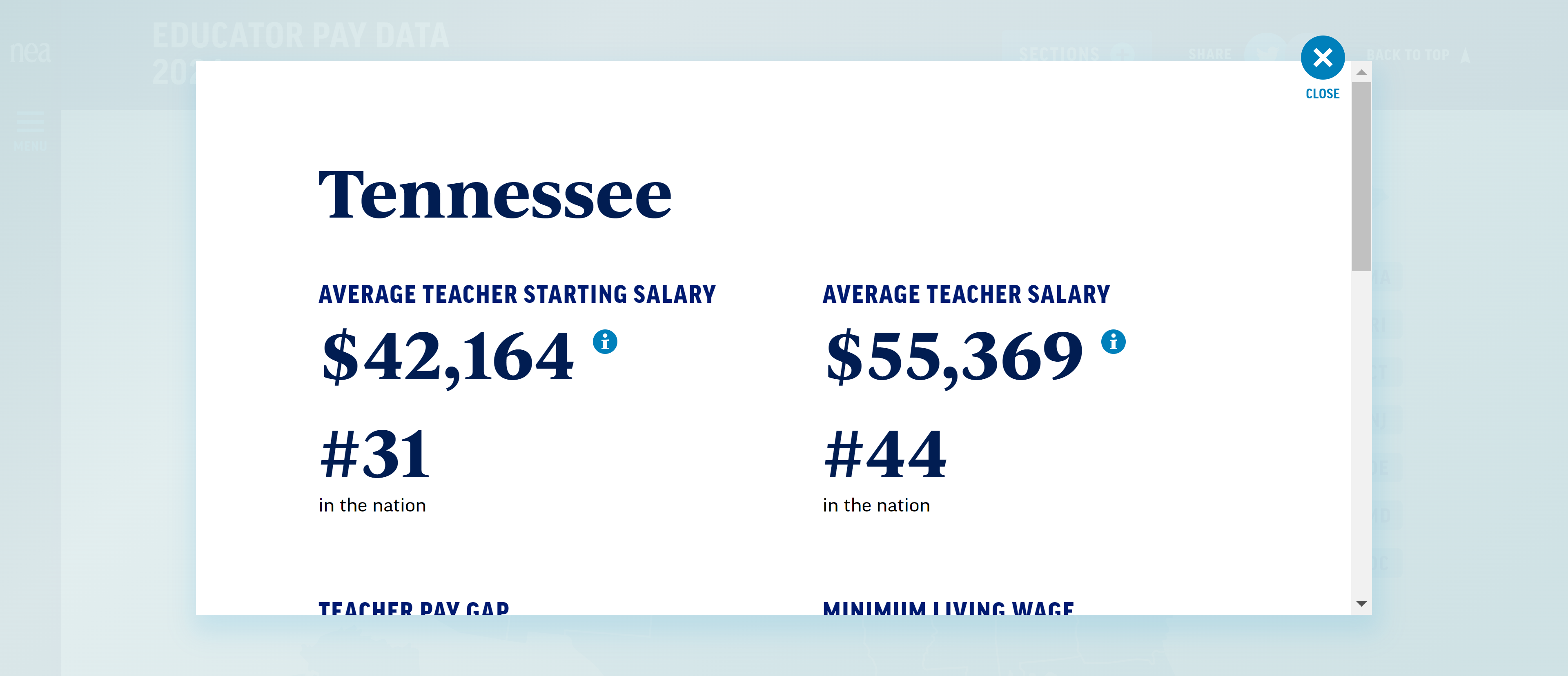
Despite Gov. Bill Lee and his GOP allies claiming to invest in teachers, average teacher pay in the state is still among the lowest in the nation.
From National Education Association analysis of teacher pay
And a new report suggests the teacher pay penalty – the gap between teacher pay and the pay of other comparably-educated professionals – is at an all-time high.
The latest data says the “teacher pay penalty” – the gap between teacher compensation and the pay of other professionals – is now at an all-time high – 27%.
Of further concern:
Young people’s interest in education continues to slide as they recognize “many downsides” to teaching, including its unattractive pay.
Since 2009, Tennessee has identified shortages in the overall numbers of K-12 teachers needed for public schools as well as teachers for specific subjects. There is a critical need in the state for STEM teachers, as well as shortages in high school English, social studies, world languages, Pre-K through high school special education, and English as a second language.
In short, policymakers have been aware of this problem for a long, long time.
Now, the crisis is acute – and nothing is being done.
The following post is a submitted guest column by Greg O’Loughlin
Last Saturday, some teacher friends and I were having lunch, and the conversation turned to the conditions required for students to trust their teachers with questions about racism, equity, and justice.
One of the teachers was recounting a recent experience with some of her students who were discussing the use of a racial epithet by some other students. Some were quoting recent headlines and others were using it in full while questioning appropriate usage. It sounded very much like kids playing with fire – it was dangerous, potentially harmful, and if things got out of hand, there was the risk that people would be hurt. Lines were crossed and confusion was leading to injury, so they came to this teacher seeking some help and guidance.
She shared the details of the conversation she facilitated with them, in between classes, in the hallway, then later in the day for some follow up. It was tricky and sensitive, and it worked – everyone involved in the conversation reported leaving it with a better understanding of the risks, the consequences, and the humanity involved.
A member of our party asked, “How did those students know that they could trust you with questions like that? Why did they know that they could turn to an older White lady with questions about the N-word? I don’t think I would have trusted a teacher with a question that was so full of emotion and vulnerability.”
The teacher reflected for a moment and said, “I think it’s because I’ve been in that school for so long. I taught their older brothers, and I’ve taught so many siblings, I guess I have a reputation as being trustworthy and safe and engaged in the work of exploring topics like that one. I know all the families, and they know me. We don’t always see eye to eye but we feel connected and like we’re part of the larger community, and we trust one another.”
She was trusted because she had spent countless hours investing in the community building and relationship building that is essential to effective teaching and learning.
That’s not something that’s covered in most analysis and discussion of teaching and teachers. Teachers are leaving at unprecedented rates and the harm this is causing in our communities cannot be addressed by simply replacing them.
Recent news about the growth of a program that will bring new teachers into the profession is welcome. Teachers have been sounding the alarm for far too long about the need for more adults in the building and more teachers in classrooms, and it’s good to see people in positions around the state deciding to do something about that. But who will be on the faculties of the schools when these new teachers arrive for the first day of school?
Will these new teachers arrive at school buildings where the majority of the faculty know the families, the siblings, and surrounding community? Or will these new teachers arrive at schools with dozens of other new teachers, lacking the relationships that are essential for effective teaching and learning?
A study by the University of Pennsylvania found that in 1987-1988, the average American teacher had approximately 15 years of experience in the classroom. By 2016, the average was less than 3 years. Nearly 50% of new teachers quit teaching in the first 5 years in the classroom. The kinds of relationships my friend described as being essential to her ability to connect with her students and their families take time. Learning takes time. Community building takes time. If we can’t keep teachers in the classroom, we are not providing them or their students with the necessary components of teaching and learning.
It’s a good idea to hire more teachers, and plans for how to do so are clear, celebrated, and well funded. Teachers in the classroom now deserve at least the same. A failure to address the specific needs of teachers is a failure to support the students. Bringing thousands of new teachers to a system that does not effectively support current teachers with well-defined and effective retention efforts is a short-sighted idea that could prove to be more harmful than good.
Let’s be sure that our most creative and concerted efforts are oriented toward retaining teachers. It’s what EdCo does, and we know it makes a difference in the lives of teachers, students, and communities.
Greg O’Loughlin, Founder and Director of The Educators’ Cooperative, a nonprofit based in Nashville that supports ALL educators with workshops and resources that result in longer, healthier, and more effective careers in the classroom.
Belmont University’s College of Education has its first Dean, and he’s got a record of undermining public schools and attacking teachers. The Lexington Herald-Leaderreports that outgoing Kentucky Commissioner of Education Wayne Lewis will be the inaugural Dean of the College of Education at Nashville’s Belmont University. Here’s more:
Wayne D. Lewis Jr., who just resigned under pressure from Gov. Andy Beshear’s newly appointed Kentucky Board of Education, was on Monday named the inaugural Dean of the College of Education at Belmont University at Nashville, according to a news release from Belmont.
As Commissioner of Education in Kentucky, Lewis advanced an agenda focused on creating charter schools in Louisville and Lexington. He also helped then-Governor Matt Bevin crackdown on teacher strikes by requesting that districts provide him with a list of teachers who had taken sick days on days coinciding with demonstrations against Bevin’s privatization agenda in Frankfort.
In announcing the hire, Belmont Provost Thomas Burns said:
“We wanted to find a different kind of leader to build our ‘dream’ of a College of Education, who will lead the faculty and staff in the School of Education to develop and deliver world-class programs designed to educate teachers for students in our community and our world as the next generation of compassionate, confident and committed leaders in the classroom and beyond.”
Apparently, Belmont’s dream includes the privatization of public schools and the silencing of teachers voicing dissent over low pay and poor working conditions. Should be great for recruiting students to the program.
For more on education policy in Tennessee, follow @TNEdReport
Your support — $5 or more today — makes publishing education news possible.
According to a recent report, Tennessee’s education policies have resulted in our state becoming a national leader in at least one category. The Learning Policy Institute notes that Tennessee has the highest percentage of 1st- and 2nd-year teachers of any state in the nation. Nearly 20% of Tennessee’s teacher workforce is very new to the profession. That’s well above the national average of 12.7%. When that number is combined with the percentage of uncertified teachers (4.1%), the outlook is not good: Our schools are not retaining experienced teachers. The national average for classrooms staffed by uncertified teachers is 2.6%.
Check out the data:
Teacher compensation in Tennessee is certainly one factor playing into this challenge. Our teachers are paid 27.3% less than individuals in similarly trained professions. In fact, we have among the highest teacher wage gaps in the country.
Helpfully, the Learning Policy Institute offers some recommendations for improving this situation:
Service scholarships and student loan forgiveness:
The cost of high-quality teacher preparation is a significant obstacle to those considering entering the teaching profession. To overcome such barriers, at least 40 states have established service scholarship and loan forgiveness programs to recruit and retain high-quality teachers. These programs underwrite the cost of teacher preparation in exchange for a number of years of service in the profession. Research has found that effective service scholarship and loan forgiveness programs leverage greater recruitment into professional fields and locations where individuals are needed, and support retention.
High-retention pathways into teaching:
Teacher turnover is higher for those who enter the profession without adequate preparation. However, teachers often choose alternative certification pathways that omit student teaching and some coursework because, without financial aid, they cannot afford to be without an income for the time it takes to undergo teacher training. High-retention pathways are developed to subsidize the cost of teacher preparation and provide high-quality training for incoming teachers. These pathways include teacher residencies and Grow Your Own programs that recruit and prepare community members to teach in local school districts
Mentoring and induction for new teachers:
Evidence suggests that strong mentoring and induction for novice teachers can be a valuable strategy to retain new teachers and improve their effectiveness. Well-mentored beginning teachers are twice as likely to stay in teaching as those who do not receive mentoring. However, the number of states supporting mentoring and induction programs decreased during the recent recession, and a 2016 review of state policies found that just 16 states provide dedicated funding to support teacher induction. Under ESSA, states can leverage federal Title II, Part A funds to support new teacher induction and mentoring. Indeed, a number of states, including Delaware and Ohio, are taking such an approach. Other states have invested state funds to support new teacher induction, including Connecticut and Iowa.
High-quality school principals:
Principals play a central role in attracting and retaining talented teachers. Teachers cite principal support as one of the most important factors in their decision to stay in a school or in the profession. Therefore, states can benefit from building effective systems of preparation and professional development for school leaders. Title II, Part A of ESSA provides states with new opportunities to invest in and improve school leadership in ways that could increase teacher retention, including by reserving up to 3% of their state Title II, Part A funds for school leader development. Many states—including North Dakota and Tennessee—are seizing this opportunity, with nearly half of states using the optional 3% set aside and 21 states using ESSA funds to invest in principal preparation. The North Carolina Principal Fellows program is an example of a long-standing, successful state effort to support principal development.
Competitive compensation:
Not surprisingly, the lack of competitive compensation is one factor that frequently contributes to teacher shortages, affecting the quality and quantity of people planning to become teachers as well whether people decide to leave the teacher workforce. Even after adjusting for the shorter work year in teaching, beginning teachers nationally earn about 20% less than individuals with college degrees in other fields—a wage gap that widens to 30% by mid-career. Large inequities in teacher salaries among districts within the same labor market leave some high-need, under-resourced districts at a strong disadvantage in both hiring and retaining teachers. More competitive compensation can be a critical strategy to recruit and retain effective educators, although different approaches may be necessary depending on the state, regional, and district context.
Recruitment strategies to expand the pool of qualified educators:
In light of fiscal constraints, many states are also opting for low-cost policy solutions that expand the pool of qualified teachers. Such strategies include recruiting recently retired teachers back into the classroom to fill open positions and strengthening licensure reciprocity to ease undue burdens to cross-state mobility and allow experienced and accomplished educators the opportunity to seamlessly transition into service in a different state. Colorado, for example, is actively pursuing both strategies, and Idaho, Oklahoma, and West Virginia are also recruiting retired teachers to help address teacher shortages.
Tennessee should certainly move forward with a serious effort to improve teacher compensation as well as an early career mentoring/induction program. Coupling these two items with meaningful new investments in our schools could make both coming to and staying in teacher a more attractive proposition in our state.
Until then, it’s likely we’ll continue to see teachers leave the profession at higher than the national rate. We simply haven’t been committed to investing in our teachers and it shows.
For more on education politics and policy in Tennessee, follow @TNEdReport
You might think Tennessee’s public schools of education are doing a poor job of turning out effective educators if you read this story in yesterday’s Tennessean.
The article notes:
Many of Tennessee’s teacher preparation programs aren’t at the quality the state expects. A number of those underperforming are at state colleges — with none of those schools performing at the highest level.
It’s a “sobering” data point education officials are highlighting as they work toward addressing fixes in Tennessee’s teaching programs.
The article references the redesigned teacher preparation report card produced annually by the Tennessee State Board of Education.
The revamped report includes candidate profile (who is enrolling in teacher prep programs), retention (whether grads stay in teaching), and “teacher effectiveness” (which is measured primarily by the flawed TVAAS system).
TVAAS scores of graduates account for 25 of the 75 points available to rate teacher prep programs. That means the rating formula is heavily skewed toward an unreliable statistical estimate of performance.
At best, TVAAS is a rough estimate of teacher performance. A fairly solid indicator that a teacher earning a “5” is NOT a “1,” but relatively meaningless otherwise.
Now, of course, Tennessee has transitioned to new tests. TNReady has been fraught with problems, but even if it hadn’t been, the results would render TVAAS data highly suspect. So, 33% — the largest single portion — of the score attributed to teacher prep programs comes from a number that is essentially meaningless. Let me be clear: Schools receiving grades of 4 (the highest) or 1 (the lowest) on this metric are getting numbers that have no basis in statistical reality.
The next area of importance to a program’s score is the profile of the candidates enrolled in their program. Here, the state is looking for high academic achievers and overall diversity.
As noted in the article:
McQueen also has plans for a statewide tour to schools with the purpose of getting high-achieving, young students into the education profession, especially since preparation programs are having trouble getting qualified candidates in the doors.
This is predicated on the assumption that students with higher ACT scores will ultimately become better teachers. Whether or not that’s true, it ignores the underlying reality: Teaching just may not be a very attractive field. That’s not the fault of schools of education and it certainly isn’t their responsibility to fix it.
In fact, Tennessee has been looking at a coming teacher shortage for years now. Districts like MNPS are already seeing the impact.
Why might teaching be unattractive? Well, for one, the pay is not exactly great. In fact, Tennessee teachers earn about 30% less than their similarly prepared peers. Boosting pay may be one way to help make the field more attractive. Alternatively (and much cheaper), the state could send the outgoing Commissioner of Education on a tour of schools to attempt to persuade high achieving students to enter a profession where they can expect to earn significantly less than other professionals and be subjected to a testing and evaluation system that according to some is “driving teachers crazy.”
Another factor? Our state under-funds the BEP (the state’s funding formula for schools) by around $500 million. So, new teachers face low pay, a problematic evaluation system, and under-resourced schools. Is it any wonder teacher prep programs aren’t getting enough qualified applicants?
Nevertheless, teacher prep programs are being held “accountable” for fixing problems over which they have little control. Makes perfect sense.
*NOTE: An earlier version of this story indicated TVAAS accounted for 40 points on the scale. That has been corrected to accurately reflect the 25 points TVAAS scores comprise.
For more on education politics and policy in Tennessee, follow @TNEdReport