Teachers in Hamilton County are seeing a strong outpouring of community support ahead of a planned town hall meeting do discuss teacher compensation, according to a story in the Chattanooga Times-Free Press:
Hundreds of teachers and supporters of public education are continuing to organize ahead of a Sunday town hall aimed at discussing teacher compensation and how to fund public education in Hamilton County.
The move comes as teachers in Hamilton are highlighting both low pay and a significant amount of uncompensated time and out-of-pocket expenses:
“If those averages apply to the entire county, we’ve got about $2.5 million in uncompensated time and expenses that we’ve given,” said Brock.
The teacher pay crisis in Hamilton County comes as districts across Tennessee struggle to attract and retain teachers. Shelby County has explored a significant pay raise and Nashville’s school board recently heard a proposal about boosting pay.
For more on education politics and policy in Tennessee, follow @TNEdReport
Hamilton County has a problem. It’s a problem that plagues school districts across Tennessee. It’s simple: Teacher compensation isn’t what it should be. NewsChannel9 has the story of a group of teachers collecting data to demonstrate the dollar value of uncompensated time and expenses:
Dozens of Hamilton County teachers say they’ve done the math, and what they’re making versus what they’re spending on school doesn’t add up.
“If those averages apply to the entire county, we’ve got about $2.5 million in uncompensated time and expenses that we’ve given,” said Brock.
This shortfall is occuring in a state where teachers earn about 30% less than similarly-trained professionals:
This year’s results indicate a national average teacher pay gap of 23.8%. Tennessee’s gap is 27.3%. That’s an improvement of two points for Tennessee, which had a gap of 29.3% two years ago.
Of 12 Southeastern states, Tennessee ranks 8th in teacher pay gap — that’s up one place from 9th two years ago.
The teacher compensation crisis in Hamilton County is similar to what’s playing out all across a state that has historically not invested in teachers. In fact, this year, Governor Lee made a big investment in charter schools and a relatively small boost to teacher compensation through the BEP. Additionally, Lee is fast-tracking his expensive voucher scheme, using funds that could be used to invest in public schools and teacher pay.
Will the Hamilton County legislative delegation continue to support a Governor whose policies are leaving teachers and public schools behind?
For more on education politics and policy in Tennessee, follow @TNEdReport
It looks like Nashville is finally getting serious about addressing their woefully inadequate teacher pay. Or, at least they are talking about it. The Tennessean reports that the Metro Nashville school board is taking up the issue of pay for teachers and all system staff.
Boosting the salaries of Nashville teachers to match the city’s median income would cost more than $100 million a year.
For example, Majors presented a possible scenario in which the district would pay mid-career teachers about $64,000 a year — comparable to Nashville’s median income. The increase in salary for all teachers of all experience levels would mean an annual infusion of $100 million to fix the district’s pay schedule.
The discussion on teacher pay in MNPS is long overdue. Also long overdue: Actual action by the School Board and Metro Council to increase pay.
It’s been clear for some time now that teacher pay in Nashville is a crisis:
Attracting and retaining teachers will become increasingly more difficult if MNPS doesn’t do more to address the inadequacy of it’s salaries. The system was not paying competitively relative to its peers two years ago, and Nashville’s rapid growth has come with a rising cost of living. Does Nashville value it’s teachers enough to pay them a comfortable salary? Or, will Nashville let cities like Louisville continue to best them in teacher compensation?
That was written in 2017. The story notes a 2015 analysis of teacher pay in Nashville. That analysis found Nashville significantly behind similar urban districts in pay. The MNPS board and Metro Council did basically nothing with that information. We’ve seen Mayors Dean, Barry, and Briley barely touch the issue. We’ve yet to see Mayor Cooper talk about a plan to boost pay in a meaningful way.
IF the issue gets addressed in the upcoming budget cycle, it will be August of 2020 before Nashville teachers see a meaningful boost in their paychecks. That’s five years after teacher pay in Nashville was reported to be at near crisis levels. It’s after allowing things like this to happen:
Hundreds of parents with children in Metro Nashville Public Schools had letters sent home this week telling them that their kids were having to take online courses in the classroom due to a teacher shortage.
It’s after school districts like Williamson County have made consistent improvements to salary and districts like Sumner County have approved a big pay bump.
It’s great to see the district finally take a look at a problem they’ve known about for years. It’s absolutely necessary that instead of just talking about it, the School Board, Council, and Mayor actually do something.
For more on education politics and policy in Tennessee, follow @TNEdReport
Groups representing teachers in Memphis are seeking a salary increase of up to 18%, according to a story in Chalkbeat:
Shelby County Schools teachers would be able to earn up to $86,000 annually under the highest of three proposals from the district’s two teacher associations.
That would be 18% more than the current maximum salary of $73,000. The associations want up to a 16% boost to the district’s $43,000 minimum salary for new teachers. But Cheronda Thompson, who represented United Education Association of Shelby County, said increasing the maximum is more important. “It’s not about how we start, it’s about how we finish,” she said during negotiations Friday afternoon. “We want to retain people. They already start good.”
The move comes as districts like Nashville struggle with teacher retention and pay significantly less than other urban districts. Additionally, suburban districts like Sumner County have moved to make meaningful improvements to teacher pay.
Teacher pay is a national crisis, but particularly problematic in Tennessee, as Chalkbeat notes:
Research shows that teachers make the most difference in a student’s academic success, but districts nationwide are struggling to recruit and retain effective educators. An often cited reason is salary, especially in states like Tennessee where the average teacher salary trails both regional and national numbers.
It’s worth noting that Governor Bill Lee has done nothing to address the teacher pay crisis, and in fact has worked to divert funds to voucher schemes and charter schools.
For more on education politics and policy in Tennessee, follow @TNEdReport
Tennessee is making some lists in the education world, and where we fall is disappointing, if not surprising. While Tennessee is among the states with the lowest investment in public schools, we are also one of the worst states to be a teacher. Here’s more from HeyTutor and Business Insider:
Tennessee is near the bottom in investment in public schools, according to data published here:
Tennessee
Total spending per student: $9,184
Instructional spending per student: $5,584
Support services spending per student: $3,090
Total spending: $9.27 billion
Average teacher salary: $48,456
Graduation rate: 89.8%
Academic performance: Below average
Tennessee is also one of the worst places in the country to be a teacher, according to Business Insider:
Tennessee: One-third of teachers in the state would leave the profession for something with higher pay, a 2019 survey found.
And, here’s a friendly reminder:
For more on education politics and policy in Tennessee, follow @TNEdReport
Your support helps make publishing education news possible.
Even as neighboring districts like Sumner County move to significantly increase teacher pay, teachers in Metro Nashville find their salaries stagnating.
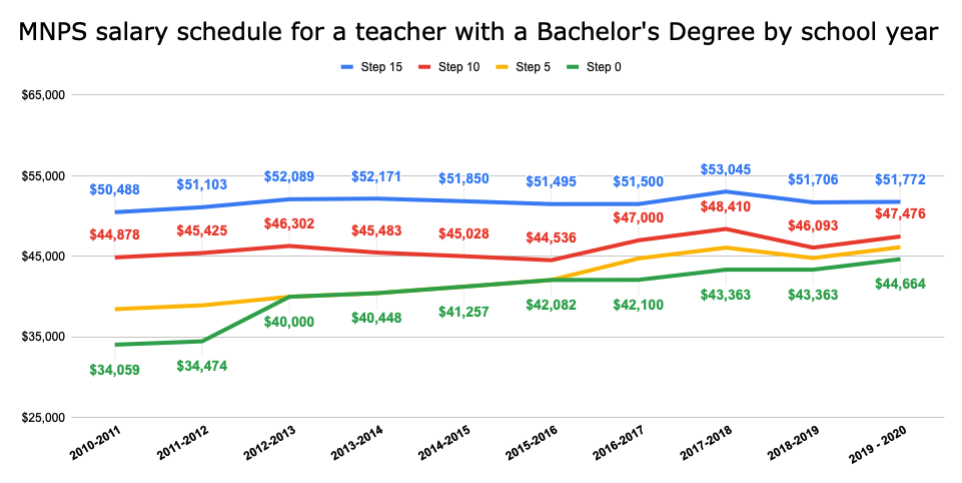
Ben Hall of NewsChannel5reports that a teacher in Metro with 15 years of experience actually earns LESS money today than a teacher with 15 years of experience earned back in 2012:
It’s hard to believe, but a Metro teacher with a Bachelor’s Degree and 15 years experience is paid less today than a teacher in that same position back in 2012. As you can see in the chart above, in 2012-2013 teachers on Step 15 made just over $52,089. Today, seven years later, Step 15 is valued at $51,772.
This chart shows the stagnation of teacher pay in MNPS
The problem of low teacher pay in Nashville is not new. In fact, in 2015, I reported on teacher pay in Nashville relative to peer districts and noted that at that time, starting pay was reasonably competitive, but pay for experienced teachers lagged behind:
Just three hours north of Nashville in a city with similar demographics and cost of living, a teacher can earn significantly better pay over a career. While a teacher in Louisville starts out making slightly less than a new Nashville teacher, by year 10, the Louisville teacher makes $9,000 more than her Nashville counterpart and by year 20, that difference stretches to $15,000. The lifetime earnings of a teacher in Louisville significantly outpace those of a teacher in Nashville.
In 2017, I updated this analysis with a comparison to Louisville:
A Nashville teacher with a bachelor’s degree and 20 years experience makes $56,000. In Louisville, that teacher makes $71,000. A teacher working in Louisville with 20 years experience earns $22,000 more a year than that city’s “comfortable living” salary. In fact, they earn more than Nashville’s “comfortable” salary.
How about the top of the pay scale? At year 25, a Nashville teacher earns $57,000. In Louisville, it’s just over $72,000.
Some may note that teachers often earn advance degrees over the course of their career and that boosts pay. That’s true. So, a teacher with a master’s degree working in Nashville earns $62,600 at the top of the scale. In Louisville, it’s $78,000.
Imagine working for 25 years in the same profession, earning an advanced degree in your field, and making $7000 less than the “comfortable living” salary for your city? That’s what’s happening in MNPS.
In short, teacher pay in Nashville has been an “area of concern” for years now. So far, little has been done to address it. Yes, the state should absolutely put forward its fair share — though Bill Lee wants that money spent on vouchers. But, Nashville has the resources to significantly boost teacher pay. That the city has chosen not to should tell you all you need to know about the priorities of those in power.
For more on education politics and policy in Tennessee, follow @TNEdReport
The Metro Nashville Education Association (MNEA) has this statement regarding the awarding of $5000 bonuses to first-year teachers in “priority schools.”
MNEA has contacted MNPS leadership with the following concerns about the recent decision to give $5000 bonuses to new teachers at priority schools:
First, we are deeply concerned that veteran educators who have chosen to work in priority schools for more than one year did not receive this compensation. The message this bonus sends is that new employees are more valuable than those with experience. In some cases, the $5000 bonus for beginning teachers means they are now earning more than teachers with more years of experience at the same school. This is deeply troubling, especially since the more experienced teachers are often charged with mentoring new teachers, which increases their workload for no additional compensation. Quite frankly, many current employees of priority schools feel this is a slap in the face.
Secondly, we strongly believe that it would be beneficial to the district to inform MNEA of any initiatives that involve changes to compensation ahead of time. Learning about this initiative from the news after it had already happened did not allow for proactive feedback at our end. We have heard from many angry employees about this issue, and we feel overall the bonuses have done more harm than good. As Dr. Majors reminded the Board of Education at last night’s meeting, the best recruiters are current employees. We want to ensure that MNEA is able to give the district feedback from an educator perspective, as we feel this will lead to better workplace morale and make recruiting educators easier.
In addition, we are also worried that this bonus was given in one lump sum at the beginning of the year. It is statistically very likely that a number of the first-year teachers who received this bonus will either leave before the year is out or will not return next year. They will take that bonus with them while at the same time veteran teachers will see nothing for their dedication to stay. In addition to making sure that all employees at priority schools are rewarded for their dedication to serving our students with the greatest needs, any bonuses should be given out at the middle and end of the year, to ensure the bonus is actually earned before it is given.
In conclusion, we have asked what steps the district will be taking to reward veteran employees who have chosen to remain at priority schools. After all, it is unlikely that priority schools will make academic progress without not only recruiting but also retaining the professional educators who are charged with doing the work of making sure that every student succeeds. These veteran educators not only have more experience and tools to teach, but they have built the lasting relationships with students and their families that are required as a foundation for academic success. It is in the best interests of our students to make sure they have equitable access to veteran employees.
For more on education politics and policy in Tennessee, follow @TNEdReport
Your support makes publishing education news possible.
Chalkbeat has the story of how 1 in 3 Tennessee teachers is seeking a way out of the profession. The data comes from the annual Tennessee Educator Survey released last week. Here’s more:
A third of Tennessee teachers say they would leave the profession for a higher-paying job and also would choose a different career if given a do-over, according to the results of a new statewide survey.
The bad news comes amidst a national teacher shortage that is definitely impacting Tennessee. In fact, Metro Nashville schools opened the year with more than 100 vacancies and a number of schools have few math teachers. Nearby Sumner County opened school with as many as 30 vacancies and has taken action — raising pay by $4000.
It’s no wonder Tennessee teachers want to leave the profession. Not only do they earn less than their peers in similar states, as Chalkbeat notes, they also earn nearly 30% less than similarly trained professionals:
This year’s results indicate a national average teacher pay gap of 23.8%. Tennessee’s gap is 27.3%. That’s an improvement of two points for Tennessee, which had a gap of 29.3% two years ago.
Of course, Bill Lee’s focus on vouchers and funding for charter schools instead of teacher pay only serves to exacerbate the problem:
So, charter schools — which serve only 3.5% of the state’s students — will see a 100% increase in available facility funding from the state while teachers will see only a 2% increase in pay.
If the two investments were equal and funded at the rate granted to charter schools, there would be a $342 million investment in teacher salaries. That’s roughly a 10% raise. A raise that’s desperately needed as Tennessee leads the nation in percentage of teachers with little to no classroom experience. We also have one of the largest teacher wage gaps in the Southeast.
Of course, teachers cite more than pay as a reason for wanting to leave the profession. Many cite the poor treatment by the state as an impetus for wanting to exit the field. For example, Kindergarten teachers have essentially been told their opinions about what’s best for kids count for nothing:
So, teachers and students will have to wait ONE MORE YEAR until the DOE actually provides an alternative model. That means your Kindergarten student will be losing instructional time and that teachers across the state will be forced to jump through meaningless hoops in order to meet a ridiculous mandate.
Does the TNDOE care? Nope. Not at all.
It’s as if Governor Bill Lee and Commissioner Penny Schwinn are joining together and singing to Tennessee teachers:
“I want you, I need you, but there ain’t no way I’m ever gonna love you…”
For more on education politics and policy in Tennessee, follow @TNEdReport
Your support – $3 or more today — helps make reporting education news possible.
The Sumner County Commission on Monday night gave approval to a new tax rate that includes necessary funding to give every teacher a $4000 raise. It’s part of a pay scale adjustment put forward by Director of Schools Del Phillips earlier this month.
The move is the first scale adjustment in Sumner County since 2014, when teachers saw an overall 3% adjustment to pay. Phillips argued the move was necessary in order to make Sumner competitive with other counties in middle Tennessee.
By a vote of 17-7, the Sumner County Commission last night approved a budget and certified tax rate. The measures included a $4000 pay raise for all teachers. If the Sumner County Board of Education approves, the raise will go into effect in January.
Based on numbers from neighboring districts, Sumner will now have one of the most competitive pay and benefits packages in the region. In fact, depending on where teachers fall on the pay scale, Sumner will be just behind Davidson County in total compensation.
The average Davidson County teacher earned a total of $59,154 when pay and benefits were combined in 2018. Sumner teachers will see a $4000 bump in pay and will still enjoy the same benefits package they have been, so the average pay and benefits package there will now be around $59,000.
The move also puts Sumner in line with Williamson and Rutherford Counties in terms of best overall compensation in the area.
For more on education politics and policy in Tennessee, follow @TNEdReport
Your support makes publishing education news possible.
As the Sumner County Commission prepares to vote tonight on setting a tax rate that would in part fund a $4000 raise for every teacher in the county, local educator Kyle Craighead explains the importance of taking this step.
My name is Kyle Craighead, and I have lived in Sumner County my entire life except for the four years I attended Lipscomb University. I am a proud graduate of Hendersonville High School and am thankful for the education I received at Lakeside Park, Hawkins, and HHS. I began teaching science at Merrol Hyde Magnet School in 2008, where I also at various points coached basketball, tennis, and served as the athletic director and as a teacher leader. From 2016-2018 I taught biology and served as a teacher leader at Gallatin High School. I am currently in my 2nd year as an assistant principal at White House High school and am in my 12th year overall in education. My wife, brother, and several cousins are educators in Sumner County. Education is a calling, and my family is 100% devoted to doing what is right by our students in Sumner County.
You will likely hear many facts and figures tonight, and I have a few of my own, but I want to first tell a story. This summer in June we were interviewing for an open teaching position, and at the end of the interview we asked the prospective teacher if he had any questions for us. He then asked, “Well I don’t know how to ask this without sounding selfish, but I looked up the pay scale in Sumner County, and it looks like to me that I would take almost a 1200 dollar pay cut if I moved over here. I know that can’t be correct, so can you explain this to me?”
How do you answer that question? Sumner is the 9th wealthiest county in TN out of 95 counties. Robertson is 21st . I’m not talking about Williamson. I’m not talking about Davidson or Rutherford. Robertson is across the street from White House Middle School…literally. White House Heritage is less than 1 mile from White House High School. Let that sink in a minute. This is not a distant competitor.
When finding prospective teachers, we pride ourselves on selling a strong student and faculty culture as well as a supportive community, and it works. Everyone wants to work where they are respected and have growth opportunities. We have accomplished this in Sumner County Schools. But as the Sumner County Community as a whole, how can a brand new teacher looking for a job out of college think that they are supported when Robertson, Davidson, Wilson, Trousdale, and Macon counties all pay first year teachers more? How many teachers overlook Sumner immediately? How many drop out of interview pools when they figure out the pay scale? How many of our top level Sumner County graduates are going to decide to teach in a different county? When you’re talking about a salary of 35,000 dollars, every bit counts.
I want to say this to all parents of Sumner County students: you, like us, want the best education for your child. There are endless studies on the biggest influence on a student’s learning, and every one of them point to the classroom teacher as the most important factor. I am a parent of a future student in our county, and I don’t just merely want good teachers. I expect it. I demand it, just like all of the rest of the parents out there.
In summary, I hope you all see that I am not clamoring for ridiculous teacher pay increases. I’m not even arguing that teachers work way more and are far more devoted that anyone outside of education understands, because although those are very true and valid points, I’m making a simpler point and it is incredibly easy to understand: Robertson, Trousdale, and Macon have a combined total of 95,000 residents. Sumner has over 160,000. Sumner routinely outperforms those other 3 counties on every measurable piece of student achievement and growth, and that’s because we have amazing teachers.
In terms of wealth, Sumner is 9th, Robertson is 21st, Trousdale is 40th, and Macon is 85th.Based on that evidence, how can Sumner continue to pay the least and expect to have the best teachers in the future?
For more on education politics and policy in Tennessee, follow @TNEdReport
Your support – $5 or more today — helps make publishing education news possible.