Unable to convince federal lawmakers to pass a voucher scheme despite the persuasive talents of Education Secretary Betsy DeVos, President Trump today issued an Executive Order calling on the Department of Health and Human Services to create a school voucher program from CARES Act funds.
Peter Greene writes about this and provides the reassuring analysis that President-elect Biden can simply reverse this Executive Order on January 20th when he becomes President Biden (yes, despite Gov. Bill Lee’s reticence to acknowledge it, Joe Biden will be the President on January 20th).
The argument in favor of this is that January 20th is coming and the administration wants their damn vouchers now, dammit. Okay, not really. The argument for this is
1) We totally identified effective measures for resuming face-to-face and we gave you $13 billion whole dollars to do it (never mind the part where we tried to divert a bunch of that to private schools)
2) Continued distance learning is bad. Here are a few statistics we found.
3) Building closures are extra hard on students with special needs, because they cut off not only education but support services. They’re not wrong on this one. Of course, another solution would be to give public schools the resources they need to fix this. In fact, that would be the solution that would make sense, since the public system already knows who and where the students are and what they need. Bringing in another batch of service providers means that they should be done with needs assessments right around June.
I’m eagerly awaiting the press release from Gov. Lee’s office enthusiastically supporting this ridiculous effort. Next, Tennesseans for Student Success will chime in to support the Gov.
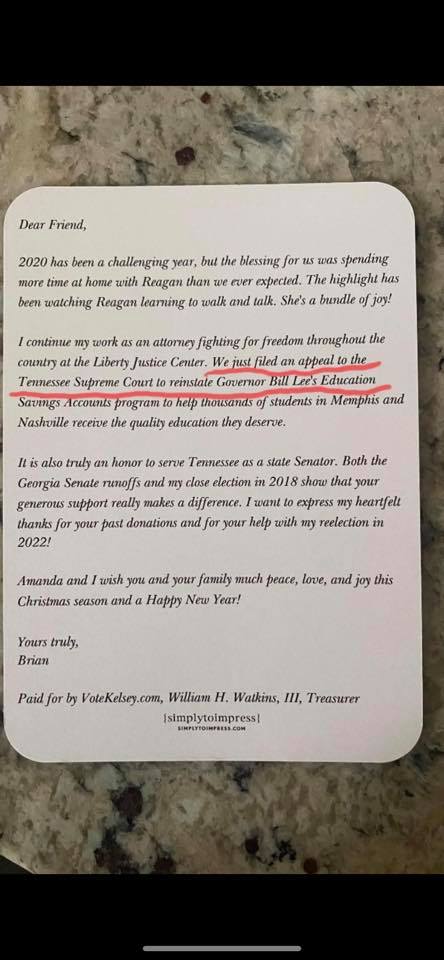
Tennessee’s “Mr. Voucher” State Senator Brian Kelsey sent Christmas greeting cards with a grinchy message about his non-stop work to privatize Tennessee’s public schools. Apparently, even the “Season of Giving” is one where Kelsey spends his time thinking about how to send taxpayer money to public school privatizers.
Here’s that fun card:
Of course, public school advocates are fighting back, asking the Supreme Court not to hear Kelsey’s appeal. It seems Kelsey’s just mad because after doing all that work to help Gov. Bill Lee pass a voucher scheme, the Tennessee courts have repeatedly held the law to be unconstitutional.
Parents Fight Back
Here’s a press release from the group Public Funds for Public Schools:
Parents of students in the Nashville and Memphis public schools, who are plaintiffs in a lawsuit challenging a state law imposing a private school voucher program on their counties, have told the Tennessee Supreme Court there is no basis to review lower court rulings striking down the voucher program as unconstitutional.
In 2019, the Tennessee legislature passed, by a one vote margin, a law to divert funding from the already under-resourced public schools in Shelby (Memphis) and Davidson (Nashville) Counties to private schools through an “education savings account” (ESA) voucher program. ESA vouchers are used to pay private school tuition and other private education expenses.
Two lawsuits were promptly filed to challenge the voucher program, one by Shelby and Davidson Counties and the second by public school parents and community members in those counties.
The plaintiffs in the second lawsuit, McEwenv. Lee, are represented by the Southern Poverty Law Center and Education Law Center, partners in the national Public Funds Public Schools campaign, as well as by the American Civil Liberties Union of Tennessee and pro bono by the law firm Robbins Geller Rudman & Dowd LLP.
In May 2020, Chancellor Anne Martin of the Davidson County Chancery Court found that the voucher law violated the home rule provision of the Tennessee Constitution, which prohibits the general assembly from passing laws applicable only to specific counties without local approval. In September, the Tennessee Court of Appeals upheld Chancellor Martin’s ruling, concluding that the trial court had applied well-established precedent in determining the voucher law violated the constitution’s home rule protections.
The defendants in the litigation, led by Governor Bill Lee and joined by pro-voucher groups, have now asked the Tennessee Supreme Court to take up the case. The McEwen plaintiffs have moved to file an amici curiae brief urging the court to reject the appeal.
The brief argues against Supreme Court review of the voucher law for three reasons:
The public interest would not be served because private school vouchers have racist origins; voucher programs increase racial segregation; research evidence demonstrates vouchers harm the education outcomes of students who use them; and vouchers drain money from underfunded public schools serving the vast majority of students.
There is no constitutional duty to fund vouchers. Establishing and funding a private school voucher program is not within the state’s power and duty under the Tennessee Constitution’s education clause and, therefore, does not implicate a state function at all.
The voucher law is not a “pilot program” and has no impact on the state’s ability to improve education through innovative or pilot programs, as long as they comply with all provisions of the constitution.
“If the voucher law had not been struck down, tens of millions of dollars would have been diverted from the budgets of the Memphis and Nashville public schools in the current year alone,” said Jessica Levin, ELC Senior Attorney and Director of the PFPS campaign. “Because the program would automatically increase in size each year for five years, it’s crucial that the lower courts’ rulings invalidating the law are not reversed.”
In this extremely challenging time there is a critical need to increase funding and resources to public schools to address the impacts of COVID-19 on students and families. In addition to the Tennessee litigation, PFPS’s work over the past year has prevented hundreds of millions of public education dollars from being diverted to private schools.
Read more about PFPS litigation here and access additional information aboutMcEwen v. Leehere.
Three Sizes Too Small?
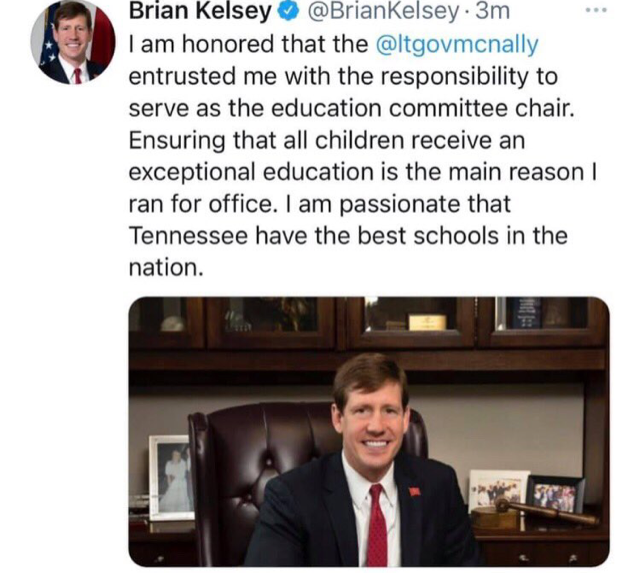
In a year that has seen a devastating pandemic and a Governor who has done nothing to lead, Kelsey simply won’t stop fighting to take from our public schools and their students. We’ve seen cuts to a planned teacher raise and a stubborn insistence on state testing. Now, Brian Kelsey wants you to think about vouchers as the Holidays approach.
Brian Kelsey Gets Ready for the Holidays
For more on education politics and policy in Tennessee, follow @TNEdReport
Your support – $5 or more – makes publishing education news possible.
A new hotline was announced today to provide emotional support to teachers struggling in light of the COVID-19 pandemic. Why are teachers struggling? Amanda Kail of MNEA has some ideas.
Here’s the full press release:
Today, the Tennessee Department of Education and the Tennessee Department of Mental Health and Substance Abuse Services (TDMHSAS), in partnership with several statewide organizations, announced the COVID-19 Emotional Support Line is now available for all Tennessee educators.
The emotional support line provides free and confidential support from specially trained volunteer mental health professionals to callers experiencing increased anxiety and stress due to the national pandemic. The COVID-19 Emotional Support Line is available to call at 888-642-7886 from 6 a.m.- 10 p.m. CT/ 7 a.m.- 11 p.m. ET daily.
“The COVID-19 pandemic has brought about significant challenges, anxiety and stressors for many, including those doing the work of educating our kids,” said Commissioner Penny Schwinn. “We are grateful to our partners at TDMHSAS for extending access to this resource to all Tennessee educators, who now can get critical supports from trained mental health professionals in a confidential setting.”
Specially trained mental health professionals answer incoming calls from the line and provide emotional support through active listening, helping callers identify and address basic needs, and informing callers about tools for managing stress and strategies for self-care.
In May, the COVID-19 Emotional Support Line was created by the Tennessee Department of Mental Health and Substance Abuse Services, along with the Mental Health Active Response Team (MHART), the Tennessee Association of Alcohol, Drug, and other Addictions Services (TAADAS), National Association of Social Workers-TN Chapter (NASW-TN), for healthcare workers and first responders who are on the front lines of the COVID-19 pandemic response.
“When we created this Emotional Support Line with our partners back in May, it was intended for those working on the front lines of the pandemic working in health care and as first responders. Due to the outpouring of support as well as capacity, we are grateful to be able to announce this expansion to offer needed support to educators across the state of Tennessee,” said TDMHSAS Commissioner Marie Williams, LCSW.
“We at MHART are so thankful to be able to be a part of facilitating the expansion of this Emotional Support Line to all teachers and educators across the state of Tennessee. The fact that 5 statewide organizations have come together in the span of just a few weeks to support this expansion is a testament to the goodwill of Tennesseans and to the desperate need for a service like this for educators who have been struggling during this pandemic now more than ever. We are committed to being there for our teachers because they are committed to being there for our kids in one of the noblest and oldest professions. The future of our state depends on their success,” said T.J. Stone, Executive Coordinator, MHART.
The COVID-19 Emotional Support Line does not offer mental health treatment and is not intended to replace mental health crisis or suicide prevention services. The TDMHSAS Statewide Crisis Line is available at 855-274-7471 or by texting “TN” to 741-741.
Learn more about the COVID-19 Emotional Support Line here.
Or, Teachers Can Just Call Bill Lee
After all, it is Gov. Bill Lee who allegedly leads our state government. A state government that is failing to adequately report data on teachers with COVID.
It is Lee who during the emergency COVID budget discussion completely eliminated a planned teacher pay raise even while declaring that teachers are essential workers.
It is Lee who insisted (and still insists) that we continue with state testing of kids even though those tests won’t be used in any so-called accountability measures.
It is Lee who continues to hire former legislators intent on privatizing public schools so he can pass a voucher scheme.
It’s Bill Lee who consistently demonstrates he’s not a fan or supporter of our public schools or their teachers. His actions are speaking. Loudly.
So, teachers, when you need some support, call Bill Lee.
Here’s that number:
615-741-2001
For more on education politics and policy in Tennessee, follow @TNEdReport
Your support – $5 or more – makes publishing education news possible.

Gov. Bill Lee just keeps adding voucher vultures to his senior leadership team. He’s already tapped former state Rep. Bill Dunn to serve as an advisor (and possible future Commissioner) in the Education Department. Now, he’s added defeated state Rep. John DeBerry to a Cabinet post paying $168,000 a year.
DeBerry is a long-time supporter of school voucher schemes who lost a re-election bid this year. His loss was attributed in part to his consistent support for “disruption” in public education.
Here’s some of what Lee had to say in a press release:
“John DeBerry is a respected leader and man of faith who has served our state with integrity for decades as both a legislator and civil rights champion,” said Gov. Lee. “John has fought to protect life, provide better education options for Tennessee students, and to reform our criminal justice system and I’m honored to have his counsel within the Cabinet.”
One thing DeBerry does not have faith in is Tennessee teachers. Anyone who has sat in a House Education Committee meeting for very long has surely heard DeBerry denigrate teachers in our state, it’s pretty much his favorite topic. When he wasn’t busy attacking teachers or public schools, he was finding new ways to work with school privatizers to send public money to private schools. Dark money groups like Tennesseans for Student Success loved candidates like John DeBerry, because he made them look bipartisan.
Now, DeBerry and Dunn will be advising Lee on ways to advance a voucher and charter agenda.
Two supporters of Gov. Bill Lee’s unconstitutional school voucher scheme are seeking seats on the Knox County School Board, CompassKnoxreports. Here’s more on the three-person race that includes two voucher supporters:
Rob Gray
Gray supports Gov. Bill Lee’s effort to introduce school vouchers into Tennessee. Lee’s Education Savings Account program, which would only operate in Nashville and Memphis, has been blocked for the moment by a court ruling. Gray said competition for public dollars from private schools would force public schools to be better.
“You’ve got to be innovative,” Gray said. “Competition just makes you develop a better product.”
Betsy Henderson
On vouchers, Henderson said, “I am for school choice. And I think that comes in many forms, whether it’s through vouchers, through charter schools. You know, my family got the choice to live anywhere in Knoxville that we wanted to. And I think that every child should have the choice of where they go to school, or the school that meets their needs.”
It appears Hannah Kirby is the only candidate running who is unequivocally a supporter of public schools.
For more on education politics and policy in Tennessee, follow @TNEdReport
Your support – $5 or more – makes publishing education news possible.

Gov. Bill Lee’s voucher scheme is unconstitutional, according to a decision by the Tennessee Court of Appeals. The Tennessean has more:
Gov. Bill Lee’s education savings account program took another hit Tuesday, with the Tennessee Court of Appeals upholding a lower court’s decision that the controversial plan is unconstitutional.
“Davidson and Shelby counties sued the State of Tennessee to challenge the constitutionality of the Tennessee Education Savings Account Pilot Program. The trial court found that both counties had standing and that the act was unconstitutional,” said Judge Andy Bennett, who delivered the court’s opinion Tuesday. “The State and intervening defendants appealed. We affirm.”
Capitol Hill observers expect Lee to present a new voucher scheme to the legislature in the 2021 session.
For more on education politics and policy in Tennessee, follow @TNEdReport
Your support – $5 or more – makes publishing education news possible.
This piece by leaders of Pastors for Tennessee Children exposes the failed agenda of school privatizers and offers a path forward that involves meaningful investment in Tennessee public schools.
When meeting with elected leaders tasked with improving education in Tennessee, we have heard a common refrain: “We have to do something.”
In response to public education challenges, our state has tried various “solutions,” almost all of which have involved privatization: vouchers, charter schools, excessive for-profit standardized testing, and expensive curriculums.
None of these options has made a sustainable difference. In fact, vouchers and charter schools have made it worse, serving to exacerbate existing inequities in school systems by draining desperately needed funding from the neighborhood schools that serve around 90% of Tennessee’s students.
Often, the real impetus behind these privatization efforts is not the well-being of children, but a desire for personal profit.
State Senate candidate Ronnie Glynn is holding incumbent Bill Powers accountable for his votes on public education in the 22nd district race. Specifically, Glynn notes in a recent tweet that Powers voted to cut funding to public schools while voting in favor of tax cuts for corporations that donated to his campaign.
It’s worth noting that Powers has a record of selling out public schools in favor of privatization. He also has an aversion to telling the truth. While campaigning for the Senate seat in 2019, Powers assured voters he would oppose private school voucher schemes. Then, less than three hours after being sworn-in, Powers voted in favor of Gov. Bill Lee’s education savings account voucher plan.
During the campaign, Powers promised he’d be against vouchers if elected. The race, decided by around 1000 votes, was relatively close. It’s possible if he’d said he supported vouchers, he would have lost the race.
While new to the body, he’s apparently not new to the art of creative deception. The very first bill Powers voted on was Governor Bill Lee’s voucher proposal. How did Powers vote? He voted YES.
For more on education politics and policy in Tennessee, follow @TNEdReport
Your support – $5 or more – makes publishing education news possible.

Gov. Bill Lee’s school voucher scheme is not only constitutionally suspect, but also the likely cause of Rep. Matthew Hill’s ouster from the legislature. WJHL has more on how Hill’s turn against public education led to his defeat in the August Republican primary.
A controversial 2002 income tax vote helped usher in the Matthew Hill era in Northeast Tennessee politics. Another controversial vote — this one over school vouchers — likely contributed to that era’s end.
“Year after year he voted ‘no’ on voucher legislation,” area public school teacher Jenee Peters said. “He voted ‘no’ every year up until he didn’t.”
“I would like to think the local area teachers were the final nail in his coffin, but there were clearly other issues that brought about the demise of his campaign,” Peters said.
Peters communicated often with Hill and said he gave teachers “a few good years” starting in 2014 after an early adversarial relationship with them. But a seeming focus on political power within the Capitol became pretty clear to people, culminating for the education community in Hill’s abandonment of his anti-voucher position.
“He wasn’t grounded in his community,” Peters said. “He was more interested in playing politics in Nashville and currying favor with the governor and making a bid for the speakership.”
A professor at Teachers College at Columbia University says interest in vouchers may be waning in part due to poor academic performance. This comes as Gov. Bill Lee’s voucher scheme was delayed by court action.
Here’s more:
The demand by parents for education vouchers and Education Saving Accounts (ESA’s) – which allow them to use government funds to pay for private school tuition — is showing signs of flagging, possibly because private schools are not subject to public regulation and thus not required to meet government standards on measures that range from testing performance to teacher accreditation to instruction for special education students.
Yet the latest studies show that academic performance among voucher and ESA students is trending lower, according to Luis Huerta, Associate Professor of Education and Public Policy. Huerta and Kevin Welner, Professor of Education at the University of Colorado Boulder School of Education and co-founding Director of the National Education Policy Center, spoke in a recent webinar about the evolution of conventional school vouchers into vouchers funded by private, tax-free donations and, most recently, into Education Savings Accounts (ESA’s).
Of course, the poor performance and waning demand haven’t stopped Tennessee’s Lamar Alexander from pushing forward legislation to siphon COVID-19 relief funds to private schools.
Huerta also said that proposals by Republican Senators Tim Scott of South Carolina and Lamar Alexander of Tennessee would siphon CARES COVID relief aid to fund private school scholarships. “But again, it’s too soon to know whether this will give private schools the advantage to open more readily compared to publics, especially since the money linked to these proposals is only in the form of portable scholarships and not infrastructure dollars.”
For more on education politics and policy in Tennessee, follow @TNEdReport
Your support – $5 or more – makes publishing education news possible.