Tucked inside this Chalkbeatstory on Hamilton County dropping its lawsuit over state funding of public schools is a note about just how inadequate the formula (the BEP) is.
In Tennessee, classroom size requirements have forced districts to hire more than 9,000 teachers beyond what the BEP provides to pay for their salaries, according to a statewide analysis presented by the Department of Education in December to the BEP Review Committee.
When looking at an average actual salary for Tennessee teachers of around $52,000, this means that local districts are responsible for $468 million in teacher salary expenses before benefits are included. That’s an unfunded mandate that easily exceeds half a billion dollars.
No one is suggesting we hire less teachers. In fact, many districts report needing additional teachers and other staff — such as nurses and counselors — to adequately serve their students.
However, this number does show that our state systematically underfunds public schools in a way not addressed by the current funding formula. It’s likely that when you combine the unfunded salary and benefits of teachers and the needs for programs like RTI2 with the proper staffing levels for nurses and counselors, you’d see a number exceeding $1 billion.
Let’s be clear: The state’s own Department of Education has provided information to the committee responsible for reviewing the state funding formula that indicates we’re at least $500 million behind where we should be in terms of current funding.
It’s also worth noting that these numbers don’t include any significant boost in pay for existing teachers.
In short: Tennessee is not properly funding schools.
For more on education politics and policy in Tennessee, follow @TNEdReport
Economic analysts are predicting a slowing of the growth that has driven the Tennessee economy in recent years, according to an article in the Tennessean. Those same analysts indicate tax revenue growth in the state over the past 10 years has been 7% when adjusted for inflation. Here’s more:
Most of Tennessee’s cities have reaped the benefits during this longest economic boom in history with double-digit jumps in employment and gross domestic product.
However, Tennessee tax collections have only increased 7% in the past decade, when adjusted for inflation.
“That’s not a lot of growth,” said William Fox, director of the Boyd Center for Business and Economic Research at the University of Tennessee, Knoxville. “Revenue growth would have been stronger, but we had a number of policy decisions to reduce revenues.”
An analysis provided by the Tennessee Education Association (TEA) indicates that average teacher pay in the state is actually down by 2.6% over the same time period when adjusted for inflation.
For the past five years Tennessee has been running huge revenue surpluses as education needs go unmet. Over this five-year span the state collected nearly $3 billion more in general fund revenue than it anticipated. Last year alone the state general fund had a $580 million surplus. These are millions that could have gone to classrooms.
Not only is Tennessee bringing in more revenue than anticipated but also, as Fox notes, the state has used that good fortune to reduce future revenue. In fact, the state of Tennessee phased-out the inheritance tax (previously paid on estates worth $5 million or more) and is phasing out the Hall Income Tax on investment income. Here’s more on that from the Department of Revenue:
The Hall income tax is being phased out through December 31, 2020. The tax is fully repealed beginning January 1, 2021. See important notice 17-09 for more information.
Some estimates indicate completely eliminating the Hall Income Tax means foregoing $180 million in state revenue each year. That’s roughly the equivalent of foregoing a 7% raise in teacher pay each year.
So, let’s be clear about a few things: 1) State lawmakers prioritized tax cuts for wealthy Tennesseans over raising pay for teachers and 2) Even with these tax cuts, there is significant money available to fund teacher raises and 3) Now that the economy is slowing a bit, legislators are being encouraged to exercise caution — which likely means less money to invest in teacher pay and other public service needs.
Shorter: Tennessee policymakers have not made investing in teachers a priority.
For more on education politics and policy in Tennessee, follow @TNEdReport
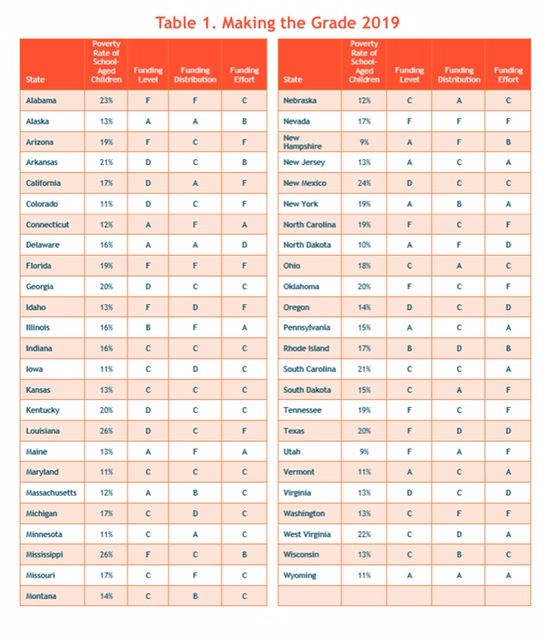
That’s the grade Tennessee gets from the Education Law Center’s latest report on school funding in the United States. To be clear, Tennessee earned an F in both funding level and funding effort. We earned a C in distribution of the paltry sum our state dedicates to schools.
Here’s how Education Law Center defines those terms:
Funding Level – the cost-adjusted, per-pupil revenue from state and local sources
Funding Distribution – the extent to which additional funds are distributed to school districts with high levels of student poverty
Funding Effort – the level of investment in K-12 public education as a percentage of state wealth (GDP) allocated to maintain and support the state school system
The report notes that Tennessee is 43rd in the nation in overall funding level and 47th in effort. The effort category is of particular interest because it indicates that Tennessee has significant room for improvement in terms of funding level. That is, there are untapped resources Tennessee is NOT using to fund schools.
Shorter: Funding schools is NOT a key policy priority in Tennessee.
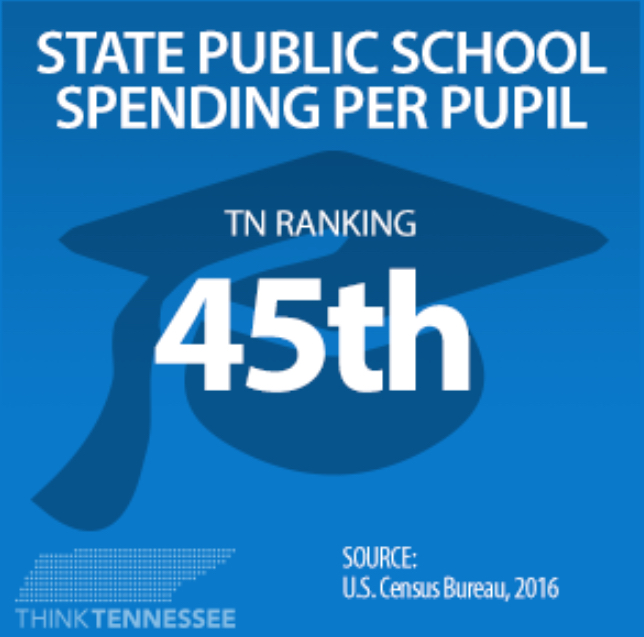
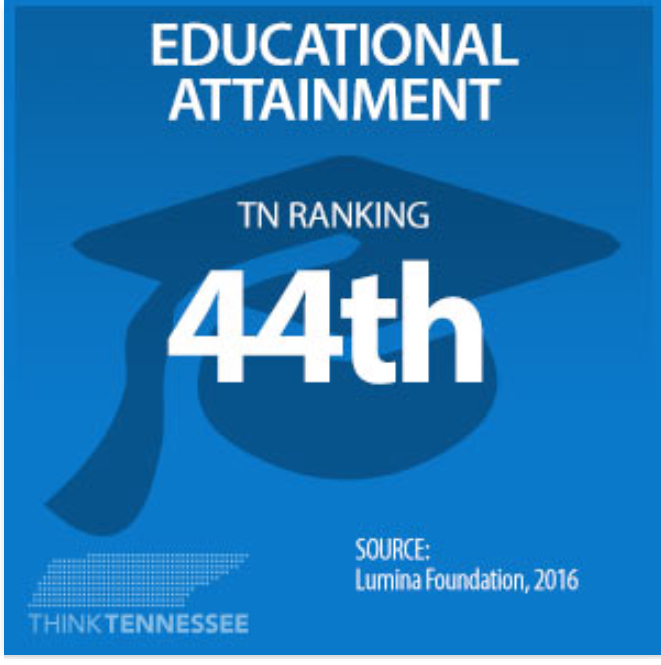
Additional evidence for this can be found in graphics shared by Think Tennessee earlier this year:
Tennessee is (and has been) at or near the bottom in school funding and even in funding effort. That’s not changing. Instead, Governor Lee and his policy acolytes are diverting education dollars to voucher schemes and charter schools.
For more on education politics and policy in Tennessee, follow @TNEdReport
This story about retailers attempting to be “good citizens” by offering discounts to teachers actually highlights two larger problems: We don’t adequately fund our schools AND we don’t pay teachers what they deserve.
We already know there’s a significant teacher pay gap across the country. That gap is particularly troubling in Tennessee — a state with a teacher pay gap above the national average. In fact, Tennessee has one of the worst teacher pay gaps in the Southeast. Teachers in Tennessee earn 27.3% less than their similarly-educated peers. Not only that, teacher pay in Tennessee is growing at a rate well below the national average:
Average teacher salaries in the United States improved by about 4% from the Haslam Promise until this year. Average teacher salaries in Tennessee improved by just under 2% over the same time period. So, since Bill Haslam promised teachers we’d be the fastest improving in teacher pay, we’ve actually been improving at a rate that’s half the national average. No, we’re not the slowest improving state in teacher pay, but we’re also not even improving at the average rate.
Then, there’s the issue of basic supplies for learning. Here’s the promotion that got the attention of the writer:
Target wants to help teachers stretch their back-to-school dollars on more than just supplies for their classrooms.
For the second year, the Minneapolis-based retailer will offer teachers a weeklong 15% discount on select items starting July 13, officials shared exclusively with USA TODAY Wednesday…
This year, in addition to school supplies and essentials, which include disinfecting wipes and food storage bags, adult clothing and accessories, Pillowfort furniture and Bullseye’s Playground items also are included.
Here’s the bottom line: School systems should just buy the damn supplies. School administrators should find out what teachers need — the basics, yes, paper, pencils, etc. And also find out what else is needed to run an excellent classroom at all levels and then forward that request to the school system.
Lots of these items could be found at reasonable prices due to bulk purchasing discounts. Moreover, it’s important to have a clear understanding of what it takes to run a classroom and a school.
Not once in the 20+ years that I’ve worked professionally have I been asked to purchase and bring in the supplies I need to do my job. But we ask that of teachers ALL THE TIME.
Stop it. As the writer says:
Stores that have “back to school” sales so parents can buy all those necessary supplies that (usually elementary) teachers post on their classrooms doors or windows? Nope. If public education is a public good, then the schools should provide the necessary supplies.
Is public education a public good in Tennessee? Our Constitution says so:
Article XI, Section 12 of the Tennessee Constitution says, “The General Assembly shall provide for the maintenance, support and eligibility standards of a system of free public schools.”
That obligation was reinforced in the 1993 Tennessee Supreme Court decision in Small Schools v. McWherter:
“The constitution imposes upon the General Assembly the obligation to maintain and support a system of free public schools that affords substantially equal educational opportunities to all students.”
Simply put, Governor Lee and the General Assembly are not living up to this obligation. According to the Comptroller of the Treasury, we under-fund schools by at least $500 million.
We routinely ask underpaid teachers to fill in the gaps when it comes to supplies. And we applaud the businesses who offer discount promotions to teachers or back-to-school sales as if they are actually doing something. If they wanted real change, those business leaders would be at school board and county commission meetings asking for the needed revenue to fund schools adequately. Then, they’d go to the General Assembly — to the very politicians their businesses bankroll – and pursue policy change that resulted in excellent teacher pay and fully-funded schools.
Too often, though, those same businesses beg the state for tax incentives — enriching themselves at public expense while true public goods like education suffer.
Our state needs leaders who will call this out — leaders not beholden to the private entities who want your tax dollars to boost their profits. Our public schools are a priority in our state Constitution. They should be a priority for our political leaders as well.
For more on education politics and policy in Tennessee, follow @TNEdReport
Your investment of $3, $5, or $7 makes reporting education news possible.
Think Tennessee is out with a digital data dashboard highlighting Tennessee’s rankings in a number of categories related to health, education, quality of life, and well-being.
I present these two numbers without further comment:
For more on education politics and policy in Tennessee, follow @TNEdReport
Teachers working for substandard wages. Students attending school in trailers because of overcrowding. A lack of school counselors, nurses, and support staff. A funding shortfall of around $1 billion.
Yes, these conditions all describe Tennessee. But the story reporting on them is about schools in our neighboring state of Virginia.
Here’s more of what’s happening next door:
Just a few miles away from the moldy trailers of McLean high school is the proposed site of on Amazon’s new headquarters in Crystal City, Virginia, right across the Potomac River from the Lincoln Memorial. The influx of new residents to northern Virginia attracted by Amazon is only likely to expand the trailer parks sitting outside of many northern Virginia schools.
While Virginia’s Democratic governor Ralph Northam is proposing to increase education funding by $269m, he has proposed to spend nearly three times as much, $750m, to lure Amazon to northern Virginia. The offer was made to secure Amazon’s “HQ2” – the tech company’s second headquarters which it split between Virginia and a second – equally controversial – site in Long Island City, New York.
Teachers are pushing back and now are going out in the first statewide teachers’ strikes in Virginia’s history.
Sound familiar?
It should.
Tennessee has consistently under-funded schools while foregoing revenue and offering huge local and state tax incentives to Amazon.
In fact, while telling teachers significant raises were “unaffordable” last year, Metro Nashville somehow found millions to lure an Amazon hub to the city. This despite a long-building crisis in teacher pay in the city. Combine a city with low pay for teachers with a state government reluctant to invest in salaries, and you have a pretty low value proposition for teachers in our state.
In fact, some teachers are openly expressing concern and highlighting our state’s failed business plan:
I’m starting a business and looking for workers. The work is intense, so the workers should be highly skilled. Experience preferred. Starting salary is 40k with the opportunity to get all the way to 65k after 25 years of staying in the same position. See how dumb that sounds?
Teachers in West Virginia, Arizona, Oklahoma, Kentucky, and Los Angeles have experienced some level of success in recent strikes. Teachers in Virginia were on strike today. These strikes have earned the support of parents and community members and have yielded tangible results both in terms of new investments in schools and increased political power for teachers.
Here in Tennessee, however, teachers have yet to strike. In fact, it’s difficult to find serious discussion of a strike. Sure, our investment in schools is less now than when Bill Haslam took over ($67 less per student in inflation-adjusted dollars). And yes, our teachers earn among the lowest salaries in the region with no significant improvement in recent years. Oh, and our own Comptroller says we’re at least $500 million short of what we need to adequately fund schools. A closer look at what the state’s BEP Committee leaves out reveals that number is very likely $1 billion.
So, when will Tennessee teachers strike?
Or, are the conditions that are unacceptable in so many places across the country just fine for our schools here in Tennessee?
If you’re a teacher and you have thoughts on striking, I’d love to hear from you: andy@tnedreport.com
For more on education politics and policy in Tennessee, follow @TNEdReport
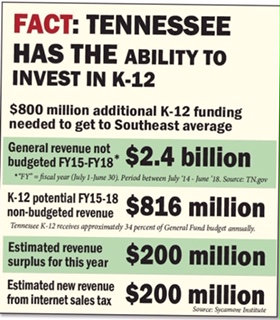
The Tennessee Education Association is out with a fact sheet on school funding. The document makes clear Tennessee can certainly afford to invest more money in schools. In fact, TEA identifies more than $800 million in revenue from budget cycles dating back to 2015 that could be invested in schools. Additionally, there’s an estimated surplus of $200 million and new internet sales tax revenue of $200 million.
The bottom line: When Gov. Lee and the legislature say we can’t afford to do more for our schools, don’t believe them.
In fact, since 2010, Tennessee has actually failed to move the needle on school funding. Specifically:
To translate, in 2010 (the year before Bill Haslam became Governor), Tennessee spent an average of $8877 per student in 2016 dollars. In 2016 (the most recent data cited), that total was $8810. So, we’re effectively spending slightly less per student now than in 2010. The graph indicates that Tennessee spending per student isn’t really growing, instead it is stagnating. Further evidence can be found in noting that in 2014, Tennessee ranked 43rd in the nation in spending per student. In 2015, that ranking dropped to 44th. 2016? Still 44th.
We’re not getting the job done. The state’s Comptroller suggests we are underfunding schools by at least $500 million a year.
The analysis of available revenue by TEA makes clear Tennessee can afford to close that gap. Unfortunately, our leaders have so far lacked the political will to make that happen. Why not invest in schools? Why not use available revenue to boost opportunity for every child in our state? Why not close the funding gap?
These are the questions Tennesseans should be asking as the 111th General Assembly begins and Bill Lee assumes office.
For more on education politics and policy in Tennessee, follow @TNEdReport
A lawsuit challenging the adequacy of the state’s school funding formula will keep moving forward despite a last-ditch effort by Gov. Bill Haslam and Tennessee Attorney General Herb Slatery to derail the effort.
A school funding lawsuit that has hung over Gov. Bill Haslam’s administration for more than three years has survived a third attempt in six months to kill it, including a “Hail Mary” legal maneuver before Tennessee’s Court of Appeals.
In the waning days before the Republican governor leaves office on Jan. 19, the appellate court denied Attorney General Herbert H. Slatery’s request to consider an appeal for dismissal.
The third strike increases the likelihood of a 2019 trial over whether the state adequately funds its K-12 schools — a question that could have far-reaching implications for Tennessee’s system of funding public education.
Despite Haslam’s claims that he’s made valiant efforts to increase school funding, a look at relevant data indicates Tennessee still has a long way to go to adequately fund schools:
To translate, in 2010 (the year before Bill Haslam became Governor), Tennessee spent an average of $8877 per student in 2016 dollars. In 2016 (the most recent data cited), that total was $8810. So, we’re effectively spending slightly less per student now than in 2010. The graph indicates that Tennessee spending per student isn’t really growing, instead it is stagnating. Further evidence can be found in noting that in 2014, Tennessee ranked 43rd in the nation in spending per student. In 2015, that ranking dropped to 44th. 2016? Still 44th
It will be interesting to see how the lawsuit proceeds and what the outcome will mean for school funding in Tennessee.
For more on education politics and policy in Tennessee, follow @tnedreport
Tennessee’s next Governor, Bill Lee, is an unabashed voucher supporter.
As the General Assembly prepares to return in January, it will be important for policymakers to focus on what gets results instead of what the new Governor thinks is the cool new thing for Tennessee schools.
Derek Black, who teaches law at the University of South Carolina and focuses on education policy issues, points out some flaws in arguments in favor of “school choice” in a recent column in Salon.
His argument is essentially that a lack of accountability in many choice programs combined with the financial strain they put on traditional K-12 schools has a devastating impact and must be re-examined:
The current debate over school funding must move beyond teacher salaries and whether the books in public schools are tattered. Those conversations ignore the systematic policies that disadvantage public schools. Increasing public school teachers’ salaries alone won’t fix the problem. The public school teaching force has already shrunk. Class sizes have already risen. And the rules that advantage charter and private schools remain firmly in place.
Long-term solutions require a reexamination of these preferences. As a state constitutional matter, the law requires that states make public education their first priority. It is not enough to make education one of several competing priorities. And as a practical matter, states cannot continue to ask public schools to work with whatever is left over and then criticize them for doing a poor job. This cycle creates a circular justification for dismantling public education when states should be repairing it.
Black’s analysis is especially relevant in a state that consistently brings up the rear in investment in education and also continues to lag behind in overall student achievement.
For more on education politics and policy in Tennessee, follow @TNEdReport
Over at the Law Professors Blog Network, Derek Black offers some insight on the importance of funding to obtaining better school discipline outcomes. Specifically, Black looks at Nashville and the positive impact a state grant had on reducing discipline referrals.
He starts by referencing some past analysis regarding funding, achievement gaps, and suspensions:
A month ago, I tried to show how school quality and school discipline are intertwined. I talked about my prior research, put up a fancy color-coded map of school funding and achievement gaps from Bruce Baker and another fancy color-coded map of school suspensions by the ACLU and UCLA Civil Rights project. A rough mashing together of these two maps showed that the funding and achievement gaps had substantial overlap with school suspensions.
Then, he turns to a pretty clear piece of evidence from Nashville:
The Tennessean reports that “[t]he increased support for students has helped almost every school see a reduction in office discipline referrals, helping keep kids in the classroom.” The first school to implement the trauma informed practices saw “the most promising results, with a 97-percent reduction in discipline referrals.” All but one of the other schools also saw impressive reductions:
Fall-Hamilton Elementary — 97 percent reduction in year one and a 53 percent reduction in year two over the previous year.
So if someone asks what money buys, it buys district and school coordinators for the program, reduced suspensions, and more time in the classroom.
The bottom line: Spending on quality programs has an impact. Money matters.
While Black notes the specific impact of the grant-funded program at select Nashville schools, it’s worth noting that Tennessee fails to adequately fund school counselors, school nurses, and trained interventionists (though a small RTI component was just added to the state’s funding formula). While education experts have noted the shortcomings, little has been done to actually make improving funding a priority. In fact, Tennessee has remained relatively stagnant in terms of funding in recent years.
Tennessee policymakers have been told what works and now have a very clear example of an intervention that gets results. So far, they’ve not been willing to act on this knowledge.
For more on education politics and policy in Tennessee, follow @TNEdReport
Your investment helps make education reporting sustainable.