Revenue Up, Teacher Pay Down

Economic analysts are predicting a slowing of the growth that has driven the Tennessee economy in recent years, according to an article in the Tennessean. Those same analysts indicate tax revenue growth in the state over the past 10 years has been 7% when adjusted for inflation. Here’s more:

Most of Tennessee’s cities have reaped the benefits during this longest economic boom in history with double-digit jumps in employment and gross domestic product. 

However, Tennessee tax collections have only increased 7% in the past decade, when adjusted for inflation. 

“That’s not a lot of growth,” said William Fox, director of the Boyd Center for Business and Economic Research at the University of Tennessee, Knoxville. “Revenue growth would have been stronger, but we had a number of policy decisions to reduce revenues.”

An analysis provided by the Tennessee Education Association (TEA) indicates that average teacher pay in the state is actually down by 2.6% over the same time period when adjusted for inflation.

TEA also notes:

For the past five years Tennessee has been running huge revenue surpluses as education needs go unmet. Over this five-year span the state collected nearly $3 billion more in general fund revenue than it anticipated. Last year alone the state general fund had a $580 million surplus. These are millions that could have gone to classrooms. 

Not only is Tennessee bringing in more revenue than anticipated but also, as Fox notes, the state has used that good fortune to reduce future revenue. In fact, the state of Tennessee phased-out the inheritance tax (previously paid on estates worth $5 million or more) and is phasing out the Hall Income Tax on investment income. Here’s more on that from the Department of Revenue:

The Hall income tax is being phased out through December 31, 2020.  The tax is fully repealed beginning January 1, 2021.  See important notice 17-09 for more information.

Some estimates indicate completely eliminating the Hall Income Tax means foregoing $180 million in state revenue each year. That’s roughly the equivalent of foregoing a 7% raise in teacher pay each year.

So, let’s be clear about a few things: 1) State lawmakers prioritized tax cuts for wealthy Tennesseans over raising pay for teachers and 2) Even with these tax cuts, there is significant money available to fund teacher raises and 3) Now that the economy is slowing a bit, legislators are being encouraged to exercise caution — which likely means less money to invest in teacher pay and other public service needs.

Shorter: Tennessee policymakers have not made investing in teachers a priority.

For more on education politics and policy in Tennessee, follow @TNEdReport

Your support$5 or more today — makes publishing education news possible.



Nothing to Win, Nothing Left to Lose

Nashville can’t live without its teachers, but it seems the city’s leaders can’t live with the idea of actually paying them. While the need to improve pay for teachers has been clear for years, Mayor Cooper recently announced yet another study to determine what can be done with teacher pay. Now, Nashville finds itself in a budget crisis, short the money needed to meet this year’s obligations. That crisis has caused some to question whether the funds for a promised mid-year teacher raise will actually be available.

Metro Nashville Public Schools teachers union leaders are worried that an anticipated 3% raise for educators in January may be in danger after comments from Mayor John Cooper’s administration Friday evening. 

The concern was exacerbated by a weak statement from Mayor Cooper’s office:


“In light of the Comptroller’s report this week, we are doing everything possible to make the raise happen. The finance director is working with MNPS to determine the sources of funds.”

Additionally, at-large Metro Councilman Bob Mendes took to Twitter this weekend to explain how the promised raise came about and indicate a bit of a conflict in terms of whether it should be given:

Here’s the bottom line: Metro Nashville has been giving tax breaks to developers and companies like Amazon for years now. These tax giveaways mean new revenue from growth is already spent. Simultaneously, Nashville has been ignoring the looming crisis in teacher compensation. Now, those two trains are colliding.

The next question: If there’s no raise for teachers in January, will there be teachers in classrooms in January?

Nashville has teachers with nothing to win and now nothing left to lose.

For more on education politics and policy in Tennessee, follow @TNEdReport

Your support$5 or more today — makes publishing education news possible.


MNEA Statement on Teacher Raises

In light of recent concerns regarding the financial health of Metro Nashville, the Metro Nashville Education Association (MNEA) put out this statement regarding the planned teacher raises scheduled to take effect in January. It’s worth noting the uncertainty regarding the funds for teacher pay comes at a time when teachers in Nashville are already paid at a rate well below the cost of living.

In MNEA’s first meeting with MNPS leadership after school began in August, and other subsequent meetings, Vice President Michele Sheriff and President Amanda Kail inquired about the status of Briley’s promised 3% raise for teachers in January. After speaking to Mayor Cooper’s office, MNPS leadership assured MNEA the raises were indeed going to occur. No additional monies were required because the necessary funds already existed in the MNPS budget as a TIF (tax increment financing) expenditure that was renegotiated for this year.

With the recent release of the state comptroller’s report that shows Metro Finances short $200-300 million, MNEA reached out to MNPS leadership to confirm the raises are not in jeopardy. MNPS leadership has in turn been waiting for a response from the Mayor to confirm. After MNPS received no response, MNEA contacted Mayor Cooper’s office and this afternoon received this statement:

“In light of the Comptroller’s report this week, we are doing everything possible to make the raise happen. The finance director is working with MNPS to determine the sources of funds.”

While there is no evidence to suggest the funds will not be available, we look forward to a confirmation from Mayor Cooper of the promised 3% raise in January and on which paycheck teachers should expect it to begin.

For more on education politics and policy in Tennessee, follow @TNEdReport

Your support$5 or more today — makes publishing education news possible.

Teachers Organize for Pay Boost in Hamilton County

Teachers in Hamilton County are seeing a strong outpouring of community support ahead of a planned town hall meeting do discuss teacher compensation, according to a story in the Chattanooga Times-Free Press:

Hundreds of teachers and supporters of public education are continuing to organize ahead of a Sunday town hall aimed at discussing teacher compensation and how to fund public education in Hamilton County.

Since a group of Hamilton County Schools teachers, now called Hamilton County United, released an open letter on Oct. 20 calling out five county commissioners for voting against increased funding for public education, hundreds more have signed on.

The move comes as teachers in Hamilton are highlighting both low pay and a significant amount of uncompensated time and out-of-pocket expenses:

“If those averages apply to the entire county, we’ve got about $2.5 million in uncompensated time and expenses that we’ve given,” said Brock.

The teacher pay crisis in Hamilton County comes as districts across Tennessee struggle to attract and retain teachers. Shelby County has explored a significant pay raise and Nashville’s school board recently heard a proposal about boosting pay.

For more on education politics and policy in Tennessee, follow @TNEdReport

Your support$5 or more today — makes publishing education news possible.
Math Problem

Hamilton County has a problem. It’s a problem that plagues school districts across Tennessee. It’s simple: Teacher compensation isn’t what it should be. NewsChannel9 has the story of a group of teachers collecting data to demonstrate the dollar value of uncompensated time and expenses:

Dozens of Hamilton County teachers say they’ve done the math, and what they’re making versus what they’re spending on school doesn’t add up.


“If those averages apply to the entire county, we’ve got about $2.5 million in uncompensated time and expenses that we’ve given,” said Brock.

This shortfall is occuring in a state where teachers earn about 30% less than similarly-trained professionals:

This year’s results indicate a national average teacher pay gap of 23.8%. Tennessee’s gap is 27.3%. That’s an improvement of two points for Tennessee, which had a gap of 29.3% two years ago.


Of 12 Southeastern states, Tennessee ranks 8th in teacher pay gap — that’s up one place from 9th two years ago.

The teacher compensation crisis in Hamilton County is similar to what’s playing out all across a state that has historically not invested in teachers. In fact, this year, Governor Lee made a big investment in charter schools and a relatively small boost to teacher compensation through the BEP. Additionally, Lee is fast-tracking his expensive voucher scheme, using funds that could be used to invest in public schools and teacher pay.

Will the Hamilton County legislative delegation continue to support a Governor whose policies are leaving teachers and public schools behind?

For more on education politics and policy in Tennessee, follow @TNEdReport

Your support$5 or more today — helps make publishing education news possible.
Necessary

It looks like Nashville is finally getting serious about addressing their woefully inadequate teacher pay. Or, at least they are talking about it. The Tennessean reports that the Metro Nashville school board is taking up the issue of pay for teachers and all system staff.

Boosting the salaries of Nashville teachers to match the city’s median income would cost more than $100 million a year. 

Although just an example detailed in a pay study released by Metro Nashville Public Schools on Friday, it represents the high figure the district would need to fix a pay system educators say is flawed and causing teachers to leave.


For example, Majors presented a possible scenario in which the district would pay mid-career teachers about $64,000 a year — comparable to Nashville’s median income. The increase in salary for all teachers of all experience levels would mean an annual infusion of $100 million to fix the district’s pay schedule.

The discussion on teacher pay in MNPS is long overdue. Also long overdue: Actual action by the School Board and Metro Council to increase pay.

It’s been clear for some time now that teacher pay in Nashville is a crisis:

Attracting and retaining teachers will become increasingly more difficult if MNPS doesn’t do more to address the inadequacy of it’s salaries. The system was not paying competitively relative to its peers two years ago, and Nashville’s rapid growth has come with a rising cost of living. Does Nashville value it’s teachers enough to pay them a comfortable salary? Or, will Nashville let cities like Louisville continue to best them in teacher compensation?

That was written in 2017. The story notes a 2015 analysis of teacher pay in Nashville. That analysis found Nashville significantly behind similar urban districts in pay. The MNPS board and Metro Council did basically nothing with that information. We’ve seen Mayors Dean, Barry, and Briley barely touch the issue. We’ve yet to see Mayor Cooper talk about a plan to boost pay in a meaningful way.

IF the issue gets addressed in the upcoming budget cycle, it will be August of 2020 before Nashville teachers see a meaningful boost in their paychecks. That’s five years after teacher pay in Nashville was reported to be at near crisis levels. It’s after allowing things like this to happen:

Hundreds of parents with children in Metro Nashville Public Schools had letters sent home this week telling them that their kids were having to take online courses in the classroom due to a teacher shortage.

It’s after school districts like Williamson County have made consistent improvements to salary and districts like Sumner County have approved a big pay bump.

It’s great to see the district finally take a look at a problem they’ve known about for years. It’s absolutely necessary that instead of just talking about it, the School Board, Council, and Mayor actually do something.

For more on education politics and policy in Tennessee, follow @TNEdReport

Your support$5 or more today — helps make publishing education news possible.
18%

Groups representing teachers in Memphis are seeking a salary increase of up to 18%, according to a story in Chalkbeat:


Shelby County Schools teachers would be able to earn up to $86,000 annually under the highest of three proposals from the district’s two teacher associations.

That would be 18% more than the current maximum salary of $73,000.
The associations want up to a 16% boost to the district’s $43,000 minimum salary for new teachers. But Cheronda Thompson, who represented United Education Association of Shelby County, said increasing the maximum is more important.
“It’s not about how we start, it’s about how we finish,” she said during negotiations Friday afternoon. “We want to retain people. They already start good.”

The move comes as districts like Nashville struggle with teacher retention and pay significantly less than other urban districts. Additionally, suburban districts like Sumner County have moved to make meaningful improvements to teacher pay.

Teacher pay is a national crisis, but particularly problematic in Tennessee, as Chalkbeat notes:

Research shows that teachers make the most difference in a student’s academic success, but districts nationwide are struggling to recruit and retain effective educators. An often cited reason is salary, especially in states like Tennessee where the average teacher salary trails both regional and national numbers.

It’s worth noting that Governor Bill Lee has done nothing to address the teacher pay crisis, and in fact has worked to divert funds to voucher schemes and charter schools.

For more on education politics and policy in Tennessee, follow @TNEdReport

Your support$5 or more today — helps make publishing education news possible.
Lists

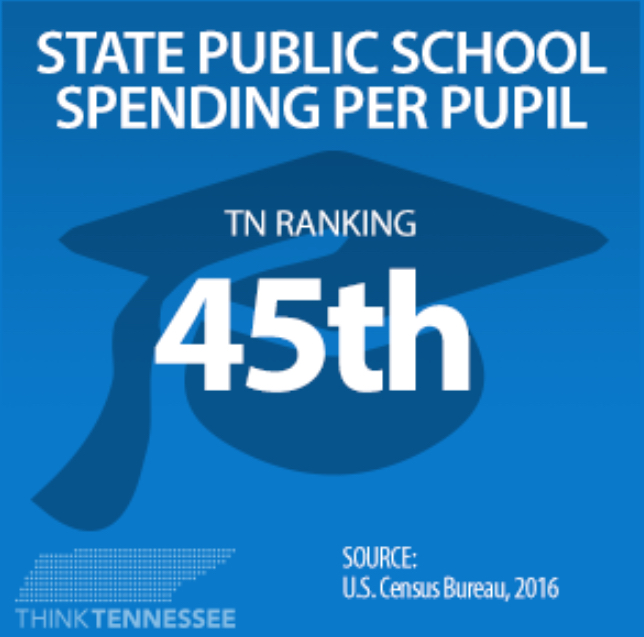
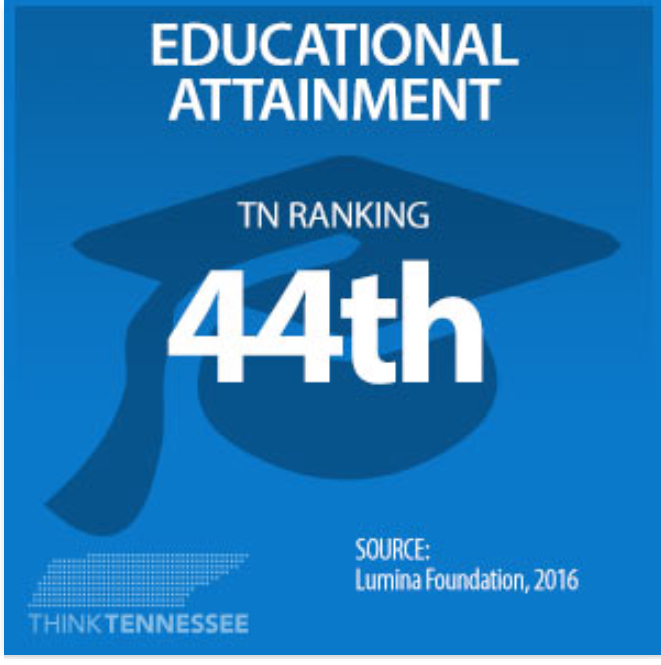
Tennessee is making some lists in the education world, and where we fall is disappointing, if not surprising. While Tennessee is among the states with the lowest investment in public schools, we are also one of the worst states to be a teacher. Here’s more from HeyTutor and Business Insider:

Tennessee is near the bottom in investment in public schools, according to data published here:

Tennessee

  • Total spending per student: $9,184
  • Instructional spending per student: $5,584
  • Support services spending per student: $3,090
  • Total spending: $9.27 billion
  • Average teacher salary: $48,456
  • Graduation rate: 89.8%
  • Academic performance: Below average

Tennessee is also one of the worst places in the country to be a teacher, according to Business Insider:

Tennessee: One-third of teachers in the state would leave the profession for something with higher pay, a 2019 survey found.

And, here’s a friendly reminder:

For more on education politics and policy in Tennessee, follow @TNEdReport

Your support helps make publishing education news possible.

Wrong Direction

Even as neighboring districts like Sumner County move to significantly increase teacher pay, teachers in Metro Nashville find their salaries stagnating.

Ben Hall of NewsChannel5 reports that a teacher in Metro with 15 years of experience actually earns LESS money today than a teacher with 15 years of experience earned back in 2012:


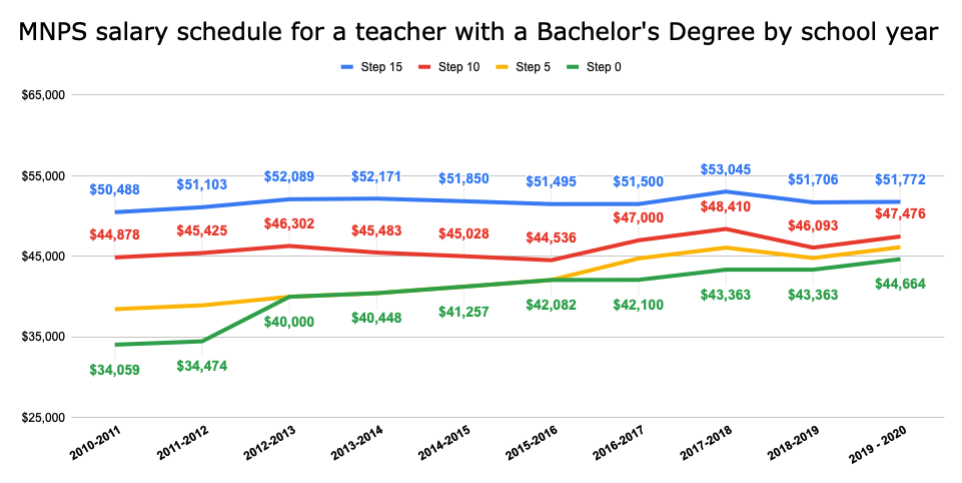
It’s hard to believe, but a Metro teacher with a Bachelor’s Degree and 15 years experience is paid less today than a teacher in that same position back in 2012. As you can see in the chart above, in 2012-2013 teachers on Step 15 made just over $52,089. Today, seven years later, Step 15 is valued at $51,772.

This chart shows the stagnation of teacher pay in MNPS

The problem of low teacher pay in Nashville is not new. In fact, in 2015, I reported on teacher pay in Nashville relative to peer districts and noted that at that time, starting pay was reasonably competitive, but pay for experienced teachers lagged behind:

Just three hours north of Nashville in a city with similar demographics and cost of living, a teacher can earn significantly better pay over a career. While a teacher in Louisville starts out making slightly less than a new Nashville teacher, by year 10, the Louisville teacher makes $9,000 more than her Nashville counterpart and by year 20, that difference stretches to $15,000. The lifetime earnings of a teacher in Louisville significantly outpace those of a teacher in Nashville.

In 2017, I updated this analysis with a comparison to Louisville:


A Nashville teacher with a bachelor’s degree and 20 years experience makes $56,000. In Louisville, that teacher makes $71,000. A teacher working in Louisville with 20 years experience earns $22,000 more a year than that city’s “comfortable living” salary. In fact, they earn more than Nashville’s “comfortable” salary.


How about the top of the pay scale? At year 25, a Nashville teacher earns $57,000. In Louisville, it’s just over $72,000.


Some may note that teachers often earn advance degrees over the course of their career and that boosts pay. That’s true. So, a teacher with a master’s degree working in Nashville earns $62,600 at the top of the scale. In Louisville, it’s $78,000.


Imagine working for 25 years in the same profession, earning an advanced degree in your field, and making $7000 less than the “comfortable living” salary for your city? That’s what’s happening in MNPS.

In short, teacher pay in Nashville has been an “area of concern” for years now. So far, little has been done to address it. Yes, the state should absolutely put forward its fair share — though Bill Lee wants that money spent on vouchers. But, Nashville has the resources to significantly boost teacher pay. That the city has chosen not to should tell you all you need to know about the priorities of those in power.

For more on education politics and policy in Tennessee, follow @TNEdReport

Your support$3 or more today — helps make reporting education news possible.


Bonus Statement

The Metro Nashville Education Association (MNEA) has this statement regarding the awarding of $5000 bonuses to first-year teachers in “priority schools.”


MNEA has contacted MNPS leadership with the following concerns about the recent decision to give $5000 bonuses to new teachers at priority schools:


First, we are deeply concerned that veteran educators who have chosen to work in priority schools for more than one year did not receive this compensation. The message this bonus sends is that new employees are more valuable than those with experience. In some cases, the $5000 bonus for beginning teachers means they are now earning more than teachers with more years of experience at the same school. This is deeply troubling, especially since the more experienced teachers are often charged with mentoring new teachers, which increases their workload for no additional compensation. Quite frankly, many current employees of priority schools feel this is a slap in the face.


Secondly, we strongly believe that it would be beneficial to the district to inform MNEA of any initiatives that involve changes to compensation ahead of time. Learning about this initiative from the news after it had already happened did not allow for proactive feedback at our end. We have heard from many angry employees about this issue, and we feel overall the bonuses have done more harm than good. As Dr. Majors reminded the Board of Education at last night’s meeting, the best recruiters are current employees. We want to ensure that MNEA is able to give the district feedback from an educator perspective, as we feel this will lead to better workplace morale and make recruiting educators easier.


In addition, we are also worried that this bonus was given in one lump sum at the beginning of the year. It is statistically very likely that a number of the first-year teachers who received this bonus will either leave before the year is out or will not return next year. They will take that bonus with them while at the same time veteran teachers will see nothing for their dedication to stay. In addition to making sure that all employees at priority schools are rewarded for their dedication to serving our students with the greatest needs, any bonuses should be given out at the middle and end of the year, to ensure the bonus is actually earned before it is given.


In conclusion, we have asked what steps the district will be taking to reward veteran employees who have chosen to remain at priority schools. After all, it is unlikely that priority schools will make academic progress without not only recruiting but also retaining the professional educators who are charged with doing the work of making sure that every student succeeds. These veteran educators not only have more experience and tools to teach, but they have built the lasting relationships with students and their families that are required as a foundation for academic success. It is in the best interests of our students to make sure they have equitable access to veteran employees.

For more on education politics and policy in Tennessee, follow @TNEdReport

Your support makes publishing education news possible.