Jarred Amato’s Reading and Teaching Journey

This is a guest post by Jarred Amato, a high school English teacher with Metro Nashville Public Schools. Amato has served as a SCORE, Hope Street Group, and America Achieves educator fellow, as well as a member of the Metro Schools Teacher Cabinet. In 2015, Amato participated in the district’s Teacher Leadership Institute, and was named a Blue Ribbon Teacher and Teacher of the Year for his school.

The original post is here and you can follow him on twitter @jarredamato.

Growing up, I moved a lot. First, it was from Rhode Island to Massachusetts in the middle of Kindergarten. Then, it was off to Vernon Street in first grade and Austin Street in third before settling in on Jasset Street in fourth.

Despite the constant transition, I always felt at home with books.

The first book I remember reading on my own was Bears on Wheels by Stan and Jan Berenstain. I couldn’t tell you what it was about, or exactly how old I was when I read it, but I’ll never forget the sense of pride and accomplishment I felt when I finished it.

From that moment forward, I was hooked. From the Boxcar Children and Hardy Boys to everything by RL Stine and Matt Christopher, I devoured one book after another. With no smart phone or computer to distract me, most of my early childhood was spent either on a field or court, or curled up somewhere with a book, newspaper, or magazine.

Sundays were always my favorite because it was my mom’s day off from work. She would usually grab breakfast from Dunkin Donuts along with a copy of the Boston Globe, and I would spend the rest of the morning pouring through the sports section, reading every article and memorizing the league leaders in batting average, home runs, and RBIs.

During the summer, we would pack a cooler and make the hour drive to the beach, where I’d lay on the blanket with a book mom had recommended, stopping only for some body surfing, whiffle ball or a trip to the ice cream truck.

I also have fond memories of the public library, where I’d walk down one aisle after another in search of books to add to my stack before finding a cozy spot to hide for the day, and the local Barnes and Noble, where instead of buying a book, I’d take it off the shelf and read it in the store before putting it back.

Sometimes I wonder: Why did I read so much?

Maybe it was because books took me places, real and imaginary, that I knew I’d never be able to visit in person. Maybe it was because I found characters that I could root for and identify with. Maybe it was because reading helped me relax when I was upset, and allowed me to escape without actually running away (although I tried that too, but never for more than a few hours).

Maybe it was because reading was something that my mom and I could do together. Maybe it was because it helped me realize that I wasn’t alone, and that my problems weren’t so bad after all. Maybe it was because I saw books as the great equalizer. Maybe it was just because I was bored, and didn’t have anything better to do.

But, I think that the main reason I loved reading was that it made me feel smart. And as someone who grew up in a neighborhood where most kids didn’t go to college, that mattered a great deal to me.

It’s no surprise, then, that I always loved school. Yes, I was that kid who enjoyed homework and cried if I didn’t earn all “S+”s or “As” on my report card. As I look back on my elementary experience, a few things stand out:

One was that I had some pretty amazing teachers, who not only believed in me, but were also experts in their craft. Two, my teachers never told me my reading level or assigned me a test-prep worksheet, but because I read all the time and received great instruction from them day in and day out, I always breezed through the MCAS, Massachusetts’ standardized test. Three, reading and writing were always linked.

For example, I remember publishing my first book in third grade. In fact, I can still recall one of the lines (“I jumped as high as a kangaroo”) because Mrs. Madsen was so proud that I had used a simile. The fact that my teacher believed that a scrawny eight-year-old with a bowl cut could be a serious author, I started to believe it, too.

One more thing I appreciated about elementary school: we always had choice. Sure, teachers made recommendations, and I participated in lit groups with classics such as Mr. Popper’s Penguins, Shiloh, Tuck Everlasting, and Mrs. Frisby and the Rats of NIMH, but for the most part, I read what I wanted to read. And I loved it.

That changed in middle school, and certainly in high school. To be sure, there are many books I’m thankful my teachers made me read: To Kill a Mockingbird, Night, Of Mice and Men, Their Eyes Were Watching God, Catcher in the Rye, A Separate Peace, The House on Mango Street, and The Great Gatsby, to name a few.

But, I’m also certain that I would have read more often, and enjoyed reading more, if I was given choice. Instead, as my schedule became busier – sports practice, homework, TRL, and the emergence of AOL Instant Messenger — I learned how to BS my way through English class. With the help of Sparknotes, I was able to write killer essays on symbolism in The Scarlet Letter and the role of women in The Odyssey without ever opening the books.

While my love of reading faded in high school, Mrs. Smith’s Journalism 101 class inspired me to keep writing. As an athlete, I appreciated Mrs. Smith’s no-nonsense approach and tough love; she had extremely high expectations and had no problem letting you know when you failed to reach them.

It was under her wing, as a member of the school newspaper staff, that I learned how to write a lead, conduct interviews, take notes, check facts, and meet deadlines. I’m still convinced that the college essay I wrote – about balancing my time as sports editor and student-athlete, while trying to give back to my mom, who had sacrificed everything to raise my brother and me – was the main reason I got into Vanderbilt University.

In college, I quickly realized that I was much better at reading and writing essays than I was at memorizing formulas in Calculus (I think my only “F” ever) and Econ. However, it wasn’t until I read Jonathan Kozol’s Savage Inequalities in a course on educational inequity in America that I knew I wanted to become a teacher.

Upon graduation, I said “yes” to the first school that offered me a job and haven’t looked back since. As a middle school – and now high school – English teacher, I have had the privilege of falling in love with reading all over again. Even more rewarding is the opportunity to share that love and passion for reading with my students.

I know what the research says: that today’s teens are texting and snapchatting more, and reading less. There is no question that reading faces more competition than at any point in history.

But, in many ways, that’s what makes my job so fun, and so fulfilling. The competitor in me revels in the opportunity to prove to students that reading can, in fact, be more enjoyable than Instagram or YouTube.

The fact that there are so many phenomenal Young Adult authors out there writing books that have a way of affecting all students (and adults) certainly makes my job of creating confident and capable lifelong readers easier.

I’d have a much harder time selling students on the joy and value of reading if I forced all of them to read the same book at the same pace, regardless of their interests or ability level. But, by introducing them to novels by the likes of Kwame Alexander, Sherman Alexie, Kiera Cass, Suzanne Collins, Walter Dean Myers, Matt de la Pena, Sharon Draper, John Green, Khaled Hosseini, Marie Lu, Rick Riordan, J.K. Rowling, Veronica Roth, Rainbow Rowell, Gary Schmidt, Paul Volponi, Jacqueline Woodson, and Markus Zusak, I’ve got a chance.

Offering my students choice in what they read is only one piece of the puzzle. I must give them consistent time to read in a calm and comfortable environment. It’s also my responsibility to provide my students with the same love, support and encouragement that my mother and my teachers gave me.

This year, I got a bit emotional when one of my ninth-graders, beaming ear to ear, revealed to me that he had just finished a chapter book on his own for the first time. I could see in him that same sense of pride and accomplishment that I felt reading Bears on Wheels twenty-something years ago.

And I knew, from that moment forward, he was hooked.

For more on education policy and politics in Tennessee, follow @TNEdReport.


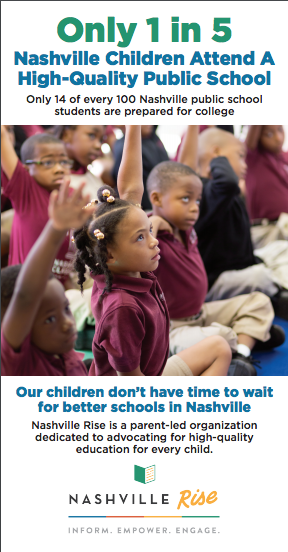
Nashville Rise Fights Back

Wendy Tucker of Project Renaissance, which oversees Nashville Rise, is in the Tennessean disputing the lies made from a handful of school board members. Wendy Tucker does a great job at laying down the facts around Nashville Rise and Project Renaissance.

Like I have previously written about, Tucker first discusses that one of Will Pinkston’s demands was a list of schools that the parents of Nashville Rise send their kids.

We sincerely hope Mr. Pinkston is interested in the needs of all children in his district and across Nashville, not just of those who attend schools he condones.

She then delves into the fighting back the lies that have been spread.

Hasn’t Project Renaissance/Nashville Rise hidden their funding from everyone? Not true.

When reporters asked for our Schedule of Contributors, we provided it immediately. When The Tennessean asked for our tax return, we provided that immediately as well.

Isn’t Project Renaissance funded by the Eli Broad Foundation? Not true.

Mr. Pinkston and school board member Amy Frogge have attacked the Eli Broad Foundation and continue to insist that they are funding our work. We have never requested or received funding from the Broad Foundation.

What about the allegations Project Renaissance recruited Amy Frogge’s opponent? Not true.

We have also been accused of political activity, including a claim by Ms. Frogge on her public Facebook page that we recruited her opponent. As a 501(c)(3) nonprofit, Project Renaissance has not engaged in any political activity, including recruiting candidates or participating in political campaigns, and our organization is not endorsing or advancing the cause of any candidates in this or any election.

Doesn’t Project Renaissance support vouchers and employ lobbyists? Not true.

We are not supporting vouchers. We do not employ a lobbyist and do not engage in any lobbying at the state legislature.

Sitting school board members are to blame for this false spread of information. It’s sad that our elected officials would rather spread lies than discuss education with Nashville’s parents.

Public officials should be mindful of the irreparable harm that false accusations cause. While lively debate is a reality in the education arena, defamation takes things too far.

Wendy Tucker again extends the invitation to the forum to Pinkston, Frogge, and Jill Speering.

Are these school board members too afraid to talk to a group of diverse parents? It looks that way so far.


Payday Loans for Charter Schools

Earlier today, I reported on the links between Nashville’s Project Renaissance/Nashville RISE and national groups promoting corporate education reform. Specifically, I noted Renaissance’s membership in Education Cities and the similarities between what’s happening in Nashville and what’s happening in other “Education Cities” like Indianapolis.

It’s important to also examine what’s happening in Indianapolis — a district following the Education Cities playbook — in order to see if that’s what we’d like to have happen in Nashville.

First, the charter schools in Indy aren’t doing so well. It may be because, as former TN ASD Superintendent Chris Barbic once said:

“As a charter school founder, I did my fair share of chest pounding over great results,” he wrote. “I’ve learned that getting these same results in a zoned neighborhood school environment is much harder.”

Chalkbeat’s Scott Elliott reported in April of this year on the struggles faced by charters in IPS:

Many Indiana schools saw rock-bottom passing rates on last year’s tougher ISTEP exam but in a city where public and charter schools compete for students, it’s worth noting that a majority of charter schools in the city had passing rates below the district’s average.

And that’s not a new phenomenon:

But of the 18 charter schools operating this year (2014-15) in the city that took ISTEP last year, about half fell below the Indianapolis Public Schools districtwide average of 51.6 percent passing.

These results may not be surprising, but they certainly don’t point to an Education Cities success story.

Here’s something else that’s interesting. Charter advocates have built clout in the Indiana legislature and used it create a charter school cash advance program — a payday loan of sorts, but with far better interest rates.

Chelsea Schneider in the Indianapolis Star reported on the plan:

The Indiana State Board of Education on Wednesday endorsed a plan to divvy out as much as $40 million in loans in the 2015-16 school year through a controversial new state program to fund charter schools.

Here’s how it works:

The per-student limit means a charter school could receive a maximum advance of $1,836 per student from their state tuition support, according to information shared by board staff. That could lead to some schools receiving less than what they requested. Two schools are seeking approximately $45,000 per student.

Under the program, eligible charter schools can request a maximum of $5 million. Interest rates on the loans are set at 1 percent.

That’s a pretty friendly interest rate provided to schools that may or may not get results.

The point is, it’s not clear from Indy’s example that theirs is a model Nashville should follow — even though Nashville’s ed reform advocates are using the same playbook used in “Education Cities” around the country.

For more on education politics and policy in Tennessee, follow @TNEdReport


Cameron: From Lowest Performing to Reward School

Chris Reynolds, the CEO of LEAD Public Schools, is out with an editorial in the Tennessean. The editorial discusses how Cameron has been transformed from the lowest preforming school in the state with declining enrollment to a reward school for growth and a 20% growth in enrollment.

Cameron was a Black high school in Nashville during segregation and graduated many of the Black leaders in Nashville. Thanks to the amazing partnership with MNPS, the Cameron facility just held it’s first graduation in 40 years! Every person in the graduating class was accepted to a four year college. That’s a great way to continue the legacy of Cameron.

Here’s a small portion of the editorial:

In just five years, Cameron has been transformed, and we have learned a great deal about what it takes to engineer such a successful turnaround. We have learned that our vision of success for all students works. Cameron serves a high number of students with special needs, extraordinarily high numbers of English language learners, and accepts all students at all times of the year, just like any other school does. No one is turned away, yet our expectations remain high. Cameron (like three other LEAD campuses) has now become a top 5 percent Reward School for growth. In addition, the transformation has brought nearly 20 percent more enrollment back to the neighborhood school, reducing the number of students who had once been opting out for other schools.

Our families are thrilled that Cameron has been restored as the reliable educational asset it once was, and we are honored to be able to serve our community in this way. Our teachers and staff have done truly special work that is a lighthouse for what the future can hold for all students. We have learned that partnership is not always easy, but is the best path to sustained success. We have also learned a great deal about what students and families in the most vulnerable of circumstances face and how to support them.

For more on education politics and policy in Tennessee, follow @TNEdReport.

Nashville’s Not Alone

The involvement of Project Renaissance/Nashville RISE in this year’s MNPS school board races has been the source of a bit of controversy, from promoting (then deleting) an event with Stand for Children to a Phil Williams story raising questions about the source of funding and lack of disclosure.

A group of incumbent board members have said they won’t attend the upcoming forum and Zack Barnes on this blog asks questions about that decision.

This all may seem a bit much over a group that bills itself as a grassroots collection of parents dedicated to improving school quality.

Of course, Nashville has seen what an organic grassroots schools movement looks like. Just look at East Nashville United as one example.

There’s something a little different about Renaissance/RISE and it merits further examination.

As the Phil Williams story points out, Nashville RISE is incredibly well-funded, backed by money from philanthropic interests and by supporters of the charter school movement. Also backed by some donors who don’t want their identities revealed.

But there’s more. Project Renaissance/Nashville RISE is part of a national network of groups known as Education Cities.

Here again, the mission sounds pretty nice:

Our members are nonprofit organizations that create and coordinate ecosystems that foster the growth of high-quality public schools in their respective cities. Together, our members are improving opportunities for millions of children and their families. To find out more about our members, please click on the map or list below.

But, it’s difficult to find a true “success” story among the so-called “Education Cities.”

A closer look at two cities with Education Cities member organizations that have impacted education policy reveals a need for caution.

First, a look at Minneapolis and a group called MN Comeback. Sarah Lahm reports on this group:

In Minneapolis, MN Comeback has been meeting privately for at least a few years, and busily concocting a vague but “doable” plan to “remake our entire city’s education system.” This plan centers on the creation of 30,000 “rigorous and relevant seats” across the city, in “sector agnostic” settings, meaning they don’t care where these seats are–charter, private or traditional public school–as long as they are “high performing.”

This may all sound quite familiar, in that the rhetoric of Renaissance/RISE and Nashville’s charter sector is consistently focused on quality “seats” rather than the children who occupy those seats.

Further, Lahm notes:

Clearly, the privately managed, privately funded MN Comeback–which bears no responsibility to the “seats” it hopes to serve–has had its hands in the Minneapolis schools for some time. And their range is focused: the CPS model is one of only three things being “supported” by MN Comeback, according to the Education Cities website. The other two are MinnCAN, whose flush, reformy thumbprints are all over every MN Comeback policy “team,” and the IFF, a Chicago-based nonprofit that specializes in real estate consulting for “low-income communities.”

Next, let’s turn to Indianapolis, where their version of Renaissance/RISE is called The Mind Trust. You guessed it, The Mind Trust is also an Education Cities member. Also, Project Renaissance lists Ken Bubp as a Board Member and notes his role as Vice President of The Mind Trust.

What you are about to read may sound eerily familiar, as current MNPS board member Amy Frogge recently raised concerns about the high cost of school board races in Nashville.

Regarding the education scene in Indianapolis, Justin Miller reports for the American Prospect:

At the epicenter of the city’s reform push was the Mind Trust, a local education-reform group that promotes more school choice, autonomy, and charter partnerships. To do those things, the district needed a friendly superintendent and a sympathetic school board. The Mind Trust helped bring in DFER, the advocacy group Stand For Children, and the network of political money that came with them.

Sound familiar?

Miller continues, noting how Mind Trust-friendly groups and donors helped dramatically increase the cost of School Board races in Indy:

By the end, Cosby had raked in a total of nearly $80,000. Two other reform candidates were elected with more than $60,000 in support, including $10,000 checks from former New York City Mayor Michael Bloomberg.

The purchase of the Indianapolis School Board by outside groups continued, as Miller notes:

In her campaign to oust Roof, who had been elected board president, from Roof’s at-large seat, Sullivan (the reform candidate) raised more than $70,000, inundating the city with mailers, phone-banking, and paid media. She trounced Roof by more than 25 percentage points.

Miller suggests that what happened in Indianapolis is part of a broader, national effort supported by the likes of the Broad and Walton Foundations.

And here’s something interesting about all that: The funders of Education Cities include The Broad Foundation, the Walton Foundation, and The Gates Foundation — the Big Three in corporate education reform.

Perhaps more interesting is the group of partners, including the pro-voucher Fordham Institute.

All of the above are big players in the drive to remake American public schools, though it is difficult for that group to point to a true “Education City” success story.

What is clear is Renaissance/RISE is following a playbook developed by outside interests. Looking to Minneapolis or Indianapolis can help us see where that playbook may lead Nashville.

For more on education politics and policy in Tennessee, follow @TNEdReport


Please Read the Letter

Zack wrote earlier about what he calls the “slippery slope” of the escalating issue with Nashville RISE and some MNPS school board candidates.

For the sake of clarity, here is the letter sent by Will Pinkston, Amy Frogge, and Jill Speering to David Plazas regarding the upcoming forum.

In the interest of transparency, and on the heels of yesterday’s reporting by WTVF-TV, we the undersigned members of the Nashville School Board are asking you to read aloud this letter to organizers and attendees at the upcoming Project Renaissance school board candidates’ forum.

As incumbent members of the local school board, and survivors of four years of attacks by the national charter school and voucher movement, we are skeptical of organizations that appear to promote vouchers or unabated charter school growth at the expense of students, parents, teachers, and taxpayers.

We understand from WTVF’s reporting that Project Renaissance is an organization largely funded in 2015 by the Scarlett Family Foundation, whose founder is one of Tennessee’s leading supporters of charter schools and vouchers to divert public funds to private schools. Other major contributors to Project Renaissance included the Vanguard Charitable Trust, a “donor-advised fund” whose donors apparently do not want their identities disclosed, and the Sunnyside Foundation, whose stated mission is to provide “financial assistance to practicing Christian Scientists who reside in the state of Texas.”

Additionally, we understand that Project Renaissance currently is funded by, or seeking funds from, the Eli and Edythe Broad Foundation, which is attempting to convert half of the public schools in Los Angeles, Calif., into charter schools. Project Renaissance has not, to our knowledge, publicly released its list of contributors, to date, in 2016.

We have repeatedly asked Project Renaissance to fully disclose its current sources of funding and organizational support – for expenditures including, but not limited to, a month-long television advertising campaign as well as political activities coordinated with Stand for Children, a national group that is inserting itself into local school board races through candidate endorsements, candidate campaign contributions, and negative attacks. Project Renaissance has not responded to requests for disclosure of its current funding sources and only shared its 2015 contributor list after receiving pressure from WTVF.

With this letter, we are not attempting to re-litigate the now universally-recognized fact that the unabated growth of charter schools has a negative fiscal impact on existing schools, or the fact that an overwhelming majority of Tennesseans are opposed to vouchers. Instead, we are simply objecting to the general lack of transparency by Project Renaissance — especially regarding donor contributions in 2016 that may be supporting its current activities, including the upcoming candidates’ forum.

Without full disclosure and transparency, we cannot achieve a trusting and productive dialogue. For these reasons, we will not participate in the June 23 forum hosted by Project Renaissance. If students, parents, teachers, and taxpayers need to reach us, we are easily accessible. Our contact information can be found on the school board’s web page at MNPS.org.

For more on education politics and policy in Tennessee, follow @TNEdReport

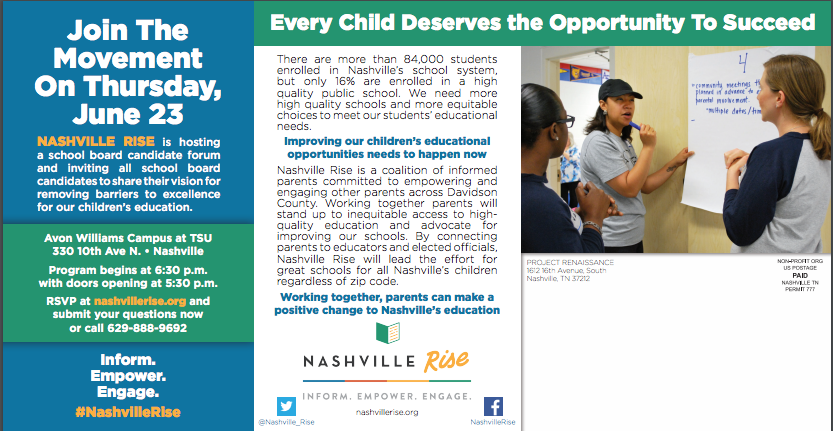
Nashville Rise to Host School Board Candidate Forum

Mark your calendars, Nashville!

Nashville Rise, a grassroots group of parents who are trying to elevate the parent voice in Nashville, is hosting a school board candidate forum later this month.

Date: Thursday, June 23, 2016
Time: 6:30 pm – 8:00 pm, with doors opening at 5:30 pm
Location: Tennessee State University, Avon Williams Campus, 330 10th Ave North, Nashville, 37203
Who will be there? School board candidates from each district that is up for election this year.
Who is moderating? David Plazas, the Opinion Editor for the Tennessean will be moderating. There will also be a panel of parents there to ask the candidates questions.

Transportation to the event and interpreters will be provided. Please RSVP at info@projectrenaissancenashville.org or 629-888-9692

I love that there will be a panel of parents asking questions!

Parents involved with Nashville Rise have been going door to door to invite parents and community members to attend the forum. In preparation for the event, Nashville Rise has released a TV ad and direct mailer to invite community members to the forum.

NASHVILLE RISE_v4Screen Shot 2016-06-13 at 2.05.25 PM

Screen Shot 2016-06-13 at 2.03.26 PM

I hope to see you on June 23rd!

TC Weber and the Return of the Summer Blockbuster

TC Weber thinks he sees blockbuster potential in this summer’s Nashville School Board race:

I’d argue that this year’s Metro Nashville Public Schools board race meets the criteria for a summer blockbuster, and with Stand For Children involved, it even has its own Michael Bay. For those of you who don’t regularly attend movies, Bay is a director known for elevating the blockbuster format through the increased use of explosions, beautiful people, and minimal substance. In other words, with apologies to William Faulkner, sound and fury signify nothing. To this point, that is exactly what the MNPS school board race has been. You have social media dust ups, campaign managers from one campaign resigning just before the filing deadline to launch their own campaigns, and other candidates attacking a spouse’s work record like it was their opponent’s. All entertaining to watch, but largely lacking substance.

The whole post outlines special interest groups, candidate recruitment, and all the other characters that make a blockbuster truly exciting. Also, he makes some recommendations on candidates he deems worthy of support.


For more on education politics and policy in Tennessee, follow @TNEdReport

Dr. Shawn Joseph Announces Key Staff

Today, Dr. Shawn Joseph announced key staff appointments in Metro Nashville Pubic Schools. He has named a Chief Academic Officer, Chief of Schools, and Chief Operating Officer. 

Chief Academic Officer: Dr. Monique Felder, currently serves as Executive Director of Teaching and Learning at Prince George’s County Public Schools in Maryland.

Chief of Schools: Dr. Sito Narcisse, current Associate Superintendent for High School Performance at Prince George’s County Public Schools in Maryland.

Chief Operating Officer: Chris Henson, current interim Director of Schools and Chief Financial Officer for Metro Nashville Public Schools.

Update: The Tennessean reported that Fred Carr, Chief Operating Officer, did not have his contract renewed.

See below for the press release that was sent to teachers and staff:

As Metro Schools’ employees, we want you to be among the first to know that our new Director of Schools, Dr. Shawn Joseph, has announced the first three members of his executive cabinet in naming a chief academic officer, chief of schools and chief operating officer. Under the new executive structure planned by Dr. Joseph, one additional cabinet member—chief of staff—will be named before the team officially begins work in their new roles on July 1. 

The chief academic officer position is being filled by Monique Felder, Ph.D., who currently serves under Dr. Joseph in Prince George’s County Public Schools in Maryland as the executive director of teaching and learning. Sito Narcisse, Ed.D., has been named chief of schools. Dr. Narcisse also comes from Prince George’s County but with strong Nashville ties, having earned his master’s degree from Vanderbilt University and serving as a student teacher at Antioch High School. Current Interim Director of Schools and Chief Financial Officer Chris Henson has been appointed to serve as chief operating officer.

Chief academic officer and chief operating officer are existing positions on the district’s executive team. Each will be reshaped with a new scope of work. Chief of schools and chief of staff are newly defined positions. These changes to the district’s leadership structure result in a reduction in the number of direct reports to the director of schools from six to four.

“Our goal is to ensure we have a structure that effectively serves students, families and schools,” said Dr. Joseph. “The four chiefs will work closely together so that silos within the organization are broken down. The new executive team will be expected to work cross-collaboratively to give clear direction and effective supports to our school leaders, educators, staff and students.”

Dr. Felder has over 25 years of experience as an educator. She has served as a teacher, principal and a district administrator for advanced learning. She holds a bachelor’s in elementary education, a master’s with a specialization in elementary science and math and a Ph.D. in educational leadership and policy studies. She also holds an advanced certificate in equity and excellence in education.

As chief academic officer, Dr. Felder will oversee all aspects of instruction and curriculum from prekindergarten through graduation. While this position previously oversaw principal and teacher supervision in addition to academics, it will now focus on student learning and social and emotional supports for students.

“If we are going to have real academic alignment through all grades and the highest quality instruction for all students, we need a chief who only thinks about teaching, learning and the social / emotional supports that are needed for student success,” said Dr. Joseph.

Dr. Narcisse’s career has taken him from teaching locally in Nashville and Williamson County to serving as a school leader in Pittsburgh City Public Schools and Boston Public Schools. He also worked on school improvement in Montgomery County Public Schools in Maryland and as associate superintendent working on school improvement in Prince George’s County. He holds a bachelor’s degree in French from Kennesaw State University, a master’s from Vanderbilt in secondary education and a doctorate in educational administration, policy studies and leadership from the University of Pittsburgh.

In his role as chief of schools, Dr. Narcisse will be responsible for overseeing the mentoring, support and evaluation of all school-based administrators.

“Dr. Narcisse and Dr. Felder will bring an intentional focus on excellence and equity to Metro Schools,” said Dr. Joseph. “Their collaborative spirits and propensity for research-based practices will strengthen our strategic plans. They both possess the passion and sense of urgency needed to ensure that all kids receive high-quality learning opportunities. We are fortunate to be adding two highly-skilled equity leaders to our team.”

Henson has been with Metro Schools since 2002, serving as chief financial officer and twice as interim director of schools. He became the interim nearly one year ago, in July of 2015, and previously served in the role in 2008. Under his leadership, MNPS was the first district in Tennessee to be awarded the Meritorious Budget Award for Excellence by the Association of School Business Officials. Before coming to Nashville, he served as CFO for Franklin Special Schools and Sumner County Schools. His expertise in school finance and operations is unmatched in Tennessee. He has served on the State Board of Education’s Basic Education Program (BEP) Review Committee for over 15 years, recently served as a member of the Governor’s BEP Task Force, and is a past president of the Tennessee Association of School Business Officials. He began his career with Deloitte and holds a bachelor’s in accounting and business administration from Trevecca Nazarene University.

As chief operating officer, Henson will continue to oversee the district’s finances but also take on an expansion of his current responsibilities, overseeing all operational and business aspects of the district.

“Mr. Henson is a proven leader, and I thank him for serving so well as interim director of schools,” said Dr. Joseph. “This realignment allows us to streamline business operations and provide better services and supports to schools and communities.”

Additional staff announcements will come later this summer, including a full organizational chart expected in July.