Finally, a good idea from Cameron Sexton. Chalkbeatreports the House Speaker is proposing providing stipends to student teachers.
Tennessee House Speaker Cameron Sexton wants the state to start paying student teachers for their required internships, a proposal state education advocates say they support amid ongoing concerns about teacher shortages.
Sexton told Chalkbeat Tennessee this week he wants to provide additional state funding to allow local districts to pay teacher trainees directly.
Sexton said the amount could mean a $1,500 or $2,000 monthly stipend, though the proposal appears to be in the early days of development with few concrete details.
When it comes to addressing Tennessee’s teacher shortage, Speaker of the House Cameron Sexton (R-Cookeville) believes it’s time to “think outside of the box,” but his idea to possibly drop the state’s bachelor’s degree requirement for teachers is drawing some criticism.
During Speaker Sexton’s state-of-the-state address last month, he suggested creating a two-year associate degree program for teaching to churn out more educators in Tennessee.
When all else fails, just make it easier to become a teacher and “churn out more educators.”
It apparently hasn’t occurred to Sexton that there is a reason (or several reasons) why people aren’t exactly lining up for teaching jobs.
Perhaps if Sexton floated the idea of improving both pay and classroom resources, more college students would consider K-12 teaching a viable career option.
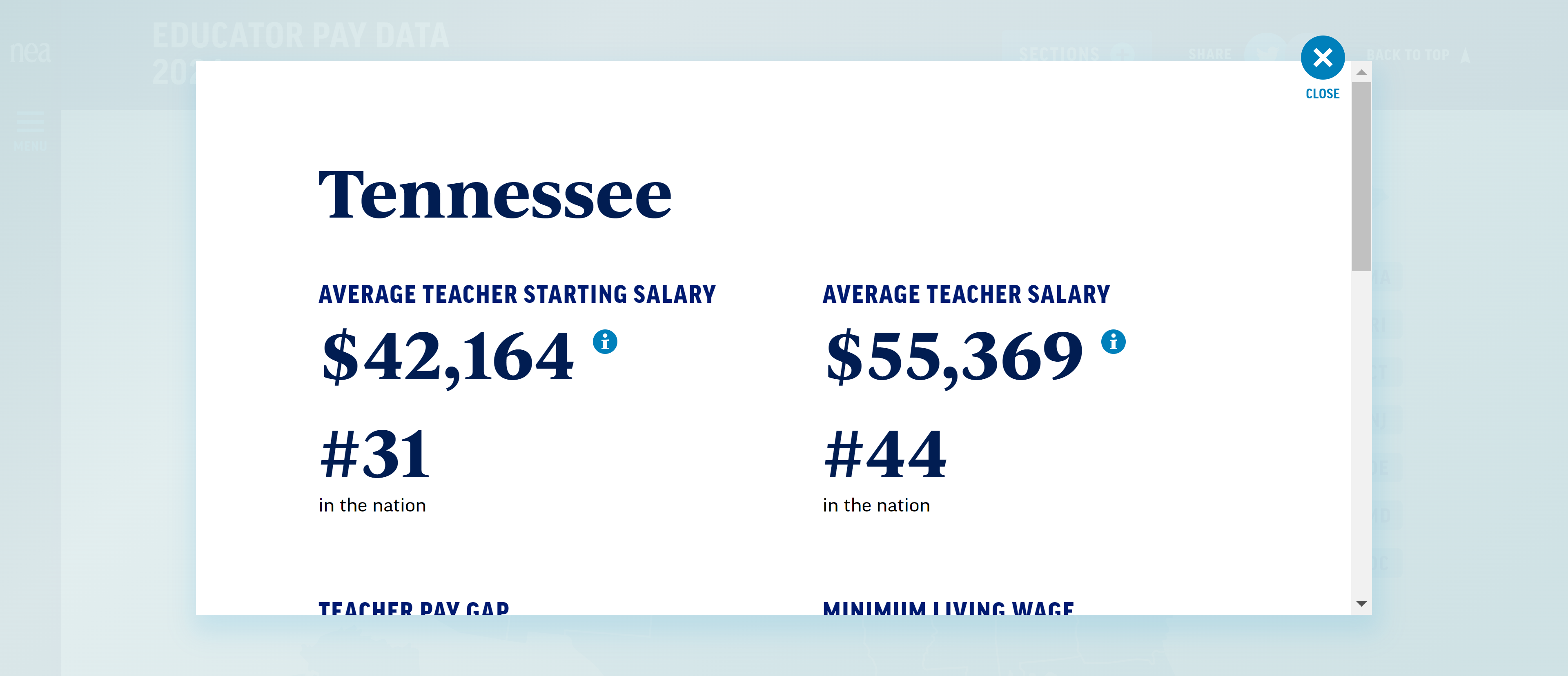
As it stands, Tennessee teachers are among the lowest-paid in the Southeast and school funding in the state lags behind our regional peers.
Now, though, there’s also an example of what might happen. A school district in Oregon moved starting pay in the district from $38,000 a year to $60,000 a year. In the process, all teachers received at least a 15% raise.
The move was approved by 100% of union members voting.
After announcing the salary schedule change, we had pools of qualified applicants to consider. It was a fun spring. Our administrators were having to have these rich conversations about best fit, really digging into things like, ‘Here’s a full table of highly qualified people; who is going to best fulfill the needs of our school? It’s a conversation that most districts don’t get to have right now.
One Tennessee school district is leaving free money for teacher pay on the table. The Grundy County School Board has decided not to accept the state’s $2000 bonus for teachers that was provided as part of the universal school voucher bill that passed this year.
I took a look at teacher pay in Olympia – starting teachers there can expect to earn $60,000 with a bachelor’s degree. Pay goes up to $120,000 depending on years of experience and education level.
In other words, it doesn’t have to be this way.
As I’ve written before, Tennessee continues to make policy choices indicating that the priorities of Gov. Bill Lee and his legislative allies are NOT investing in public education or public school educators.
The state spent $500 million to help build a new stadium for the Tennessee Titans.
The state in this past legislative session passed a $1.6 billion corporate tax break.
Past legislators have eliminated the Inheritance Tax and the Hall Tax on investment income.
For just a little more of what state taxpayers (at the behest of Lee and lawmakers) gifted the Titans, we could give all teachers a 20% raise.
Making that an ongoing commitment would be simple: Just repeal the ridiculous corporate tax giveaway the legislature just passed.
Tennessee policymakers could make investing in schools a priority – but they persist in choosing not to.
Stress and demands of teaching make the job not “worth it”
Teacher pay and support are not keeping up with the demands of the job, according to a recent report.
But also, challenges addressing student mental health. Challenges addressing cell phone use. Challenges addressing the behavioral and mental health challenges created by cell phone use.
The share of teachers who say the stress and disappointment of the job are “worth it” has fallen to 42%, which is 21 points lower than other college-educated workers, according to a poll by Rand, a nonprofit think tank. As recently as 2018, over 70% of teachers said the stress was worth it.
That’s a pretty rapid decline – and one that has accelerated post-COVID.
Policymakers aren’t exactly rushing in with solutions, either.
Yes, state law forbids teacher strikes, but there are ways around such a prohibition (as striking teachers demonstrated in states like West Virginia and Oklahoma).
In “The Causes and Consequences of U.S. Teacher Strikes” from the National Bureau of Economic Research, authors Melissa Arnold Lyon (SUNY Albany), Matthew A. Kraft (Brown University), and Matthew P. Steinberg (Accelerate) “revisit the question of how strikes affect wages, working conditions, and productivity in the context of the U.S. K-12 public education sector.”
The findings:
Strikes were most often about compensation, and the researchers find that the strikes did produce positive effects, with pay increases following in the post-strike years, regardless of the length of the contract agreement.
Tennessee teacher shortage persists as pay remains low
While current reports suggest that the shortage of teachers in Tennessee is improving a bit, the reality is a significant number of classrooms will start the year without a full-time, permanent teacher.
TC Weber takes a look at a payroll anomaly (or mixup or mistake or communication error) that meant the first summer paycheck for Nashville teachers was about 20% short.
Talk about ruining summer plans.
Last week, many of Nashville’s teachers and support staff who have extended their paychecks throughout the summer got a surprise. Paychecks were roughly 20% shorter than expected.
Metro Nashville Public Schools pays all certificated staff on a 22-week pay schedule, equivalent to the length of the school year. As a courtesy to teachers who wish to maintain a paycheck throughout the summer, they can sign up to be paid in 26 installments.
This is accomplished by MNPS deducting a portion of each paycheck, after taxes, and dividing it between four summer paychecks – two in June and two in July. For some reason, according to MNPS, this year has 27 paychecks, requiring 5 paychecks in the summer. Two in June, two in July, and one in August. That’s some fancy math turning 26 biweekly opportunities into 27.
As TC notes, all years have 52 weeks – which makes (or should make) for 26 checks.
He further notes that blaming the “mixup” on a communication error is not ok.
If teachers and staff didn’t get the message, the error is on the sender.
It’s particularly distressing in an era of teacher shortages and in a state with persistently low teacher compensation.
Teachers, staff to see raises based on School Board’s budget
While the State of Tennessee continues to move slowly when it comes to investment in teacher compensation, local districts are stepping up.
Sumner County is the latest to announce planned pay raises for its teachers and staff.
Sumner County Schools approved an additional $28,950,000 in its budget to increase pay for all of its employees, according to an email sent to parents and the community. The school board has approved the following raises:
– Increasing classified staff pay to a minimum of $16 per hour.
– Increasing new teacher pay to $47,800, an average raise amount of $3,023 for experienced teachers.
The School Board passed the proposal by a 9-1 vote, with the lone dissenting vote noting he hoped to move starting pay up to $50,000 and ask the County Commission for additional funds for raises.
The proposal will now go through the budget approval process at the Sumner County Commission.