It appears there’s some miscommunication between James Turner’s campaign for the Tennessee House of Representatives and pro-privatization group Tennesseans for Student Success (TSS).
Last week, Turner released a statement denouncing any support from TSS.
James Turner is committed to ensuring every student in Tennessee has access to great public education and opportunities for a bright future. James Turner will be a leader in helping Tennessee build on our historic gains in education by supporting school choice…
So, is James Turner the type of education “hero” who will sell our public schools out to privatizers? Or, is TSS just making things up?
School privatization group Tennesseans for Student Success has gotten involved in a Democratic primary for the Tennessee House of Representatives in Nashville. The group is backing James Turner in his challenge to incumbent Mike Stewart in House District 52.
Here’s more on the effort by TSS to influence the Democratic primary:
And here’s James Turner’s campaign stating they don’t really want the “help.”
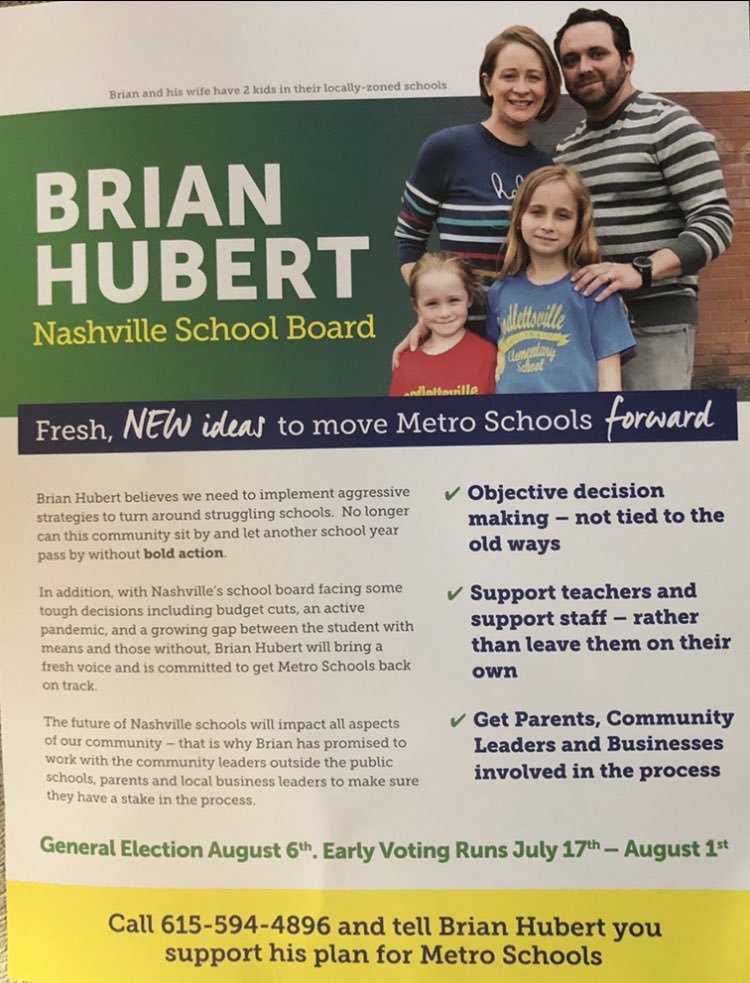
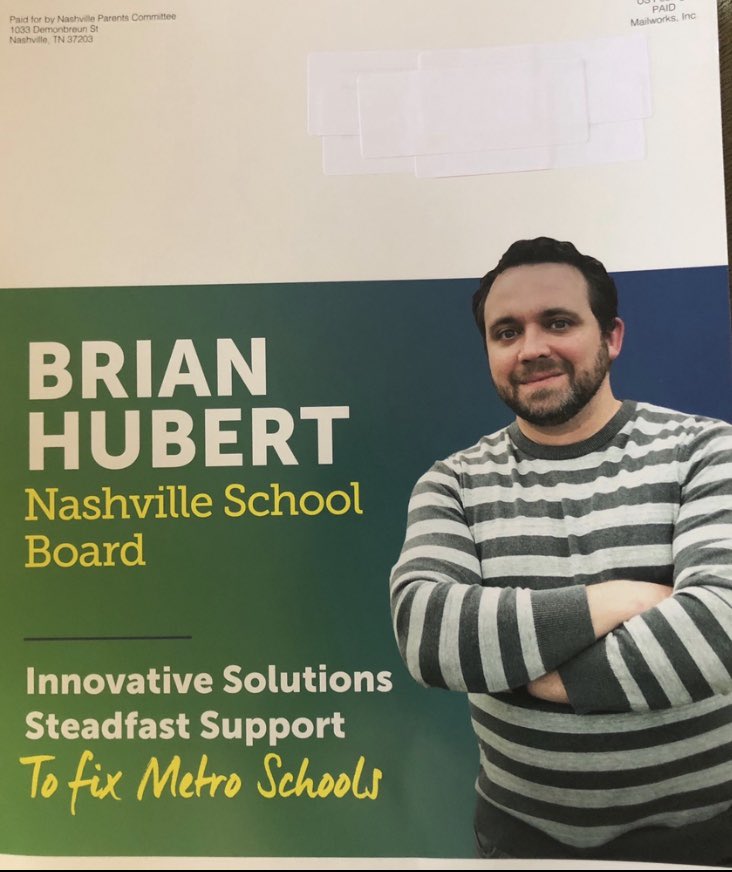
The races for Nashville School Board are heating up and there appears to be a new player on the scene. A group called the Nashville Parents Committee is sending out mailers in support of Brian Hubert in the 3rd District race.
What’s interesting about the Nashville Parents Committee is that a google search for them yields no results. The group also hasn’t filed campaign finance disclosures with either the Davidson County Election Commission or the Tennessee Registry of Election Finance. There’s no Facebook page or Twitter feed for this committee of parents.
So, let’s take a look at these pro-Hubert mailers and see if we can find some clues.
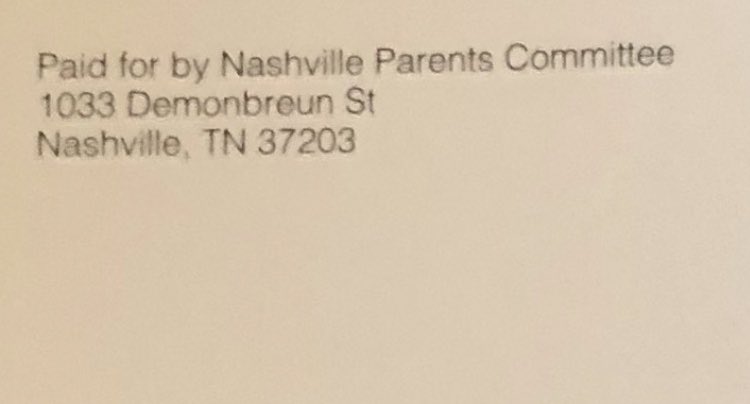
Let’s take a look at the return address for “Nashville Parents Committee.”
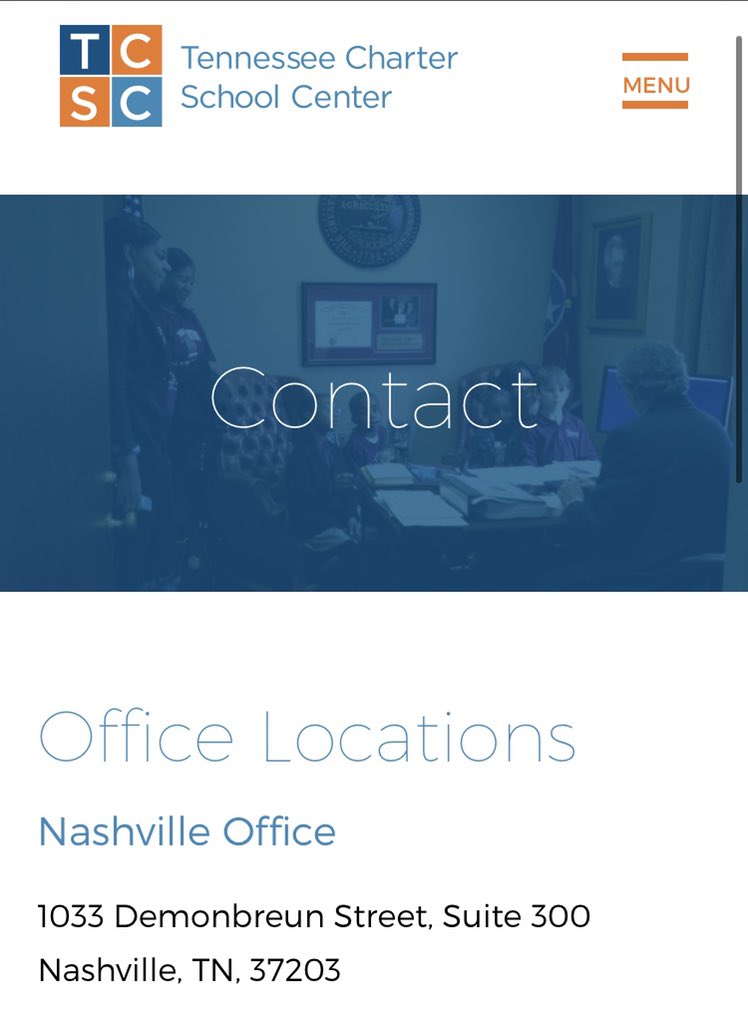
Well… this is interesting. Look who has the same address:
Yes, that’s right. The Tennessee Charter School Center. That’s the group started by former Nashville Mayor and charter school backer Karl Dean. I wonder how many Nashville “parents” make up this committee. Also, the Tennessee Charter School Center is not registered as a PAC or disclosed (so far) as a donor to Hubert.
Will we ever know who is pumping tens of thousands of dollars into this race in order to move the ball for charter schools? Possibly not, as the mailer doesn’t explicitly say to “vote for” Hubert. It’s pretty damn clear that those behind the mailer want you to vote for Hubert, though.
Should dark money like this be a driving force in our elections? Did Hubert know about the mailer and coordinate with the pro-charter group? Why is a charter school group backing Hubert?
As voters head to the polls, these are important questions that Hubert and his financial backers should answer.
The Washington Post‘s Valerie Strauss features an excerpt from Diane Ravitch’s latest book Slaying Goliath that tells the story of Nashville School Board member Amy Frogge and her relentless advocacy for public schools. Highlights follow. The short version: Don’t f*** with Frogge.
Amy Frogge is a lawyer and a parent of children who attended Gower Elementary School in Nashville, Tennessee. In 2010, the city suffered a devastating flood, and people came together from across the city and even from out of state to help rebuild the damaged neighborhoods. Frogge was impressed by the energy that is generated when people coalesce behind a common goal. Aware that the Parent Teacher Organization at Gower Elementary was moribund, she and another parent decided to rebuild it. Over a year, they enhanced parent engagement, developed new community partnerships, and helped to bring about major improvements in the school’s performance, atmosphere, and culture.
Determined to “give back to her community,” Frogge decided to run for the Metro Nashville school board in 2012. With the help of many volunteers, she rang doorbells across her district. She raised $25,000. Her opponent was endorsed by Nashville mayor Karl Dean, the Chamber of Commerce, the local teachers’ union, and the Gates-funded group called Stand for Children. Her opponent spent $125,000, five times what Frogge spent. But Frogge won by a two-to-one landslide. When she ran, she was unaware of the national debates about privatization. She just wanted to do her part as a citizen. She quickly learned about the efforts by national charter chains to gain a foothold in Nashville and decided that this was not good for the local public schools.
Frogge emerged as an articulate critic of privatization and Corporate Disruption. In her role as a board member, she wanted expanded recess time, more time for art and music, less time devoted to testing, and increased funding for the schools, but these issues were overshadowed by the persistent struggle between the school board and the state over charter expansion. She courageously stood up to the right-wing governor, the legislature, the state commissioner, and Mayor Dean, who were all pushing for more charters in Nashville. The local newspapers criticized her as “divisive” and “shrill” for taking a stand (these are the words applied to women who speak out but not to men, who are seen as “forceful” and “strong”). The newspapers grew tired of her complaints about the large amounts of outside money that poured into school board races.
In 2016, Frogge ran again for the school board, and she was now Enemy Number One for the Disrupters. In hopes of ousting her, they funneled over $200,000 into the race, most of it directed through the Gates-funded Stand for Children. She won again, receiving 65 percent of the vote. Voters liked the principled stand that she took supporting public schools and demanding accountability and transparency for charters.
Amy Frogge recalled in an interview with T. C. Weber, a Nashville parent-blogger, that her husband had given her a clip of the Reverend William Barber, the charismatic leader of the Resistance in North Carolina who has often been compared to Dr. Martin Luther King Jr. Reverend Barber has championed progressive causes of every kind, including public education. Frogge remembered this message:
“When you’re called to service it’s often not convenient. It’s often very difficult and it is exhausting, but we are not allowed to give up. We don’t get to determine when it’s done. I think many of us have made huge sacrifices to continue to try to advocate for students and our teachers and our families.
READ MORE about Amy Frogge’s fight against the powerful forces that would disrupt our public schools for their own private gain.
For more on education politics and policy in Tennessee, follow @TNEdReport
Jeff Bryant writes about the 2020 Democratic Presidential candidates and the shift in the national Democratic party on issues like charter schools:
Education has been mostly ignored in previous presidential elections, and the topic had not come up for serious discussion among the candidates in televised debates prior to the Public Education Forum 2020, held in Pittsburgh on December 14. But at an event in which candidates knew they would have to field some tough questions about education issues and be held closely accountable for their answers, most of the leading candidates—including the front-runners—showed up and welcomed the dialogue. Furthermore, the tables were turned on who controlled the dialogue. “How many times have we been dictated to, have we been told to do?” asked American Federation of Teachers president Randi Weingarten. Teachers, students, and community organizers who’ve wanted more of a dialogue with political candidates and elected officials have often been “silenced,” Weingarten stated. But what unfolded in Pittsburgh was “a paradigm shift,” she said, because the candidates had to “actually listen” to the folks who inhabit the world that is “the farthest place in the universe,” to use Bennet’s words, from education policymakers in Washington, D.C. The candidates heard that “the priorities of the federal law should be to level the playing field to make sure that kids… actually have the things they need,” she said. “These candidates are listening to us.” The change in heart of Democratic candidates has been a long time in coming.
While Tennessee languishes near the bottom of all states in school funding, one Presidential candidate is laying out a plan to make a massive federal investment in schools — especially those with high numbers of low income kids (like so many in Tennessee). Here’s more on Elizabeth Warren’s education funding plan:
Warren unveils education plan quadrupling federal funding for public schools. The Hill: “Sen. Elizabeth Warren (D-Mass.), a leading Democratic presidential candidate, is proposing a plan to quadruple federal funding for public schools with incentives for states to fund poor and rich schools more equally. Warren has often campaigned off her personal history as a public school teacher and the importance of reforming the system. Her education plan released Monday comes after much of the primary field has already released such proposals. Warren’s plan would quadruple Title I funding — equivalent to an additional $450 billion — over the next 10 years for pre-K-12 public schools. Warren also plans to invest an additional $100 billion over ten years in ‘excellence grants’ to public schools, and an additional $50 billion in repairing and upgrading school buildings. In an effort to incentivize states to fund schools more equally, the new Title I funding would be conditioned on states ‘chipping in more funding and adopting and implementing more progressive funding formulas, so that more resources go to the schools and students that really need them.’ The plan is financed by Warren’s signature wealth tax on net incomes over $50 million, as are many of her plans.”
For more on education politics and policy in Tennessee, follow @TNEdReport
Your support makes publishing education news possible.
It seems the formal announcement of a challenger was all it took to make Rep. Bill Dunn, the prime sponsor of controversial voucher legislation, decide to retire.
Rep. Bill Dunn of Knoxville, the longest-serving Republican in the state House, says he won’t run for re-election next year. Dunn was the lead House sponsor of this year’s controversial school voucher legislation. He had already drawn a primary opponent.
“After the 2019 session was over, and we had passed Educational Savings Accounts legislation, as well as one of the most pro-life measures in the country, House Bill 1029, I decided it was the right time to conclude my public service on a high note,” Dunn said in a statement.
Knox County School Board member Patti Bounds is the only announced Republican running for the seat Dunn currently holds.
For more on education politics and policy in Tennessee, follow @TNEdReport
Your support makes reporting education news possible.
Nashville education blogger TC Weber focuses on the Mayor’s race in his latest post. Here are some of his observations:
How did you spend your weekend? If you were one of roughly 300 teachers and parents in Nashville you met downtown at Third and Lindsey and then marched to the Howard School Building to cast your early vote for State Representative John Ray Clemmons to become the next Mayor of Nashville.
Regarding momentum building for state representative John Ray Clemmons:
The news out of last week’s forum held by the Panhellenic Society, Urban League of Middle Tennessee, NAACP Nashville, and Interdenominational Ministers Fellowship indicates that it is a distinct possibility. Per the Tennessee Tribune, At the end of the forum, all of the attendees were asked to vote in a straw poll for no more than two candidates vying for Mayor in the August 1 election. Clemmons decisively won the crowd of nearly 300, gaining 46% of the vote. John Cooper came in second with 26%, with David Briley close behind at 25%. Carol Swain suffered a decisive fourth place with 3% of the attendee’s vote.
READ MORE from TC Weber about education in Nashville.
For more on education politics and policy in Tennessee, follow @TNEdReport
Your investment makes reporting education news possible.
Williamson County School Board member Brad Fiscus plans to challenge state representative and outgoing House Speaker Glen Casada in the 2020 elections, the Tennesseanreports:
Williamson County Board of Education member Brad Fiscus, 4th District, confirmed on Monday he plans to pull a petition to run against embattled lawmaker Rep. Glen Casada, 63rd District, in the 2020 state House election.
Fiscus, a 22-year resident of Williamson County, was elected as a school board member in 2018 and serves as a director of Next Gen Discipleship ministry as part of the Tennessee Conference of The United Methodist Church.
Fiscus was also heavily involved in Pastors for Tennessee Children, a faith-based advocacy group dedicated to supporting public schools. In his role with the organization, he was a leader in opposing the school voucher scheme that ultimately passed the House under Casada’s leadership.
Fiscus will make the challenge to Casada as Independent.
For more on education politics and policy in Tennessee, follow @TNEdReport
Your support makes publishing education news possible.
The Tennessee Tribune has the story of how State Representative John Ray Clemmons is positioning himself to be Nashville’s “Education Mayor.”
Last Saturday, State Representative John Ray Clemmons, candidate for mayor of Nashville, hosted an Educators VOTE Rally and March to the Polls with members of the MNEA union and fellow MNEA-endorsed candidates. Starting at 3rd and Lindsley, Amanda Kail, president of MNEA, greeted the crowd before introducing Representative Clemmons. “We endorsed John Ray because of his commitment to our schools and our children. He’s the only candidate with kids in public schools, and he’s the only candidate who’s committed to supporting us,” Kail said.
Rep. Clemmons took the stage with thunderous applause from over 200 educators in the room. Once reaching the stage, Clemmons invited all the children in the room to join him on stage. Wearing red, in solidarity with the educators in the room, Clemmons showed his support for Nashville’s educators and shared his plans for increasing the quality of public schools in the city.
Clemmons has been endorsed by MNEA — the Nashville union representing teachers and enjoys the support of more than 100 teachers and supporters of public schools who signed an OpEd written by teacher and blogger Mary Holden.
For more on education politics and policy in Tennessee, follow @TNEdReport