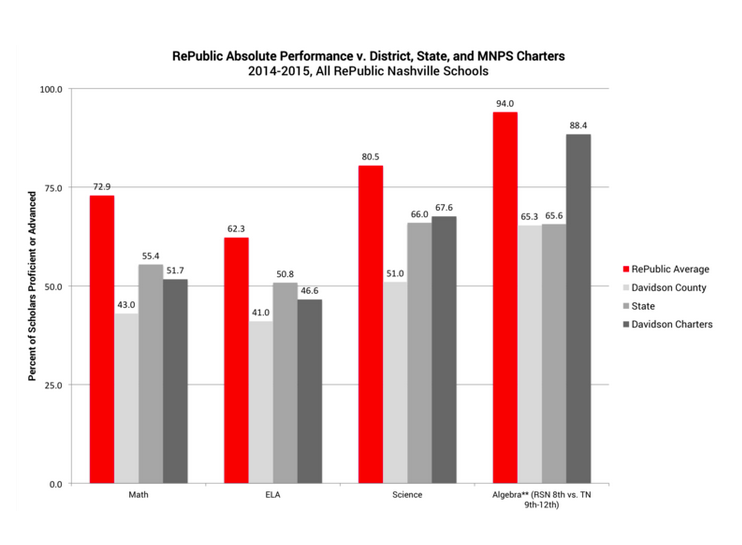
Pierce: Closing All Charters Would Cost More

MNPS Board Member Mary Pierce tried to reframe the charter debate in a recent editorial in the Tennessean. While many people believe closing all charter schools would save the district millions, it would actually cost the district millions.

Here’s what Pierce had to say:

As a new school board member, I sought to understand this claim and thus asked Metro Nashville Public Schools leadership, “What would happen to the budget if all charter schools closed and these students returned to their zoned schools?”

This hypothetical exercise, completed by the MNPS Finance Office this summer, showed that if every student attending a charter school in 2014-15 had attended his or her zoned school, MNPS would have spent roughly $3.5 million more to educate them in district-managed schools.

Hold up! If you are calling to close charters because it’s the fiscally responsible thing to do, I guess you need to stop that call. Let’s not waste millions of MNPS dollars by closing all the charter schools.

Charter schools actually get fewer dollars per pupil than a traditional school. Fiscally responsible!

On average MNPS spends $9,436 per pupil — $5,666 for direct classroom costs plus an additional $3,770 for indirect expenses such as transportation, central office and technology.

Each student enrolled in a charter school is allocated roughly $9,200, which often includes rent payments back to the district for building use.

Oh, look below! Mary Pierce puts it on the record that she does not want to charterize the district. MNPS rejects a huge majority of charter applicants, anyways.

We should not “charterize” the district, but should insist on the highest quality from all of our schools. Our charter review committees and our board have done an excellent job in recommending and approving charter schools. Anyone claiming that the MNPS Charter School Office is promoting unabated charter growth is not paying attention. This summer, the charter review committees recommended that the board deny 86 percent of the applications.

And finally, it’s not just charter schools that are taking students away from their zoned schools.

We should not ignore the realities of fixed costs. When students leave any school the result can be buildings operating under capacity, and that adds to indirect expenses. But, we won’t address the bulk of this fiscal challenge unless we include all our choice schools in the analysis. For example, Hillwood High School operates under 70 percent capacity while over 200 students zoned for Hillwood choose to attend another district school like Hume-Fogg or Hillsboro.

Go ahead and read the rest of the editorial here.

For more on education politics and policy in Tennessee, follow@TNEdReport


Pinkston: Time to Slow Charter Growth

MNPS Board Member Will Pinkston offers some thoughts on the fiscal impact of Nashville’s Charter Sector and makes a plea for the reasonableness of slowing their growth in a recent op-ed in the Tennessean.

Here are some key takeaways:

MNPS is ranked 54th out of 67 urban school systems in America in per-pupil funding.

Due in part to inadequate state funding, we trail school systems in Atlanta, Charlotte and Louisville, among others.

A recent analysis of teacher pay across urban districts similar to Nashville found the city’s teacher lag behind their peers, especially in Louisville — a city of similar size and cost-of-living.

Pinkston notes that charter expansion is expensive — and while he doesn’t say so explicitly, the question is: Is continued expansion of charters the best use of Nashville’s education dollars:

The school board took a fiscally conservative position. With 8,157 seats currently in the charter pipeline — including more than 1,000 yet-to-be-filed seats belonging to KIPP — that’s a total future annual cash outlay of $77.5 million.

What KIPP wants to do — expand the pipeline to more than 9,000 seats — would take our future annual cash outlays up to $85.5 million. None of this includes the $73 million in annual cash outlays for charter seats that already exist.

In short, there are lots of charter seats now and a lot more coming online even if MNPS doesn’t approve a single new charter application. These schools are a fiscal drain on MNPS. In some cases, this may be a worthy investment. But, Nashville residents should consider if they want a tax increase to support charter expansion OR if they believe any new money coming from a state school funding lawsuit should be directed at charter expansion rather than other education initiatives.

More from Will Pinkston:

Thoughts on the Next Director of MNPS

Charters: An Expensive Proposition

Charter Schools Drive Up MNPS Costs

For more on education politics and policy in Tennessee, follow @TNEdReport

Close a School Because of a Reading Assignment? That’s What One Nashville School Board Member Wants.

Ravi Gupta, Co-Founder and Chief Executive Officer of RePublic Charter Schools, wrote a blog post about Nashville School Board Member Amy Frogge complaining to MNPS about a book that seventh graders at Nashville Prep are currently reading. Amy Frogge wants to close down Nashville Prep because they are reading City of Thieves, a book she does not want in middle schools. This is what censorship looks like.

Screen Shot 2015-09-07 at 3.33.42 PM


If you want to close a school because they are reading a book you don’t like, you may be closing a lot of schools in Nashville. We hear so much of autonomy in MNPS schools, but some involved in education are still afraid to give up all that power. Nashville Prep agrees with the teaching of City of Thieves. That’s all that matters. If parents disagree with that decision, they can take it up with Nashville Prep and their board.

Seventh graders can handle mature content. When you work with these students everyday, like I do, you know what type of content they can handle. The seventh graders I have worked with in MNPS can handle mature content.

Teachers & schools know their students. That’s what we are trained to do.

Nashville Prep knows how to educate their students. What can the Nashville School Board do to Nashville Prep?

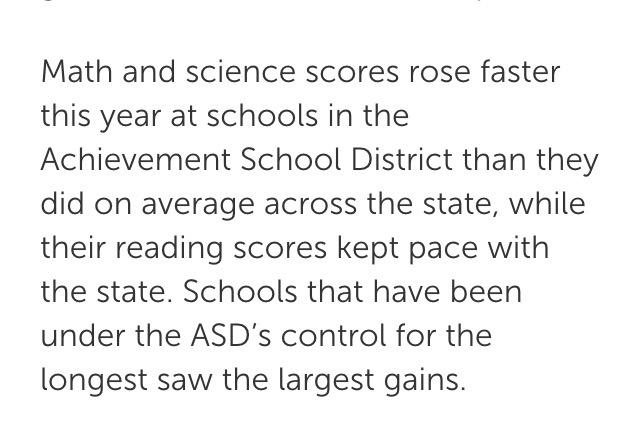
Screen Shot 2015-09-07 at 4.10.45 PM


As a literacy educator, I hate seeing books attacked while students are actually reading. City of Thieves could be the turning point for many of the middle schoolers to stick with reading. While we are spending time discussing the merits of the books, Nashville Prep is making growth while other schools are not.


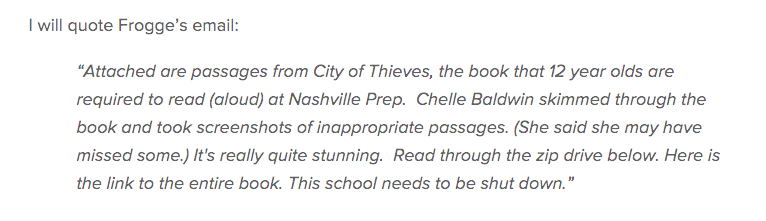
Screen Shot 2015-09-07 at 5.55.59 PM

Nashville Prep must be doing something right.

Please read the rest of the blog post that was posted by RePublic Charter Schools to hear about the claim that City of Thieves was too high of a lexile for the students at Nashville Prep and how Amy Frogge & Chelle Baldwin were for Nashville Prep before they were against Nashville Prep.


UPDATE: Amy Frogge has responded to Ravi Gupta with a lengthy Facebook post that you can read here.  She lists many allegations against Nashville Prep that she has heard over the years. You can read those at her Facebook page.

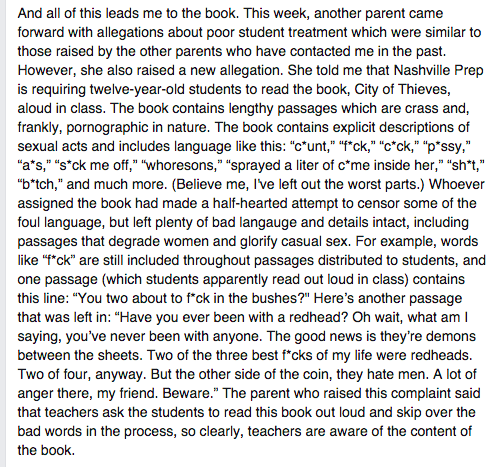
Since my post deals with the issue of the book, City of Thieves, here is what she as to say on that topic.

Screen Shot 2015-09-07 at 9.28.44 PM


This book currently resides in high schools in Nashville. This may be the start of at least one book being banned in MNPS.


Expansion Teams

In a much anticipated announcement made late on a Friday afternoon, Tennessee’s Achievement School District revealed which charter operators will get to takeover franchises in its growing Nashville market.

Chalkbeat’s Grace Tatter reports:

The Achievement School District has authorized two charter organizations to open schools in Nashville, which remains relatively unchartered territory for the state-run school turnaround district.

District leaders announced Friday that KIPP Nashville and Knowledge Academies will launch their first ASD schools in the 2017-2018 school year.

The expansion news comes on the heels of rather disappointing results from the ASD’s Memphis franchises. Add that to the turnaround posted by MNPS-managed Neely’s Bend Middle, and the ASD had to do something to inject some excitement into an off-season that will see the departure of long-time ASD leaders like Superintendent Chris Barbic and Chief of Staff Elliot Smalley.

Tatter adds that the ASD will go through a community-matching process to pair-up the charter operators with already functioning MNPS schools:

KIPP Nashville and Knowledge Academies will receive community input on which schools they should be matched with in fall 2016.

Of course, the matching process last time around proved to be a rather intense spectator sport.  With such heated community involvement, it’s no wonder the ASD wants to bring new operators into the Nashville mix.

Yes, this late Friday announcement is sure to please those fans of ASD’s school-matching cage matches. Parents, teachers, and community members can look forward to exciting matchups between schools competing for the right to possibly be adequately served by a charter operator they didn’t want and no one asked for. Will results improve? Early returns from Memphis say no, but tune-in as the Nashville market becomes the latest testing ground for the ASD’s school competition games.

For more on education politics and policy in Tennessee, follow @TNEdReport


That’s Not That Much, Really

So, statewide TCAP results are out and as soon as they were released, the Achievement School District (ASD) touted its gains.

Embedded image permalink

But, what does all that mean? How are these schools doing relative to the goal of taking them from the bottom 5% of schools to the top 25% within 5 years, as founder Chris Barbic boasted before his recent revelation that educating poor kids can be difficult.

Fortunately, Gary Rubinstien has done some analysis. Here’s what he found:

By this metric the top performing ASD school from the first cohort was Corning with a score of 48.6 followed by Brick Church (47.9), Frayser (45.2), Westside (42.1), Cornerstone (37.6), and Hume (33.1).  To check where these scores ranked compared to all the Tennessee schools, I calculated this metric for all 1358 schools that had 3-8 math and reading and sorted them from high to low.

The values below represent the school’s overall score and their percentile relative to the rest of the state, in that order.

Hume 33.1 1.5%
Cornerstone 37.6 2.6%
Westside 42.1 3.2%
Frayser 45.2 4.1%
Brick Church 47.9 5.2%
Corning 48.6 5.5%

As you can see, four of the original six schools are still in the bottom 5% while the other two have now ‘catapulted’ to the bottom 6%.  Perhaps this is one reason that Chris Barbic recently announced he is resigning at the end of the year.

So, the schools that have been in the ASD the longest, making the greatest gains, are at best in the bottom 6% of all schools in the state. That’s a long, long way from the top 25.

But here’s something else. Back in December, the ASD decided to take over Neely’s Bend Middle School in Nashville. The school had been on the priority list, after all, and it was declared the victor in a school vs. school battle against Madison Middle.

I reported earlier in the week about the impressive gains at Neely’s Bend. In fact, the state’s TVAAS website shows Neely’s Bend receiving a 5 overall in its growth score — the state’s highest number.

I wondered where Neely’s Bend might fall in comparison to Rubinstein’s analysis of the ASD schools that had been under management for the past three years. Turns out, Neely’s Bend’s proficient/advanced composite for reading and is 54.4.

Yes, you read that right. Neely’s Bend’s score is 5.8 points higher than the best performing school that’s been under ASD control the longest.

Neely’s Bend is being taken over and converted to a charter school and yet the school posted significant gains (above district average), has a TVAAS overall score of 5, and has a higher percentage of students at the proficient/advanced level than the BEST schools under ASD management.

For more on education politics and policy in Tennessee, follow @TNEdReport


Neely’s Bend Rising

In December of 2014, after a battle that pitted two schools against each other for the right to be taken over by the Achievement School District, Neely’s Bend Middle School was chosen and handed over to the LEAD charter school network — to be taken over grade-by-grade, starting with 5th grade in the 2015-16 school year.

Supporters of Neely’s Bend, including many parents (who started a support group known as Neely’s Bend United), suggested that the school belonged to the community and that it was making progress and just needed more time to demonstrate it.

In fact, Neely’s Bend had posted modest gains in Math and Reading in 2014 and a pretty impressive level of growth in Science.  Now, the results from 2014-15 are out and they show a school that while still struggling, is making real progress according to the state’s growth metrics.

Here are the numbers:

Neely’s Bend Middle School Growth Rate by Subject

2014                          2015

Math                   0.8                            8.9

Reading             2.7                              -5.0

Science              5.7                              8.7

By way of comparison, the average growth rate in MNPS was 2.8 in Math, -1.4 in Reading, and 1.0 in Science.

Neely’s Bend is showing a growth rate well above the district average and has posted consecutive years of growth in both Math and Science, with some pretty solid numbers in Science over the past two years.

While reading is an area of concern, both MNPS and the state showed a decline in reading in 2014-15. Additionally, it’s possible that Neely’s Bend is suffering from the same slowed growth as other middle schools in reading, as evidenced by a newly released study on TVAAS scores.

The Achievement School District handed Neely’s Bend over to LEAD because the school was supposedly so low-performing it needed a remake in order to start showing growth. Except it looks like Neely’s Bend is showing growth already.

For more on education politics and policy in Tennessee, follow @TNEdReport


The Road to Looney

This morning, the MNPS School Board voted 8-1 to make Williamson County Director of Schools Dr. Mike Looney the preferred finalist for the vacancy left by Dr. Register’s retirement on June 30th.

The process will move forward with a comprehensive background check on Looney and a visit by the board to his district (a short trip). If all goes well, a final offer could be made as early as next Thursday.

The meeting moved along pretty quickly this morning, with member after member noting how impressed they’d been with Looney’s interviews.

But, the road to making Looney the finalist wasn’t quite so smooth.

Just a few weeks ago, the district’s Chief Academic Officer, Jay Steele, was named the Interim Director of Schools.  Then, he wasn’t, and Chris Henson was placed in the role.

Then, the Board received a list of four finalists that included the controversial John Covington.

After Covington was eliminated from the pool following initial interviews, the Board proceeded with full-day interviews and community forums featuring the three remaining candidates.

By all accounts, the Board was impressed with how well-prepared Looney was and how specific he was about what needs to happen in MNPS.

So, this morning, Board members moved quickly to name Looney as the preferred finalist.

The process isn’t over, and Looney has issued a statement making reference to an allegation given voice by Board Member Tyese Hunter.  But, despite a bumpy process, it appears MNPS has a strong choice to be the district’s next leader.

Here’s Looney’s statement:

“I am honored to learn that Metro Nashville Public Schools has narrowed its search for the Director of Schools, and I am a finalist. Unfortunately, in the last hour of the meeting, a false allegation complicated matters by calling into question my integrity. I communicated to Board Chairwoman Gentry that my first priority is to set the record straight. I look forward to this being done in an expeditious manner. Meanwhile, I intend to converse with Williamson County School Board members about the implications of my selection as a finalist. I am especially thankful for all of the good work our families and employees are doing in Williamson County Schools. It is greatly valued. Out of respect to both School Boards and in order to facilitate getting closure on the false allegation, I will refrain from commenting further at this time.

-Dr. Mike Looney, WCS Superintendent

Read Board Member Will Pinkston’s thoughts on priorities for the next MNPS Director of Schools

For more on education politics and policy in Tennessee, follow @TNEdReport

The Looney Leap

Will MNPS hire its next Director of Schools from neighboring Williamson County?

Andrea Zelinski reports:

…after a day-long series of interviews, meet-and-greets and community forums, board members found themselves laughing at Looney’s jokes, digging his sense of urgency and engaged in the direction he wants to take the district. 

Last month Anna Shepherd was adamant that a candidate from the neighboring, largely white and wealthy district couldn’t understand MNPS’ complex and diverse student body. But after Tuesday’s marathon of meetings, Looney coming from tony Williamson County is “not as troubling” as she thought it would be, she told Pith.

The Board interviewed Barry Shephard today and is slated to make a decision on a favorite for the job by tomorrow.

It’s possible the Board could start the search over or reset it in some fashion, attempting to find additional candidates to consider.

Tune in tomorrow…

For more on education politics and policy in Tennessee, follow @TNEdReport


Since You Asked


In a recent article outlining a list of priorities for the next Director of MNPS, Board Member Will Pinkston said:

We also need a top-to-bottom review of our teacher compensation system to understand how we stack up against competing and similarly situated U.S. school systems, such as Atlanta, Austin, Charlotte, Denver and Louisville.

Here is some information on how the MNPS pay scale compares to pay scales in the cities Pinkston mentions. I used the salary paid to a teacher with a bachelor’s degree and looked at starting salary, salary at year 10, salary at year 20, and the top salary paid on the current schedule.

Here’s what it looks like:

Start                    10                          20                      TOP

MNPS                     $42,082                $44,536                 $54,800              $55,757

Louisville              $41,756                $53,759                 $69,514                $70,636

Charlotte               $37,946               $46,008                $53,954                $58,525

Austin                     $46,401               $48,837                $55,477                 $70,751

Atlanta                   $44,312               $54,167                 $62,075                 $66,467

Denver                   $38,765              $47,136                 $53,838*

*Denver has a teacher compensation system known as ProComp and the highest step is 13. Teachers in Denver earn the base pay indicated plus are eligible for incentives and base pay increases based on professional development, advanced degrees, and measures of student outcomes.

Here are a few takeaways from the raw information:

1) Starting pay in MNPS is on par with the cities Pinkston identifies as similar to/competitive with Nashville.

2) Long-term pay increases in MNPS don’t keep pace with those in other, similar districts. Taking Denver as an example, a teacher who received NO ProComp incentives and maintained only a bachelor’s degree would make at Step 13 very close to what an MNPS teacher with similar education makes at Step 20. In all other cities examined, the top step is higher (from $3000 to $15,000) than it is in MNPS.

3) Just three hours north of Nashville in a city with similar demographics and cost of living, a teacher can earn significantly better pay over a career. While a teacher in Louisville starts out making slightly less than a new Nashville teacher, by year 10, the Louisville teacher makes $9,000 more than her Nashville counterpart and by year 20, that difference stretches to $15,000. The lifetime earnings of a teacher in Louisville significantly outpace those of a teacher in Nashville.

4) Nashville’s teacher pay is higher than most of the surrounding districts — making it a competitive choice for teachers seeking to teach in middle Tennessee. However, for Nashville to become a destination for teachers wanting to build a career (or continue one) in urban education, Nashville may need to do more to improve its overall compensation package.

5) This analysis is a starting point — it’s raw data from district websites about base compensation plans. It does not take into account relative cost of living (except as noted in the comparison with Louisville) and other factors that may make teaching in Nashville an attractive proposition.


For more on education politics and policy in Tennessee, follow @TNEdReport

And Then There Were Three

The MNPS School Board has narrowed its search for the next Director of Schools. The Board heard from four finalists last week on Thursday and Friday. After those interviews, the board eliminated John Covington from the mix and will proceed with interviews of the remaining three candidates.

Read the applications from the candidates

Read what Board Member Will Pinkston thinks the next Director should prioritize

For more on education politics and policy in Tennessee, follow @TNEdReport