Elections and Education

Former Nashville School Board member Amy Frogge offers her take on recent election results around the state and what they mean for education policy.

It’s been a rough week for public education in Tennessee. Here in Nashville, John Little, a political operative paid by charter school interests, was elected to the school board. Funded by wealthy (white) elites seeking to profit off public schools, Little has used aggressive and underhanded smear tactics to “disrupt” school board meetings and legislative hearings for many years now. He considers school board work “political theater” (his words), which has been obvious from his tactics.

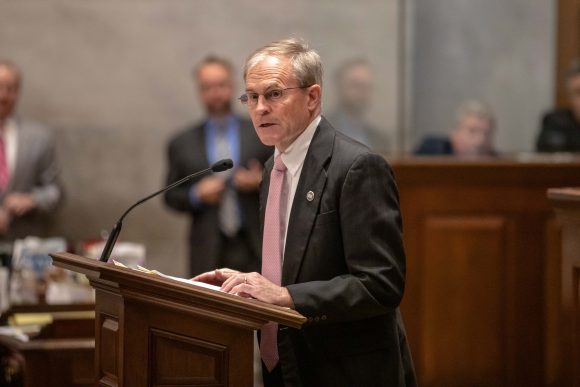
In Williamson County, former Speaker of the House Glen Casada, who used questionable tactics to pass Tennessee’s most recent unconstitutional voucher law, was reelected to the state legislature. He was accused of offering incentives to lawmakers to vote in favor of vouchers, which resulted in an FBI investigation of the voucher vote. Casada stepped down as Speaker after only months in the position when confronted by a scandal involving racist and sexist text messages that embroiled him and his staff.

In Knoxville, two voucher proponents are heading to the state House of Representatives. Rep. Jason Zachary, who was responsible for the new unconstitutional voucher law last year, flipped his vote only after Casada held the clock open for 40 minutes and allegedly offered bribes for the vote. Nevertheless, he was reelected. Voucher proponent Michele Carringer was elected to fill the seat left open by departing representative Bill Dunn, an ardent voucher advocate in the legislature for many years. Dunn has now been asked by Governor Lee to join the floundering Tennessee Department of Education.

However, there is hope. U.S. Secretary of Education Betsy DeVos, the most disliked current cabinet leader and perhaps the most despised education leader in U.S. history, will be gone in January. DeVos has consistently diverted public school funding to private schools. The national mood around “school reform” (i.e., school privatization, aka “school choice”) is rapidly changing, and President-elect Joe Biden has promised to name a teacher as Secretary of Education. Fingers crossed that we will not backtrack as a country to the low quality of former appointees under the last several presidents. We have real work to do in Tennessee, but perhaps changes at the top will make their way down to our state.

Former State Rep. Bill Dunn, now an education adviser to Gov. Lee

For more on education politics and policy in Tennessee, follow @TNEdReport

Your support$5 or more – makes publishing education news possible.
Donate Button

In Light of These Outcries

It seems that someone is finally listening to educators from across the state who have consistently complained about poor management at the Tennessee Department of Education. Let’s be clear: Though flippant and abrasive, current Commissioner of Education Penny Schwinn is merely carrying out the privatization agenda of her boss, Gov. Bill Lee.

Still, it’s noteworthy that both Senator Dolores Gresham and Rep. Mark White (who chair the education committees in the Senate and House, respectively) are now calling for an investigation into the financial management practices at the DOE under Scwhinn.

Here’s more from Chalkbeat:

Two legislative leaders are calling for an investigation into the Tennessee Department of Education’s management of millions of dollars earmarked for coronavirus relief, as well as the state’s school voucher program for students with disabilities.

Sen. Dolores Gresham and Rep. Mark White, who chair the legislature’s two main education committees, want the state’s chief internal investigator to look into “questions and concerns” raised about both CARES funding and the 4-year-old voucher program known as Individualized Education Accounts.

Neither lawmaker provided details but, in an Oct. 23 letter to Comptroller Justin P. Wilson, said the concerns “come from every level of education across the state.”

“In light of these outcries,” they wrote, “we respectfully request that your office conduct an investigation into the management of these two areas to determine if they are being administered in accordance with both state and federal law.”

That only took — FOREVER. It’s nice to know the legislature would rather placate a governor hellbent on privatizing our schools instead of actually paying attention.

Here’s …. LOTS of evidence that Gresham and White clearly missed because they are either willfully ignorant or … YOU make the call:

Those are a few examples.

Make no mistake, Bill Lee stands by Penny Schwinn. This is HIS agenda.

Today is Election Day 2020. If you want a different outcome for Tennessee schools, the next time you can vote for someone other than Bill Lee is in November of 2022.

For more on education politics and policy in Tennessee, follow @TNEdReport

Your support$5 or more – makes publishing education news possible!

Donate Button

A Note on Teacher Evaluation

Amid this interesting post by Nashville education blogger TC Weber is a note on the challenges of teacher evaluation in the age of COVID-19. While groups like the TEA have called for halting TNReady and teacher evaluation during this trying time, Gov. Lee and Commissioner Schwinn seem intent on moving forward.

Here’s more from Weber:

Furthermore, at the urging of Commissioner Schwinn, despite her public position, MNPS leadership is continuing to push forward with teacher evaluations. Principals have been given direction that evaluations need to be completed by the beginning of December. I’m really curious since the majority of instruction has been delivered remotely and remote instruction is a new frontier, who is qualified to do these evaluations? Will these evaluations take in the hours of uncompensated time that teachers have put into self-teach themselves on delivery remote instruction? Will the stress from trying to meet student needs while taking care of their families be factored in? Will the challenges associated with students not showing up be included? What about middle school teachers who found themselves suddenly creating new lesson plans for students based on the halting of the district re-entry plan?

The whole idea of evaluations at this time is inappropriate and should be suspended until a sense of stability is achieved. Unfortunately, Schwinn and the Governor need those evaluations to generate data in order to support their dastardly deeds. One long term DOE employee recently responded to an inquiry of mine by saying, “I have no idea. My sole job these days seems to be focused on forwarding the career of Penny Schwinn.” Teacher evaluations at this time reek of the same odor.

Read the entire post for more on COVID-19 and MNPS>

For more on education politics and policy in Tennessee, follow @TNEdReport

Your support$5 or more – makes publishing education news possible!

Donate Button

Tennesseans for Stupid Testing

Dark money lobbying group Tennesseans for Student Success is out with a statement supporting Gov. Bill Lee’s weak ploy on state testing — continuing with the time-wasting tests while taking it easy on so-called accountability measures.

Here’s what Tennesseans for Student Success has to say:

“Tennessee students and teachers have been challenged this year in ways we could not have imagined. We have been inspired by the commitment demonstrated by parents and teachers to provide intellectually challenging learning opportunities for students across the state,” said Adam Lister, TSS President & CEO. “In these uncertain times, abandoning testing and progress reporting for our students would be a mistake and result in leaving some of our students behind. By continuing with end-of-year testing, the governor ensures each Tennessee student will receive the support they need based on objective data to measure learning loss, inequities, and areas of improvement. We also believe, in this extraordinary moment, student growth measures should not be used in teacher evaluations unless it benefits the teacher and supports his or her professional growth. We thank Governor Lee and Commissioner Schwinn for their commitment to student improvement and growth in the future generation.”

So, basically, they say: “Hey, look, we know this pandemic sucks and learning time has been lost, etc. But, let’s take weeks out of the year for a test that hasn’t really worked at all in the past five years.”

Meanwhile, Congressman Mark Green is simply calling for the cancellation of TNReady.

In addition to being dark money spenders and supporters of stupid testing, let’s not forget this group is also pretty good friends with payday predators:

For more on education politics and policy, follow @TNEdReport

Your support$5 or more – makes publishing education news possible.

Donate Button

Taking on Testing

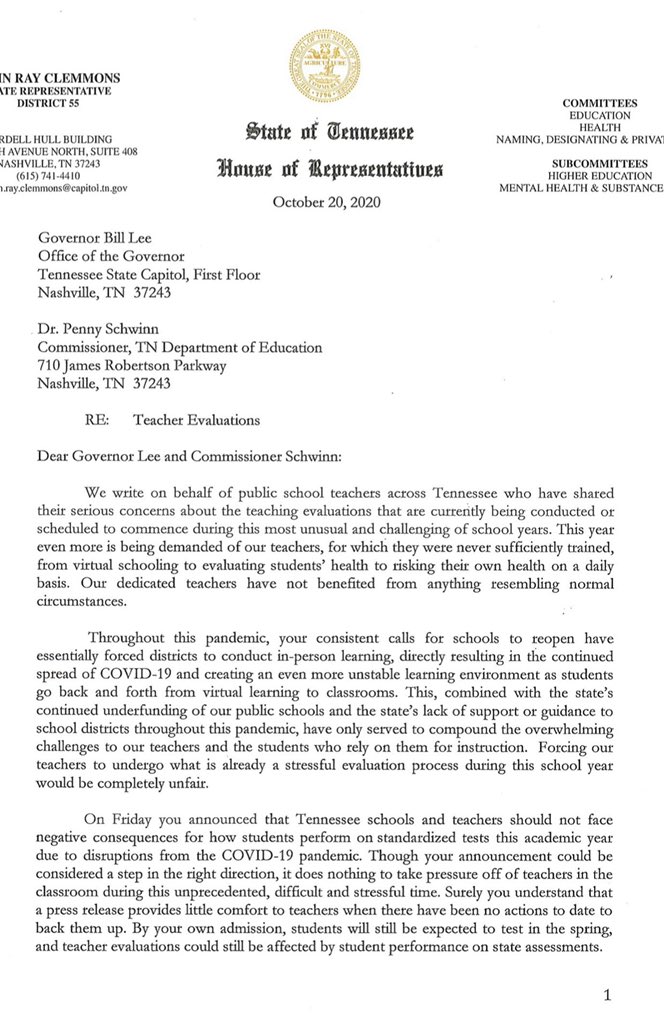
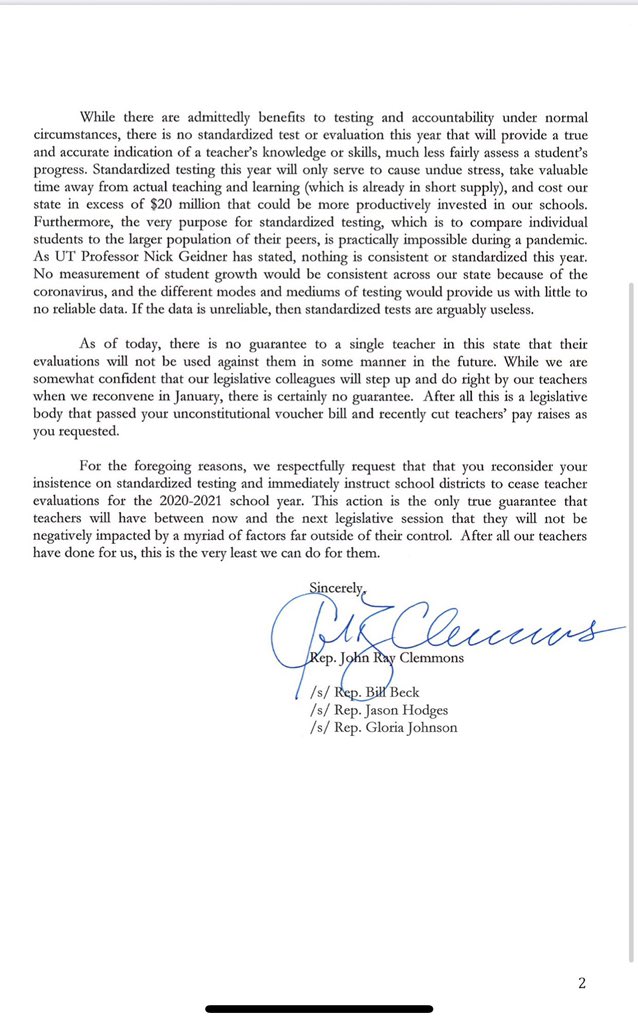
Four members of the Tennessee House of Representatives have signed a letter to Gov. Bill Lee calling on him to end TNReady testing and teacher evaluations this year. The move follows a similar request issued by the Tennessee Education Association (TEA) last week. The letter, signed by Representatives John Ray Clemmons, Gloria Johnson, Bill Beck, and Jason Hodges notes that the COVID-19 pandemic has created special challenges that must be taken into account.

Here’s that letter:

For more on education politics and policy in Tennessee, follow @TNEdReport

Your support$5 or more – makes publishing education news possible.

Donate Button

TEA Continues Push to #CancelTNReady

Following an announcement from Gov. Bill Lee today that this year’s state testing will not be used in so-called accountability measures related to teachers and schools in light of the ongoing COVID-19 pandemic, the Tennessee Education Association renewed its call to cancel the TNReady test altogether.

Here’s more from a press release:

“The governor’s statement is a good first step on how to support educators who are already doing everything they can during a pandemic,” said TEA President Beth Brown. “There are additional important steps the administration can take quickly to further reduce the burden on teachers and administrators.”

TEA calls for extending hold-harmless to include suspension of other areas of the evaluation system that take up enormous time and are not aligned to teaching in a pandemic, such as observations and portfolios for non-tested grades.

“It’s not just standardized testing. Our evaluation system is simply not designed to assess teaching during a pandemic,” Brown said. “Many educators are teaching both virtually and in person. We constantly adjust to disruptions caused by infections or quarantines. We teach while doing everything we can to minimize transmission and take time to attend to the emotional needs of students dealing with the pandemic. None of these issues are even remotely included in models the state requires schools use to evaluate teachers.”

The administration could save teachers countless hours by letting school systems know that observations, portfolios, and other evaluation requirements may be suspended, letting teachers devote that time instead to the hard work required for both in-person and online instruction. It would be a tremendous signal of support to Tennessee’s teachers.

As has been the case for months, TEA also disagrees with the administration on the need to administer state standardized testing during the pandemic and calls for the suspension of TNReady.  

“Administering state tests takes weeks and disrupts instruction,” Brown said. “Our students are already dealing with so many distractions and challenges that we simply cannot afford to lose additional instructional time. Our goal must be to get students back on track, not collect testing data that everyone knows will be so flawed it will be useless.”

TEA understands assessing students is important and is being done on a continual basis by educators.

“We don’t need to have state standardized tests to know where students are academically,” Brown said. “We have ongoing state-approved benchmark assessments in addition to the tests and exams teachers administer themselves throughout the school year. If you want to know where students are academically, just look at our gradebooks.”

For more on education politics and policy in Tennessee, follow @TNEdReport

Your support$5 or more – makes publishing education news possible.
Donate Button

TEA Pushes for School Nurses

In a recent tweet responding to Gov. Bill Lee’s proposal to have school nurses conduct COVID-19 testing, the Tennessee Education Association highlighted the need for the state to provide funding for a nurse in every school.

https://twitter.com/TEA_teachers/status/1313532196930686978?s=20

The issue of school nurses has been on the agenda of the state’s BEP Review Committee for years. In fact, back in 2014, the committee (tasked with annually evaluating the efficacy of the state’s school funding formula), recommended a significant improvement in funding for school nurses.

Here’s the recommendation from the 2014 report:

Change funding ratios for nurses from 1:3,000 to 1:1,500  $12,194,000

So, for at least six years now (and, to be fair, BEP reports before 2014 also mentioned improvements to funding for school nurses), the state has fallen significantly short of the necessary funding to adequately staff schools with nurses. Now, Gov. Lee wants to add tasks without adding personnel.

Here’s the deal: The management principle of “get more with less” is total crap. Gov. Lee should know this, as he came to state government straight from the private sector. Here’s what you get when you ask overworked, underpaid people to do more with less: You get less. Something has to suffer. Maybe COVID tests will happen, but something else will fall by the wayside. Or, maybe less people will even consider becoming school nurses in Tennessee, further exacerbating the current shortage.

Six years. Two Governors named Bill. No action.

Sad!

For more on education politics and policy in Tennessee, follow @TNEdReport

Your support$5 or more – makes publishing education news possible.
Donate Button

Upheld

Gov. Bill Lee’s voucher scheme is unconstitutional, according to a decision by the Tennessee Court of Appeals. The Tennessean has more:

Gov. Bill Lee’s education savings account program took another hit Tuesday, with the Tennessee Court of Appeals upholding a lower court’s decision that the controversial plan is unconstitutional. 

A three-member panel of the Court of Appeals upheld a previous decision by Davidson County Chancery Court Judge Anne Martin, who ruled against the school-voucher law because it only applies to Memphis and Nashville

“Davidson and Shelby counties sued the State of Tennessee to challenge the constitutionality of the Tennessee Education Savings Account Pilot Program. The trial court found that both counties had standing and that the act was unconstitutional,” said Judge Andy Bennett, who delivered the court’s opinion Tuesday. “The State and intervening defendants appealed. We affirm.”

Capitol Hill observers expect Lee to present a new voucher scheme to the legislature in the 2021 session.

For more on education politics and policy in Tennessee, follow @TNEdReport

Your support$5 or more – makes publishing education news possible.
Donate Button

Nail in the Coffin

Gov. Bill Lee’s school voucher scheme is not only constitutionally suspect, but also the likely cause of Rep. Matthew Hill’s ouster from the legislature. WJHL has more on how Hill’s turn against public education led to his defeat in the August Republican primary.

A controversial 2002 income tax vote helped usher in the Matthew Hill era in Northeast Tennessee politics. Another controversial vote — this one over school vouchers — likely contributed to that era’s end.

“Year after year he voted ‘no’ on voucher legislation,” area public school teacher Jenee Peters said. “He voted ‘no’ every year up until he didn’t.”

“I would like to think the local area teachers were the final nail in his coffin, but there were clearly other issues that brought about the demise of his campaign,” Peters said.

Peters communicated often with Hill and said he gave teachers “a few good years” starting in 2014 after an early adversarial relationship with them. But a seeming focus on political power within the Capitol became pretty clear to people, culminating for the education community in Hill’s abandonment of his anti-voucher position.

“He wasn’t grounded in his community,” Peters said. “He was more interested in playing politics in Nashville and currying favor with the governor and making a bid for the speakership.”

MORE>

For more on education politics and policy in Tennessee, follow @TNEdReport

Your support$5 or more – makes publishing education news possible.

Donate Button

Voucher Decline

A professor at Teachers College at Columbia University says interest in vouchers may be waning in part due to poor academic performance. This comes as Gov. Bill Lee’s voucher scheme was delayed by court action.

Here’s more:

The demand by parents for education vouchers and Education Saving Accounts (ESA’s) – which allow them to use government funds to pay for private school tuition — is showing signs of flagging, possibly because private schools are not subject to public regulation and thus not required to meet government standards on measures that range from testing performance to teacher accreditation to instruction for special education students.

Yet the latest studies show that academic performance among voucher and ESA students is trending lower, according to Luis Huerta, Associate Professor of Education and Public Policy. Huerta and Kevin Welner, Professor of Education at the University of Colorado Boulder School of Education and co-founding Director of the National Education Policy Center, spoke in a recent webinar about the evolution of conventional school vouchers into vouchers funded by private, tax-free donations and, most recently, into Education Savings Accounts (ESA’s).

Of course, the poor performance and waning demand haven’t stopped Tennessee’s Lamar Alexander from pushing forward legislation to siphon COVID-19 relief funds to private schools.

Huerta also said that proposals by Republican Senators Tim Scott of South Carolina and Lamar Alexander of Tennessee would siphon CARES COVID relief aid to fund private school scholarships. “But again, it’s too soon to know whether this will give private schools the advantage to open more readily compared to publics, especially since the money linked to these proposals is only in the form of portable scholarships and not infrastructure dollars.”

For more on education politics and policy in Tennessee, follow @TNEdReport

Your support – $5 or more – makes publishing education news possible.